Shop made Tap Spinners For Small Taps

Rob Pulham

Western Thunderer
We had a power cut for much of today but before it struck I managed to knock out these two.

Lie many I suspect I have an eBay bought set of BA taps and dies that go from 0BA to 10BA ( I do have 12 and 14 BA too but I bought these individually). The taps and dies have been fine and I have used them for model making for over 10 years, only recently breaking one of the 8BA tap. Which has been the first casualty.

The die holder is also reasonable albeit I do much of my threading in the lather these days and I have tail stock die holder which takes my BA taps.

The tap wrench on the other hand is pretty much useless. It's a bar type with one handle threaded to tighten onto 90 degree slot to grip the tap head. The threads are so sloppy that the moment you try to exert any pressure to get the tap moving it slips. So for years with the smaller taps at least I have tended to use a pin vice to grip them, which works but again can occasionally slip.

Recently I was watching a video on YouTube where a guy was using a small tap in a small round holder and he briefly described how to make them.
52704147182_e8a403b511_b.jpg

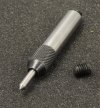
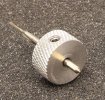
I made two with different sized through holes for different thicknesses of tap shanks - 2.5mm and 3.5mm. The upper photo has a 14BA tap in it and the phot below has an 8BA tap.

52704147022_62f8feb8bb_h.jpg

With the obligatory 5 pence piece to show how big they are.

52704146837_65fd14889c_3k.jpg

They are made from 16mm aluminium bar. I think the guy in the video used 1" but that's all I had in stock. I held it in a collet and milled (badly!) just about 20mm in length.

Then I drilled a 2.5 mm hole in the centre.
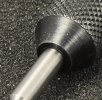
I parted them first both off part way at 8mm thick and then put a slight chamfer on each edge to take away any sharp edges.

Then I popped the piece of rod with them in the collet into a square collet block and drilled a 3.2mm hole to tap M4 for the grub screw. I chose the size based on the grub screws I had that would best fit the diameter of the bar. In this case M4 x 6

I made an initial mistake in that I only drilled through to the centre hole and I should have gone some way beyond to allow the tap to tap right to the bottom of the hole. I ended up redrilling the hole once I had parted them off which was much more messing about - lesson learned for next time.

Finally I popped them back in the lathe and parted the first one off.
Then I opened out the hole in the second one to 3.5mm and parted that off. A bit of clean up and deburring and they were ready for tapping for the grub screws.
 

Nigel Cliffe

Western Thunderer
Nice designs, but for years I've used a tap-holder like these (full set of four is very cheap):


Which I've found far better than the simpler types.

For 12BA and smaller (I have various tiny taps), I use pin chucks. And home made die holders for the small die sizes.


- Nigel
 

Martin Shaw

Western Thunderer
I bought a set of these this year and promptly returned them for a refund, awful things. A tap wrench which the taps fit properly is in my view the only way to do it, otherwise snapped taps become far too common. With no intended disrespect to both Rob and Nigel I don't believe the cost effectiveness of making tools is at all justified unless you want to do that as part of the hobby, when it becomes a different thing all together. Just buy the best quality tools you can afford and get on with the job.
Martin
 

Nigel Cliffe

Western Thunderer
Martin, clearly the ones you got were poor. I posted as an illustration of the type. I've no idea where my tap handles came from, possibly picked up at a model engineering show around 20-25 years ago. And yes, I agree use good tools.
 

paulc

Western Thunderer
We had a power cut for much of today but before it struck I managed to knock out these two.

Lie many I suspect I have an eBay bought set of BA taps and dies that go from 0BA to 10BA ( I do have 12 and 14 BA too but I bought these individually). The taps and dies have been fine and I have used them for model making for over 10 years, only recently breaking one of the 8BA tap. Which has been the first casualty.

The die holder is also reasonable albeit I do much of my threading in the lather these days and I have tail stock die holder which takes my BA taps.

The tap wrench on the other hand is pretty much useless. It's a bar type with one handle threaded to tighten onto 90 degree slot to grip the tap head. The threads are so sloppy that the moment you try to exert any pressure to get the tap moving it slips. So for years with the smaller taps at least I have tended to use a pin vice to grip them, which works but again can occasionally slip.

Recently I was watching a video on YouTube where a guy was using a small tap in a small round holder and he briefly described how to make them.

View attachment 181039

I made two with different sized through holes for different thicknesses of tap shanks - 2.5mm and 3.5mm. The upper photo has a 14BA tap in it and the phot below has an 8BA tap.

View attachment 181040

With the obligatory 5 pence piece to show how big they are.

View attachment 181041

They are made from 16mm aluminium bar. I think the guy in the video used 1" but that's all I had in stock. I held it in a collet and milled (badly!) just about 20mm in length.

Then I drilled a 2.5 mm hole in the centre.
I parted them first both off part way at 8mm thick and then put a slight chamfer on each edge to take away any sharp edges.

Then I popped the piece of rod with them in the collet into a square collet block and drilled a 3.2mm hole to tap M4 for the grub screw. I chose the size based on the grub screws I had that would best fit the diameter of the bar. In this case M4 x 6

I made an initial mistake in that I only drilled through to the centre hole and I should have gone some way beyond to allow the tap to tap right to the bottom of the hole. I ended up redrilling the hole once I had parted them off which was much more messing about - lesson learned for next time.

Finally I popped them back in the lathe and parted the first one off.
Then I opened out the hole in the second one to 3.5mm and parted that off. A bit of clean up and deburring and they were ready for tapping for the grub screws.
Hi Rob , nice work but would it be better if the grub screw/screws engaged on the flats at the top of the tap rather then the round shank . If the unit slips it will tear up the shank of the tap which inevitability means metal in fingers , well for me it would anyway .
 

Dave Holt

Western Thunderer
I mainly use 14 BA but occasionally something bigger. I usually hold the tap in a 4 jaw pin vice on the square end. This avoids the risk of slipping on the shank and i find it easier to judge the tap square to the job compared with the traditional bar type tap wrench. My original 14 BA tap lasted twenty odd years before I managed to snap it quite recently - it didn't shear off, I accidentally put a bending force on it (I think I had it horizontal and the pin vice slipped from my fingers leaving it and the tap cantilevered out from the job) which, oddly, it didn't survive.
Dave.
 

Rob Pulham

Western Thunderer
Hi Rob , nice work but would it be better if the grub screw/screws engaged on the flats at the top of the tap rather then the round shank . If the unit slips it will tear up the shank of the tap which inevitability means metal in fingers , well for me it would anyway .
Hi Paul,
It's intentional that it has the ability to slip. The idea being that it starts to slip before breaking the tap.
It would be no problem to move it up and engage on the square shank.
The guy that I got the idea from is a professional engineer and his description was specifically around not breaking small taps.
 

Rob Pulham

Western Thunderer
I bought a set of these this year and promptly returned them for a refund, awful things. A tap wrench which the taps fit properly is in my view the only way to do it, otherwise snapped taps become far too common. With no intended disrespect to both Rob and Nigel I don't believe the cost effectiveness of making tools is at all justified unless you want to do that as part of the hobby, when it becomes a different thing all together. Just buy the best quality tools you can afford and get on with the job.
Martin
Hi Martin,
I completely agree with you. I do like making tools as I really just like making things. But before embarking on making them, I work out what I would need to spend on materials, fixings etc and then check the engineering suppliers to see what it would cost to buy one.

By remarkable coincidence the next item on my hit list is a spring loaded tap follower. I watched a YouTube video on how to make one and although I have suitable materials I dont have drills and reamers in the sizes that I would need. I checked Arc Euro et, al and I can buy a reversible tap follower for under £10 plus postage. Which will be good enough for the light duty work that I do. So I will order one this morning and carry on with the Princess.
 
Last edited:

NickB

Western Thunderer
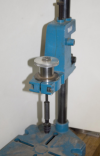
This is my tapping machine, made from a portable electric drill stand that was surplus to requirements. The chuck is an Eclipse pin chuck - the sort with a parallel shank rather than a knurled handle. It holds the tap rigid and vertical, and I can deliver just the right amount of torque (usually!). I've used it for threads as fine as 14BA and more recently, M1.0.

Nick

Tapping tool 1.png
 

mike evans

Active Member
This is my tapping machine, made from a portable electric drill stand that was surplus to requirements. The chuck is an Eclipse pin chuck - the sort with a parallel shank rather than a knurled handle. It holds the tap rigid and vertical, and I can deliver just the right amount of torque (usually!). I've used it for threads as fine as 14BA and more recently, M1.0.

Nick

View attachment 181224
Hello Nick
Great minds and all that.
This is my version of the same idea. The Chuck is from a very ancient Black and Decker Drill and the turning lever is an old 6” nail. I am sure there should be a piece of binder twine somewhere!
8737DC91-F4D4-4A1B-813F-FDCC0F253287.jpeg
Mike
 

Rob Pulham

Western Thunderer
Hi Martin,
I completely agree with you. I do like making tools as I really just like making things. But before embarking on making them, I work out what I would need to spend on materials, fixings etc and then check the engineering suppliers to see what it would cost to buy one.

By remarkable coincidence the next item on my hit list is a spring loaded tap follower. I watched a YouTube video on how to make one and although I have suitable materials I dont have drills and reamers in the sizes that I would need. I checked Arc Euro et, al and I can buy a reversible tap follower for under £10 plus postage. Which will be good enough for the light duty work that I do. So I will order one this morning and carry on with the Princess.

Further to the discussion about making, versus buying tools above, I duly bought said tap follower from Arc Euro Trade and what a journey that turned out to be.

When it came the grub screw in the image fitted into the back of the tap follower to retain the spring.

53265008858_6fb8433106_4k.jpg

53264718236_cf7a512c6d_k.jpg

Which in itself was fine aside from the fact that the body of the tap follower was too big to fit in either of my Jacobs chucks and although I could have swapped the chuck out for a collet chuck that would have been a lot of messing about each time I wanted to use the tap follower. My solution was to turn up a threaded pin to replace the grub screw. Which on the face of it is simple, except I couldn't determine what thread* was in the tap follower as supplied, so I ended up re-tapping it to M10.

That done I gave it a whirl and found that the hole in the body is far too big with too much slop for the guide rods to actually hold the tap straight. Which of course is the whole point of the exercise...

Hopefully you can just make out the gap between the two in the close up below. What should be a close sliding fit is far from it.

53264717571_49d01c24e1_z.jpg

As I had already modified it I couldn't really return it to Arc Euro so I put it in a drawer in disgust and moved on.

Fast forward to a couple of days ago and I had need to tap another hole in the lathe and I just happened to have the length of 8mm stainless rod (which I use for tightening my collet chuck) in my hand when I saw the tap follower in the drawer. I took it out and quickly dismantled it and tested the 8mm rod inside the body of the tap follower. It was a perfect fit. I cut another length from the piece I have in stock, to suite a new double ended guide rod and then turned each end down to a close sliding fit. One end has a point, the other has a 60 degree countersink to accommodate taps with points on the end.

53264717341_83bedaa9bb_k.jpg

53265008323_33677a0244_3k.jpg

Now I have a tool that does what it was supposed to when I bought it. I cannot blame Arc for the initial problem of the shank not fitting my drill chucks because it does state the shank size on their website but I missed taking note of it.

The poorly fitting guide rods is another matter.

You live and learn and I suspect that in this instance I would have been better making my own tool or buying a better quality example in the first place. At least I have been able to remedy it and I may at some point make up a second shorter version to utilise the spare guide rods.

*Having checked the Arc Euro Trade site as I was typing this to confirm that they do indeed note the shank size, I also noted that all the other measurements although primarily stated in millimetres, are in fact conversions of imperial sizes.

As I don't possess any imperial taps or dies I was doomed from the start in working out what size the thread might be.
 

Rob Pulham

Western Thunderer
Back in June last year after some discussion on the Guild forum about tapping guides I made one for small taps but since then I haven’t had a circumstance where I might actually use it.

53767294161_be071684e0_h.jpg

This is it, modelled on a proprietary example that a fellow guild member shared a photo of.

Yesterday while doing a little job I needed to tap a 12ba thread in two sides of U shaped pieces. By gripping them (they are rather small and fiddly) in an engineers clamp I was able to rest the guide on the flat side of the clamp and use my shop made tap spinners to tap the holes. One tap spinner holds the taper tap, while the second has the bottom tap.

54713120972_bd169f7d32_h.jpg
 

Bigjohn

Western Thunderer
I prefer to tap ln the mill drill
For offhand tapping I use pin chucks sometimes with extra rod in the body of the pin chucks, the extra length helping to eye up the vertical plane.
Those stubby round holders seem awkward to use on the inner edge of an angle, but ok for flat work
Bigj
 

Rob Pulham

Western Thunderer
For offhand tapping I use pin chucks sometimes with extra rod in the body of the pin chucks, the extra length helping to eye up the vertical plane.
Those stubby round holders seem awkward to use on the inner edge of an angle, but ok for flat work
Bigj
Prior to making these I used to use pin chucks myself but due to the design of my pin chucks, only a very small part of the chuck was gripping the tap shank and it sometimes tilted in the chuck leaving the handle effectively at an angle making tapping straight holes almost impossible. Since then, I have bought some better quality pin Eclipse chucks but I confess that I haven't tried any taps in them.

Those stubby round holders seem awkward to use on the inner edge of an angle,
I am not sure what you mean by "seem awkward to use on the inner edge of an angle,"

In my experience, they are really easy to use, allowing a very fine 'feel' of the tap as you turn it and I haven't found them awkward in any situation that I have used them so far.

Because I like making things, I have quite a selection on homemade tap wrenches as well as the smaller spinners shown above. I also have several proprietary examples, which include a couple of different sized Eclipse models and a superbly made "Comet" brand. The latter will take taps from 3/16 to 1/2" but the handles are 10.5" long so it's not really suitable for model use.

I just select which I think will be appropriate for the tap that I plan to use. I appreciate that making tools is not for everyone but for me it's part of my hobby.
 

Bigjohn

Western Thunderer
Rob
If you have a piece of angle, say 1x1 and lay it flat on one side and and wish to drill a hole close to the inner vertical edge you need a free length of drill and tap exceeding 1inch .this assumes that you are unable to tap and drill from the reverse side. BUT I could be the only modeller who gets him or her self into such a pickle. Perfection seems to be distributed in unequal portions. HTH
Bigj
 
Top