Sir Lamiel’s 777 Quest - A Scale7 Micro Layout Challenge

simond

Western Thunderer
Jon,

my Latin masters, for there were two, were quite peculiar. The one, a reverend gentleman, had a degree of cruelty, in that the slightest hesitation in recital of one’s homework would lead to the tweaking of the vestigial sideburn that fashionable pre-teens wore in the early seventies, and the hapless pupil would be lifted to a standing position, often squealing.

The other was beyond vague, but rather kindly. On my parting day at school, the conversation went thus

”Mr W!”,
“Ah, Dobson, isn’t it?”,
“yes sir, you took me for Latin in second year”,
“A great pleasure!, and, um, Noble?”
My pal responded “Yes sir, you didn’t take me for anything”.
“An ever greater pleasure”


I think it safe to assume my command of Latin is somewhere between “dog” and “google

cheers
S
 
Last edited:

Osgood

Western Thunderer
Jon,

my Latin masters, for there were two, were quite peculiar. The one, a reverend gentleman, had a degree of cruelty, in that the slightest hesitation in recital of one’s homework would lead to the tweaking of the vestigial sideburn that fashionable pre-teens wore in the early seventies, and the hapless pupil would be lifted to a standing position, often squealing.
OMG that is so uncanny - brings back vivid memories of the very Rev. Latin teacher!!
 

Michael D

Western Thunderer
Going back to the challenge
7’ is quite a small area I understand the significance of it of course but other societies when making these cameo challenges allowed a bit more working space for example it was about 2’6” if memory serves me that the 2mm cameos came out at so scaling that up it’s about 8’6” in 7mm scale
So 7’ is 4’ in 4mm and 2’ in 2mm quite just to put it in perspective a challenge indeed
 

RichardG

Western Thunderer
I spoke with a member of the Committee this morning and got a few clarifications:
  • This challenge has nothing to do with Arthurian legend [the only connection is, a loco numbered 777 was Sir something or other]
  • There is no expectation of a Latin theme either
  • Some pointwork is expected, to show off how good ScaleSeven track looks
  • Narrow gauge is possible
Nevertheless, I offered a sketch of a very non-working diorama using only plain track and this seemed to be valid for the challenge; though working layouts would be appreciated to help to publicise ScaleSeven.

I forgot one question:

If there is a turnout on the layout, are we allowed to measure the lengths of both tracks from the tips of the blades? Or maybe, the diverging track is to be measured from the crossing vee? Even an A-6 point takes up over a foot between tips and frog, so this could make quite an impact on meeting the minimium of 7 feet of track.
 

Dan Randall

Western Thunderer
There are so few guidelines anyway that staying within the spirit of the Quest shouldn't need a lawyer's interpretation! Otherwise some smarty-pants will produce 3'6" of gauntlet track and claim 'job done'!

Despite having to Google “Gauntlet Track”, that did make me chuckle! :)

(I guess a number of ”Salmon” wagons loaded with 60’ track panels is also being a little cheeky?…). :))


Regards

Dan
 

RichardG

Western Thunderer
I actually have some gauntleted tram track in my plan, because I thought this was more believable than single track. To go along a road passing under a railway bridge. I hadn't thought of the Salmon wagons though. Two of these on the main line and if anyone wishes to be judgemental I can invite them to choose the seven feet they wish to measure :D
 

magmouse

Western Thunderer
I've just started a thread on my proposed layout addressing the challenge - Kingfisher Quay.


Nick.
 

RichardG

Western Thunderer
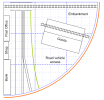
Going back to calculations for quadrants, a circle of 900 mm radius has an area just shy of 28 ft2. So a quadrant gives the 7 ft2, in fact there is room for a fascia panel (orange line) up to 8 mm deep:

Screenshot 2025-12-18 17.05.23.png
The squares are 300 and 75 mm.

DSC_1482.jpeg
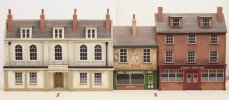
I quite fancy this scheme, to get this row of shops built by Alan Downes out of a display cabinet and onto a baseboard. I think they will always be happiest at right angles to a railway line and I don't have space to do this on a working layout.

Construction could be open-top, with three levels for road, goods yard and embankment. I envisage the road sloping downwards where the local council have lowered it to let trams run under the railway bridge. The Arthurian connection could be in the name of the road or the goods yard.

Having sketched it out I must accept I don't have the space to keep it, but I'll post it here in case someone finds it useful. The shape ought to look larger than it is, though in 7 mm scale the whole thing may well look a bit too cramped.
 

jonte

Western Thunderer
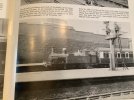
With a little selective compression, I feel this would make an ideal entry:

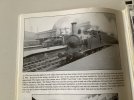
IMG_4173.jpeg

Credit to the photographer, A.G. Coltas, and his creation of a most atmospheric photograph of Birkenhead Woodside station, take from one of my favourite books:

IMG_4172.jpeg

With a fiddle yard at both ends and the moving section of the single point located in the fiddle yard representing the station throat, I think it would make an excellent composition. That signal for starters…..(forgive the…).

The bridge would be an ideal view blocker and cast a welcome shadow to ‘hide’ the terminus end fiddle yard beyond, the arches of the station roof attached in relief to the scenic board behind the bridge. Perhaps the bridge which existed over the station throat could be brought forward as view-blocker at the entry end?

But where would a Watford coaler be found (CCW seem to have stopped making kits), and imagine the number of coaches required just to play with it? And I firmly believe there really would be plenty of play value.

Perhaps study of Adrian’s @adrian latest scrtachbuild subject would pay dividends, but then how many years of failure would it take for this novice before a runner could be produced?

Perhaps it will always remain an idea.

jonte
 

simond

Western Thunderer
Woodside is an attractive station for the modeller as it is hemmed in and cramped. And saw big engines.

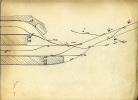
Track plans are scarce. Is there one in that book?

I know that someone on RMWeb published a plan, it was copied, he objected, it was taken down then all the earlier photos/anttachments evaporated. I did try pulling something in from NLS, but it’s not easy.

atb
Simon
 

jonte

Western Thunderer
The only way to compress that is by building it in 2mm scale not ScaleSeven!

Dave

To which post are you referring, Dave?

My suggestion was in the form of a photo (my earlier post), which showed a single turnout.

If you’re referring to the station plan, I couldn’t agree more.

Merry Christmas!

Jon
 

jonte

Western Thunderer
Further to my earlier ‘prospective’ design, here are a couple of images from another treasured source: ‘Paddington to the Mersey’ by Dr. R. Preston Hendry & R. Powell Hendry, to help in enclosing the scene:

IMG_4174.jpeg

Credit to the authors.

Plenty of Wills stone sheets to run the length of the backscene.

IMG_4175.jpeg

An interesting curved stone support wall (Slaters?) to act as a view blocker, supplemented by a compressed version of the building seen to the rear of this image, although it might not be necessary.

Incidentally, a quick flick through some photos from elsewhere shows the bridge over the station throat immediately to the end of the platform, so my earlier suggestion as a view blocker wouldn’t be a work of fiction. In the same photo lies a large ship immediately to the rear of this wall as this was the location of a dry dock. I wouldn’t suggest this as a view blocker as there wouldn’t be sufficient space within the rules, but submit it as a point of interest.
That said, the same photo shows a (modern style) signal box situated on the platform prior to the bridge, so there’s even the opportunity of a further view blocker at the ‘entry’ end to the ‘layout’ (I use the term loosely as it would be perhaps a moot point with the minuscule area provided in the rules).

If only I could scratch build locos and had the time……….

jonte
 

daifly

Western Thunderer
To which post are you referring, Dave?

My suggestion was in the form of a photo (my earlier post), which showed a single turnout.
In 7mm, a B7 turnout is c22" long, with double track requiring platform faces c6" apart, an island platform is going to be c4" wide. A small loco is c9" long while a decent passenger tender loco will be c18" long.
7mm scale is big and you're not going to get much in 7sq ft. That's why it's called a challenge!

Dave
 

jonte

Western Thunderer
In 7mm, a B7 turnout is c22" long, with double track requiring platform faces c6" apart, an island platform is going to be c4" wide. A small loco is c9" long while a decent passenger tender loco will be c18" long.
7mm scale is big and you're not going to get much in 7sq ft. That's why it's called a challenge!

Dave

Absolutely, Dave.

But key here was the phrase ‘selective compression’.

So for instance I would keep the island platform a prototypical 4”; the first and last platforms being reduced appropriately. By viewing the model from platform height, the rear platform wouldn’t be distinguishable; the front giving the impression that you’re looking onto the the model across the platform, thus the depth isn’t that critical.

The three tracks behind the island platform could be reduced to two, for example, but perhaps should be kept for added play value at the expense of the rearmost single road. Still, not impossible to model as seen if modelled with this approach in mind.

In relation to your quoted length of 22” in respect of say a B7 turnout, this wouldn’t be an issue in this case, as I’d suggested in my original post that only say the final third (from just before the crossing to the end rails) needed to be modelled in the scenic section, the last two thirds including the switch rails and toe end being sited on the ‘entry’ fiddle yard, which I think I’m right in saying is not subject to the conditions of the scenicked area?

In relation to the loco, I reckon that a 7mm scale model of a Watford would be less than ten inches in length, meaning that a diorama length of say three feet or just under would give the loco a run approximately three times its length, which is what many modellers cite as the minimum length for any layout - and as mentioned, it’s a moot point whether something of this magnitude constitutes a ‘layout’.

I could go on, but hopefully this makes clear how I arrived at my ‘out of the box’ proposition: something of a flavour of a mainline station - even in this scale.

Jon
 
Top