Rivermead Central

40057

Western Thunderer
Hello Martin

How is the rebuild of the Royal Scot coming along? I would guess that you have all the wheels and motion stripped out of the electric motor by now. I suppose that it would be prudent to test the clockwork motor with just the wheels and coupling rods fitted up, before restoring it in the body and assembling the connecting rods and valve gear.

John
Paused (briefly) due to other commitments. But I have the wheels off the driven axle of the electric motor. With great difficulty, I might add. Very tightly pressed on and no room behind the rim to get in the jaws of my wheel puller (which might not have been up to the job, anyway). They are off, at the cost of sore fingers.

Martin
 

40057

Western Thunderer
Sadly, as far as I am aware, one can no longer purchase a new clockwork O Gauge engine. Or a new clockwork motor. And very few people seem to have any real interest in spring drive - it seems almost as if you and I are the only members of this Forum to be working seriously in this area. And yet there is plenty of competition for vintage coarse-scale engines and rolling stock on the auction sites, as we know. Do all these things end up in display cases, and never get run?

John
Hi John

Clockwork motors are still being made, but as far as I know only simple, light-weight, mechanisms for powering simple, light-weight, toy trains and novelties. I am pretty certain no-one is making good quality mechanisms. And why would they? The chances of a mainstream model manufacturer introducing a new clockwork-powered model is on a par with one of the TOCs deciding to build steam locomotives to operate its new trains. Not going to happen: It’s obsolete technology.

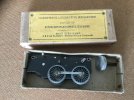
There are, of course, new (in the sense of ‘unused’) though old (made a long time ago) clockwork motors to be had. From before WW1 until the end of production, various manufacturers offered clockwork mechanisms for use by scratch builders. Then, as now, planned builds often got no further than an intention. So motors were bought and not used. I have a 1950s mechanism in its Bassett-Lowke box that has clearly never been used. Also this 00 gauge mechanism:

F39C6173-F2F6-46AE-9753-B909C20554CE.jpeg

If either of the aforementioned motors was used in a new scratch build, it would be a new clockwork model, with an effectively new motor.

Of the various manufacturers of ‘retro’ or ‘tinplate/vintage style’ coarse scale 0 gauge that have been around since the 1990s, their locomotives have been either steam or electric. One exception was in the range of very nice (but expensive) reproductions of Bassett-Lowke models sold by Ludlow’s of Bolton (see Ludlows of Bolton O Gauge). Some of the Black 5s were made using second-hand Bassett-Lowke clockwork mechanisms. I remember these when they came out but the price of the Ludlow’s reproductions was on a par or more than the going rate for an original Bassett-Lowke model. Other than the Ludlow’s Black 5s, to my knowledge clockwork versions of recent production have been entirely ‘special order’. Such as the A3 Pieter (@Fitzroy) built for me in 2018, seen on his website here: Fitzroy Loco Works – Fine Model Railway Engineering from Melbourne Australia.

One-off scratch builds are a different matter. I have my 828 recently built by Tom Mallard and Tom is now building me a shunter (see his workbench thread). It’s reasonable to ask why I or anyone else would want a locomotive built using ‘obsolete technology’. I can give five reasons.

As discussed in my post #388, new builds with clockwork motors are akin to experimental archeology, giving insights into the production of clockwork models a century ago.

Rivermead Central is a vintage model railway. I am trying to recreate a model railway as it would have been 100–70 years ago. So I try to find ways of doing things, and solutions to problems, authentic to the period, at least in the type of approach. The shunter Tom is now starting to build is to fulfil a specific need on my layout. Had I been building my railway 70 years ago, I would have done exactly what I am doing now: Getting a specialist heavy shunter built using a speed control mechanism.

Full-size steam locomotives are also obsolete technology. Yet they are kept running on heritage/preserved lines and rail tours because people love them and for their historic interest. I would say the same about my vintage models. Thanks to tremendous dedication and effort, we even have new-build full-size steam engines costing £millions. So for models, ‘new build clockwork’, by analogy, is entirely appropriate on my ‘heritage model railway’.

Development of clockwork models (and full-size steam engines) pretty much ceased in the 1950s as it became apparent they were to be replaced by newer technology. I’m interested purely out of curiosity, but what if development had continued? What improvements might have been made? With 828, we dispensed with traditional cab controls and used the appropriate scale cab fittings to control the locomotive. Tom and I have discussed some possible innovations on the forthcoming Q1 which would again improve on usual practice in the 1950s and earlier.

My fifth reason for having a new clockwork locomotive built is very simple. I love clockwork trains.

Martin

 

John R Smith

Western Thunderer
Martin

Many thanks for your interesting and thoughtful reply. I did not know that Ludlows built some clockwork engines, I expect that they would have been superb. Like lots of things in this life, I don't suppose that I would have been able to afford one!

Had I been building my railway 70 years ago, I would have done exactly what I am doing now: Getting a specialist heavy shunter built using a speed control mechanism.

Or you would have obtained a Walker-Fenn or a Walker-Riemsdyk, perhaps. But building a Q1 sounds a whole lot more fun!

John
 

40057

Western Thunderer
Martin

Many thanks for your interesting and thoughtful reply. I did not know that Ludlows built some clockwork engines, I expect that they would have been superb. Like lots of things in this life, I don't suppose that I would have been able to afford one!


Or you would have obtained a Walker-Fenn or a Walker-Riemsdyk, perhaps. But building a Q1 sounds a whole lot more fun!

John
Hi John

If you look on Tom Mallard’s thread, you will see we are using a Walker-Riemsdyk motor for the Q1. However, the controls will be differently arranged for quick and easy operation at arm’s length. So no wheel for speed and brake but a fore-and-aft lever, possibly with notches for stop, very, very slow, very slow and slow.

Martin
 

John R Smith

Western Thunderer
If you look on Tom Mallard’s thread, you will see we are using a Walker-Riemsdyk motor for the Q1.

Martin

I keep meaning to ask you - I have never seen a Walker-Riemsdyk engine, so I have no idea how it works. How does the speed control operate - is it a variable governer of some sort? And does it still produce full power at low speeds?

John
 

40057

Western Thunderer
Martin

I keep meaning to ask you - I have never seen a Walker-Riemsdyk engine, so I have no idea how it works. How does the speed control operate - is it a variable governer of some sort? And does it still produce full power at low speeds?

John
Hi John

In principle, it’s similar to the speed control fitted to the large size Bassett-Lowke 6-coupled mech. Speed is reduced by the distance between the spinning bobs and a rubbing plate being increased/reduced. In a B/L mech, it’s the rubbing plate that is moved by the control. In a vR mech, it’s the position of the bobs that is altered by turning a wheel. The rubbing plate is the motor side frame. The bobs are aluminium, so low friction. The claim that full power is maintained across the speed range is not, in my experience, justified. With the wheel turned down to slow speeds, haulage capacity is lower. But the loss of power is not as much as with a B/L speed control set at lower speeds. The biggest difference I would say is in the range of speeds. The minimum speed for a B/L mech is still quite fast, generally speaking. For a vR mech, the speed can be reduced to a crawl and ultimately to stop. There is no separate brake. The one control sets the speed from 0 mph to full speed.

The small size vR mech has a completely different reversing device to a ‘normal’ clockwork loco mech. The ratchet for winding is different too. It’s a very good motor.

You can see the governor arrangement and reversing device here:

E7575DFE-A3C7-41A3-8335-8E3FE5C47567.jpeg

Martin
 

John R Smith

Western Thunderer
Martin

Thank you very much for that reply. I think that I understand it a bit better now! A couple of observations - I get the comparison with the controlled clockwork B-L mech. As you say, slow is not actually very slow with the B-L motor, not on my Royal Scot at any rate. I am not sure whether you are meant to lubricate these 'faceplate' governers, or not, and I can find no guidance. It strikes me that the Reimsdyk arrangement using the motor sideframes as the bearing surface, will eventually just wear through the frames unless lubricated? And lastly, why the jointed coupling rods? (the wheels don't seem to be sprung).

John
 

40057

Western Thunderer
Martin

Thank you very much for that reply. I think that I understand it a bit better now! A couple of observations - I get the comparison with the controlled clockwork B-L mech. As you say, slow is not actually very slow with the B-L motor, not on my Royal Scot at any rate. I am not sure whether you are meant to lubricate these 'faceplate' governers, or not, and I can find no guidance. It strikes me that the Reimsdyk arrangement using the motor sideframes as the bearing surface, will eventually just wear through the frames unless lubricated? And lastly, why the jointed coupling rods? (the wheels don't seem to be sprung).

John
Hi John

If the motor was run continuously for, say, several centuries, the frames might eventually show a bit of wear. But the frames are hard steel, the bobs aluminium. The bobs might wear a bit. But I’m sure they will outlast me and probably other parts of the motor.

JvR was a clever man and produced a good range of different motors and locos using minimum tooling. The 6-coupled mechs have on each side two of the coupling rods fitted to the four coupled mech. There was only one coupling-rod stamping tool made which did for everything. It was also used for the connecting rods on the outside-cylinder tank engine.

Same in 00 gauge. One part was used for all coupling rods (2 pieces each side) and connecting rods.

Martin
 

40057

Western Thunderer
Finally, a resumption of work on the Royal Scot’s motor. I had my first dose of shingles vaccine on Friday and started feeling unwell on Saturday and have really been unable to do anything much until today. Most unpleasant, on a par with or even worse than man-flu.

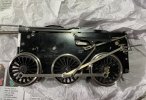
Anyway, the clockwork motor now looks like this and has five wheels:

B691369F-0C85-4A5C-B5D0-D0E7A17D29AB.jpeg

I have done partial dismantling before but I think this is my first complete transfer of a full set of wheels and valve gear. It’s a difficult job requiring considerable force to be applied to parts that could be easily damaged. The wheels need a lot of fine adjustment — and so several cycles of fitting and removal — to get true running. As of now, the leading (driven) pair of drivers are firmly fixed, true running and correctly set at 27.0 mm back-to-back. Probably the most difficult but very critical challenge. The rear wheels (now in the correct axle hole) are not fully tightened. Until the securing nut is tightened, the eared washer used for quartering allows a tiny amount of rotational movement on the wheel. I’ll keep one of the slotted nuts on the rear axle slack until both coupling rods are fitted and I can be sure the cranks on the leading and rear wheels exactly match. The middle wheels, being on stub axles, are only quartered by the coupling rods so will adjust themselves.

Nothing too unexpected as work has progressed. The return cranks on this set of valve gear are secured by a 6BA nut behind the wheel. I haven’t taken apart enough of these to generalise for valve gear, but 6BA is an unusual size for Bassett-Lowke: threads are usually 5BA or 7BA. The wheels have been extremely difficult to remove from the axles in the electric motor. Hence currently just five wheels on the clockwork mech. I think I will have to resort to a hammer and a punch on the axle end to release the sixth wheel. Finally, either when the valve gear was originally fitted at the factory or when it was transferred to the electric motor, the person doing the work wasn’t very careful. Various components have been bent to make them fit leaving scarring on the metal surface. Nothing I can do about that except make sure I am properly careful and do a better job.

Martin
 

John R Smith

Western Thunderer
It's looking good, Martin. The wheels are in excellent shape - thank heavens for cast iron rather than Mazak on B-L's top end locos.

The wheels have been extremely difficult to remove from the axles in the electric motor. Hence currently just five wheels on the clockwork mech. I think I will have to resort to a hammer and a punch on the axle end to release the sixth wheel.

That is strange. With centre-nutted wheels there should be no need for a press fit on the axles, as the nut does all the work when tightened up?

Finally, either when the valve gear was originally fitted at the factory or when it was transferred to the electric motor, the person doing the work wasn’t very careful. Various components have been bent to make them fit leaving scarring on the metal surface.

Perhaps that says a lot about QC at Bassett-Lowke in later years.

Probably a lot of the Forum members reading this will not (yet) be aware that it is not possible to test the complete drive train and valve gear on these models until it is all reassembled into the body of the engine, as the expansion link mounts, cylinders and slide bars are part of the body assembly, not the chassis. So it is somewhat nerve-wracking, because if a problem is discovered on test it can mean a major strip-down to rectify it. Hence you are absolutely correct to be very cautious and thorough at this stage.

John
 

40057

Western Thunderer
With centre-nutted wheels there should be no need for a press fit on the axles, as the nut does all the work when tightened up?
Hi John

Not at all. There’s no way you would get a reliably true and concentric wheel relying on the slotted nut.

The crucial bearing surface is the one arrowed here:

19681744-0022-419F-84C3-0504307C1584.jpeg

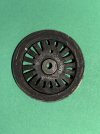
The smaller diameter part of the axle-hole at the rear of the wheel:

450D6A1D-D470-45A7-BF1B-3E5BB200BADB.jpeg

Should be a tight — ideally force — fit on the narrower part of the axle, as arrowed above. With a tight fit between the wheel and axle using surfaces created on a lathe, the wheel should be exactly concentric on the axle and run true. The eared washer then sets the quartering. The slotted nut keeps everything in place. Once tightened against the eared washer, the nut may help maintain the wheel in true — though in my experience tightening the nut is more likely to introduce wobble than correct it.

It’s different, obviously, for the centre wheels if on stub axles. No eared washer and the wheels aren’t load bearing. Just along for the ride, for the sake of appearance. The wheels are pretty loose on the stub axles and need to be — with such a long wheel-base (53 + 58 mm) on tinplate track. Any temporary track laid on the floor or in the garden will have numerous ‘summits’. The ‘slop’ in the centre wheels allows them to rise slightly so both sets of flanged wheels can stay on the track as the ‘summit’ is crossed. With stub axles, functionally this is really a 4-coupled mechanism with a long wheel base and the less interaction the middle wheels have with the track the better.

Martin
 

40057

Western Thunderer
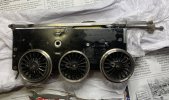
Now we are six! All the wheels have been transferred to the clockwork motor:

85CA7960-4448-41CC-A55B-F0732F310C1C.jpeg

So far, so good. Everything I need is now off the electric motor and I will post this back to its owner (who sold me the loco, but not its electric motor).

I am next going to test fit the coupling rods. Once I’m confident the motor is running smoothly with the rods in place, I’ll tighten the still-slack slotted nut on the rear axle and then take the rods off again. This is so I can undertake paint repairs on the wheel bosses. Then refit the rods ‘permanently’ using new (undamaged) crank pins from my stock of spares. Meantime, I’ll put temporary crank pins in the middle wheels, rather than attach the valve gear. This will allow the motor to be road-tested before fitting it in the loco body. I’ll have to decide whether testing on a short length of track (which I can do here) is sufficient to proceed with full reassembly. If not, in a few weeks time, I should have the opportunity to test the mech — running ‘naked’ as an 0-6-0 — on a large circuit, including hauling a load. That would give a better idea of haulage capability and length of run, though introduce a delay. The motor, as re-wheeled and repaired, seems quite lively and strong. But I would like to be sure it will perform adequately or better before putting it in the loco body.

In a worst case scenario, I do have another identical motor. But also untested and without wheels.

There’s going to be a short delay, anyway. At some point, un-noticed, the loosened 6BA lock-nut securing one of the return cranks dropped off the motor. I’ve ordered some steel 6BA half-nuts so I can reassemble the valve gear when the time comes. I am also wondering about replacing the set of valve gear that was evidently mistreated at some point by careless bending with pliers. Bassett-Lowke sold a lot of castings and other parts as aids for scratch builders. Complete sets of LMS- and LNER-style valve gear were amongst the parts sold, as used on the catalogued r-t-r models. I do have several unused sets of valve gear originally sold as parts. I’ll need to check for compatibility, but if I have an unused matching spare valve gear assembly, replacing the damaged set on 46100 would be a good use for it. Of course, I do have to find where I put the spare valve gear assemblies …

Martin
 

Fitzroy

Western Thunderer
Hi John

Clockwork motors are still being made, but as far as I know only simple, light-weight, mechanisms for powering simple, light-weight, toy trains and novelties. I am pretty certain no-one is making good quality mechanisms. And why would they? The chances of a mainstream model manufacturer introducing a new clockwork-powered model is on a par with one of the TOCs deciding to build steam locomotives to operate its new trains. Not going to happen: It’s obsolete technology.

There are, of course, new (in the sense of ‘unused’) though old (made a long time ago) clockwork motors to be had. From before WW1 until the end of production, various manufacturers offered clockwork mechanisms for use by scratch builders. Then, as now, planned builds often got no further than an intention. So motors were bought and not used. I have a 1950s mechanism in its Bassett-Lowke box that has clearly never been used. Also this 00 gauge mechanism:

View attachment 256119

If either of the aforementioned motors was used in a new scratch build, it would be a new clockwork model, with an effectively new motor.

Of the various manufacturers of ‘retro’ or ‘tinplate/vintage style’ coarse scale 0 gauge that have been around since the 1990s, their locomotives have been either steam or electric. One exception was in the range of very nice (but expensive) reproductions of Bassett-Lowke models sold by Ludlow’s of Bolton (see Ludlows of Bolton O Gauge). Some of the Black 5s were made using second-hand Bassett-Lowke clockwork mechanisms. I remember these when they came out but the price of the Ludlow’s reproductions was on a par or more than the going rate for an original Bassett-Lowke model. Other than the Ludlow’s Black 5s, to my knowledge clockwork versions of recent production have been entirely ‘special order’. Such as the A3 Pieter (@Fitzroy) built for me in 2018, seen on his website here: Fitzroy Loco Works – Fine Model Railway Engineering from Melbourne Australia.

One-off scratch builds are a different matter. I have my 828 recently built by Tom Mallard and Tom is now building me a shunter (see his workbench thread). It’s reasonable to ask why I or anyone else would want a locomotive built using ‘obsolete technology’. I can give five reasons.

As discussed in my post #388, new builds with clockwork motors are akin to experimental archeology, giving insights into the production of clockwork models a century ago.

Rivermead Central is a vintage model railway. I am trying to recreate a model railway as it would have been 100–70 years ago. So I try to find ways of doing things, and solutions to problems, authentic to the period, at least in the type of approach. The shunter Tom is now starting to build is to fulfil a specific need on my layout. Had I been building my railway 70 years ago, I would have done exactly what I am doing now: Getting a specialist heavy shunter built using a speed control mechanism.

Full-size steam locomotives are also obsolete technology. Yet they are kept running on heritage/preserved lines and rail tours because people love them and for their historic interest. I would say the same about my vintage models. Thanks to tremendous dedication and effort, we even have new-build full-size steam engines costing £millions. So for models, ‘new build clockwork’, by analogy, is entirely appropriate on my ‘heritage model railway’.

Development of clockwork models (and full-size steam engines) pretty much ceased in the 1950s as it became apparent they were to be replaced by newer technology. I’m interested purely out of curiosity, but what if development had continued? What improvements might have been made? With 828, we dispensed with traditional cab controls and used the appropriate scale cab fittings to control the locomotive. Tom and I have discussed some possible innovations on the forthcoming Q1 which would again improve on usual practice in the 1950s and earlier.

My fifth reason for having a new clockwork locomotive built is very simple. I love clockwork trains.

Martin
There have been a few thoughts on this side of the world about building the “ultimate” clockwork mechanism. One of the major issues is the sourcing of suitable spring material. A friend who was an instrument maker by trade looked into this and settled on the material used to make bandsaw blades, at the point just before they cut the teeth into it. He gave me a length of it, but I just haven’t had time to do anything. Before that happened I did survey a Bassett Lowke 6-coupled mech and drew it up in Autocad but that’s where things stayed. Another thing that happened was that the aircraft factory I was working at ( an antipodean ex- wwII shadow factory for Bristol and Avro) was throwing out all its old British Standards, including for clockwork and miniature gear trains (as used in aircraft instruments and bomb fuses), so I managed to rescue those. I also had the thought that various rubbing bearings could be replaced by ball races, much in the same way that many high end American manufacturers treat their valve gear. And of course it should have a “teleguv”, or maybe something even better, that doesn’t even rub. Anyway, nothing much is going to happen in the near future I’m afraid, but it would be good to produce a list of ‘nice to have’ features for when I finally have the time….
 

John R Smith

Western Thunderer
Anyway, nothing much is going to happen in the near future I’m afraid, but it would be good to produce a list of ‘nice to have’ features for when I finally have the time….

I would be happy to contribute to a list of desirable features for a present-day take on an O Gauge clockwork motor, so sticking my neck out, here goes (in no particular order of importance) -
  • Bronze or brass top-hat bushes for at least the axles if not the main driven gears as well - no unbushed axles just running in holes in the frames. Ball races would be even nicer, if practicable.
  • A decent speed control as found on the Bing Gauge One mechs, using a two position gear train.
  • A complete re-think on the overall speed governer, with as you say, no friction element.
  • The Bassett-Lowke remote ratchet design as used on the big engine six-coupled motors would be high on my list, as it is easy to lube and gives a nice soft wind.
  • No stub axles!
  • Some thought as to the ease of use of the controls. Most B-L motors have a very stiff and short-throw reverser, which is a pain to use when doing a lot of shunting. The auto-stop, auto-reverse and restart controls operated from the track side ramps seem to me to be superfluous these days and can be deleted.
  • The Hornby No 2 Special mechs are worth studying in addition to the Bing and B-L ones. Norman Eagles thought very highly of them and used them in many of his custom built engines.
  • Perhaps having a rethink whether or not the B-L female arbor / male key is the best solution. It allows for a smaller winding hole in the loco body, but is probably more expensive to manufacture and (in tank engines at least) can be very fiddly to use.
I'm sure there must be more things which will inevitably occur to me just after I hit "Post Reply"!

John
 

40057

Western Thunderer
Hello Pieter, John

An ‘ultimate’ clockwork mech would be a very exciting project.

In addition to the comments already made, I would add the following observations.

As previously discussed, ‘Teleguv’ governors are readily available through the antique ‘phone community of collectors/restorers. Can be bought for a few pounds. No point in making something similar.

Unused drive springs are also fairly easily found. Generally those made in Sweden, manufactured in the 1970s, as organised through the G0G (Jack Ray). Springs were made the correct size for the larger and smaller B/L standard mechs. I have several of these (somewhere) — not enough for a large production run, but for a small batch or testing a prototype certainly.

Two possible approaches immediately occur to me.

One, make a mechanism, a better one, that could be used to replace, say, the standard large B/L mech. So key-hole, axle spacing, fixing points, maximum dimensions, exactly as per B/L. Could be used as a reversible upgrade for existing B/L locos or in new builds.

Two, make a mechanism that will allow better appearance in clockwork models. So, for example bring as much of the workings as possible down between the loco frames. Allowing concealment under the cab floor, for instance, and daylight under the boiler. This would not look like the conventional ‘slab-sided’ clockwork mech. Only the section containing the main-spring would be full height — and this goes in the firebox.

I would vote for option 2 above as being the more interesting project. Truly, an ‘ultimate’, modern, clockwork mech.

Large or small size? That is going to depend on the intended prototype for the loco. At one extreme, an original ‘air-smoothed’ Bulleid Pacific. A big box right at the loading gauge. Plenty of scope for a huge spring (or two springs?) and great power. But, in a sense, not a difficult challenge. Much more of a puzzle is making a sufficiently powerful motor compact enough to fit in the boiler of a Victorian or Edwardian era loco, or smaller tank engine.

Whether or not there are stub axles is not really about the motor. It’s about the choice of prototype. Almost any mech may need stub axles if the wheel-spacing of the prototype is very close or very far apart. Even the small Marklin 4-coupled mech has stub axles when used in the Bonzone. My NBR 0-6-0 has a standard B/L 4-coupled mech and stub axles because the gap between the middle and trailing drivers forced a choice between stubs or a smaller mech. I choose the stronger mech and would do again. The extra power is useful, the stub axles are neither a visual or operational difficulty.

My advice regarding stubs would be, for its size, put the largest possible spring in the motor to get good performance. Whether that results in stubs will be down to the choice of prototype by the builder using the motor.

It’s certainly worth considering replicating the van Riemsdyk approach to reversing the motor. And JvR’s speed control as an alternative to a Teleguv. A male key is definitely preferable because it keeps the key-hole small. A male key can be made from a female key very quickly and easily using a length of square bar. Whether it would be feasible in gauge 0 to have alternative gear trains for two speeds I don’t know. Would be a big advantage if possible.

Martin
 

simond

Western Thunderer
Is the pleasure in your models specifically the fact that they’re clockwork, or is it the appearance of model, track, and scenery from an earlier age? Or indeed, some combination of these and maybe other factors?

If the former, please skip the next paragraph :rolleyes:

I suppose the question I’d like to ask (preferably without being tied to, and burnt at, the stake!) is why would you not consider a modern battery-electric mechanism? A lithium battery solution with modern motor and gears could easily be built into a “motor-chassis”, which could replicate the clockwork version (and which might offer the potential to recover models whose mechanism is beyond repair). Or of course, into something more amenable to visible-daylight-under-the-boiler models. Of course, such models lend themselves to remote control, which you presumably do not want at all.

Heretically yours
Simon
 

40057

Western Thunderer
Is the pleasure in your models specifically the fact that they’re clockwork, or is it the appearance of model, track, and scenery from an earlier age? Or indeed, some combination of these and maybe other factors?

If the former, please skip the next paragraph :rolleyes:

I suppose the question I’d like to ask (preferably without being tied to, and burnt at, the stake!) is why would you not consider a modern battery-electric mechanism? A lithium battery solution with modern motor and gears could easily be built into a “motor-chassis”, which could replicate the clockwork version (and which might offer the potential to recover models whose mechanism is beyond repair). Or of course, into something more amenable to visible-daylight-under-the-boiler models. Of course, such models lend themselves to remote control, which you presumably do not want at all.

Heretically yours
Simon
Hi Simon

Reasonable question.

There’s a fifteen inch gauge line somewhere (Scarborough?) which has a couple of steam-outline Pacifics driven by concealed petrol engines. Yuk! Speaking only for myself, I like vintage trains — which were usually clockwork before the 1930s. I like them because they are contemporary with the prototypes they represent. Because of the way they were well made using the technology available (which didn’t include domestic electricity until later). I am happy (delighted, actually) with a new build that follows the approach and spirit of a period model. It’s new but still the genuine article.

A modern model, in terms of the technology used to power it, that follows out-dated wheel standards etc seems to me neither one thing nor tother. It’s not a vintage train, not even a new vintage train. Nor is it, by contemporary standards, a good model. I have generally avoided modern ‘retro style tinplate trains’ for exactly these reasons.

Martin
 

John R Smith

Western Thunderer
A male key is definitely preferable because it keeps the key-hole small.

Martin and Pieter

I wondered if broaching a square hole in the arbor might be more expensive than milling a square on a round bar in a production scenario (both types have then to be hardened of course). One thing which we have not considered is whether this proposed clockwork motor is only to comprise a few prototypes or will it be optimised for production in serious numbers. I will be reasonably happy with a square key / female arbor as long as you promise to install a guide tube in tank engines between the winder hole and the arbor! I have wasted more time than I care to remember trying to find the square hole (which I can't see) on Bassett-Lowke tanks.

Whether or not there are stub axles is not really about the motor. It’s about the choice of prototype.

If using stub axles will enable one mechanism to cater for various different coupled wheelbases, then let us at least approach it as a serious engineering exercise. We can use the same pattern of cast-iron spoked wheels as for the other drivers, but we would bore out the centre boss to take a press-fit bronze bush, bored to say just over 3mm diameter. This bush will then run on 3mm silver steel stub axles (which will have to be fitted to the motor frames at exactly 90 deg to the vertical and horizontal axis). The stub axle will be threaded at the outermost end, and the wheel will be retained by a BA half-nut and a thin stainless steel washer. Now we should have a free-running wheel which has the longest possible bearing surface and a renewable bush which can be replaced when worn.

John
 

40057

Western Thunderer
Martin and Pieter

I wondered if broaching a square hole in the arbor might be more expensive than milling a square on a round bar in a production scenario (both types have then to be hardened of course). One thing which we have not considered is whether this proposed clockwork motor is only to comprise a few prototypes or will it be optimised for production in serious numbers. I will be reasonably happy with a square key / female arbor as long as you promise to install a guide tube in tank engines between the winder hole and the arbor! I have wasted more time than I care to remember trying to find the square hole (which I can't see) on Bassett-Lowke tanks.


If using stub axles will enable one mechanism to cater for various different coupled wheelbases, then let us at least approach it as a serious engineering exercise. We can use the same pattern of cast-iron spoked wheels as for the other drivers, but we would bore out the centre boss to take a press-fit bronze bush, bored to say just over 3mm diameter. This bush will then run on 3mm silver steel stub axles (which will have to be fitted to the motor frames at exactly 90 deg to the vertical and horizontal axis). The stub axle will be threaded at the outermost end, and the wheel will be retained by a BA half-nut and a thin stainless steel washer. Now we should have a free-running wheel which has the longest possible bearing surface and a renewable bush which can be replaced when worn.

John
Hi John

Making a square winding-hole for a male key might be tricky. But there is an easy solution. 828’s Bing mech originally had a male arbor/female key. I wanted a female winder to minimise the visibility of the key hole. So I bought a standard clock key (available in a range of sizes) costing c.£3.00 and that was used to make a new arbor.

The question of stub axles is entirely bound up with the purpose of the motor and scope of the project. I have no idea how many people might want to buy a state-of-art, cutting-edge, clockwork motor suitable for an 0 gauge scratch build. Not many I suspect. Pieter, of course, batch builds vintage type models. Offering a clockwork option in a r-t-r new locomotive is a different proposition. The motor could be tailored to the model being made.

My assumption would be a generic type of motor, suitable for a range of similar prototypes, might have the most appeal. Personally, my preference would definitely be for a motor suited to locos with low-pitched or small diameter boilers. Good motors for large locos are fairly easily found on the second hand market. Good motors for small locos almost don’t exist.

On the assumption that every purchaser will make their own choice about the prototype for their new clockwork model, the only axle provided in the motor ‘as made’ would be the driven axle. The trick there is to minimise the overhang beyond the driven axle, to allow the motor to be used either way round (spring at the front or back). The chances that any other factory-made axle hole would be in the right place for a particular prototype would be tiny. Unless, motors were made individually to order in which case axle positions could be specified. But my assumption is that a new motor would be a very good starting point for a new build. The builder would still probably have to modify it, including possibly fitting stubs, for their choice of locomotive. Similarly, my assumption is that the builder will need to buy (or make) their own wheels so they can match their prototype’s number of spokes and crank position.

Stub axles fitted to a motor for use in scratch builds would almost certainly be in the wrong place so have to be removed before the motor could be used.

I would say stub axles can be so well engineered, if they have to be, that it’s not at all obvious that the wheels are on stubs. Mostly, on Bing and Bassett-Lowke 6-coupled motors, if any wheels are on stubs it’s the middle wheels. Usually also flangeless, the loco would run just as well (or better) if the middle wheels weren’t there. Quartering is maintained by the coupling rod, but otherwise some ‘slop’ or vertical movement on the middle wheels is beneficial on indifferent track (in lieu of proper suspension). The middle wheels are essentially cosmetic. The only exceptions I am aware of are the pre-WWl Gauge 1, Bing-for-B-L, 0-6-0s (Midland and LNW). My late father-in-law had a Midland example which had run on his father’s garden railway. In these, the back wheels are on stubs. The middle wheels are driven. So the wheels on the stubs are flanged wheels which must stay in gauge. The rear wheels on my father-in-law’s MR 0-6-0 are perfectly in true and to gauge, with almost no movement except rotational.

My assumption, though, is that every purchaser of one of the new motors would put it in a different prototype. So how they organise the chassis is up to them.

Martin
 
Last edited:
Top