
You are using an out of date browser. It may not display this or other websites correctly.
You should upgrade or use an alternative browser.
You should upgrade or use an alternative browser.
BR 4MT 2-6-4T - resource material
- Thread starter Dog Star
- Start date

Lancastrian
Western Thunderer
Graham,
SL/BR/116* 4 2-6-4T LEFT HAND FRAME DRILLING SKETCH 4-01-51
SL/BR/117* 4 2-6-4T RIGHT HAND FRAME DRILLING SKETCH 15-12-50
SL/BR/1243* 4 2-6-4T ARRANGEMENT OF MISCELLANEOUS PIPES 11-01-54 21-10-59
SL/BR/1244* 4 2-6-4T ARRANGEMENT OF VACUUM & STEAM BRAKE PIPES 26-08-53
Hope these help.
Ian
SL/BR/116* 4 2-6-4T LEFT HAND FRAME DRILLING SKETCH 4-01-51
SL/BR/117* 4 2-6-4T RIGHT HAND FRAME DRILLING SKETCH 15-12-50
SL/BR/1243* 4 2-6-4T ARRANGEMENT OF MISCELLANEOUS PIPES 11-01-54 21-10-59
SL/BR/1244* 4 2-6-4T ARRANGEMENT OF VACUUM & STEAM BRAKE PIPES 26-08-53
Hope these help.
Ian

Martin Shaw
Western Thunderer
Graham
I had a look through the NRM repository of Brighton works drawings and it appears that there are no general arrangement/ rod and pipe diagrams for the standard classes. I gained the impression that the various component parts had individual arrangement drawings as Ian posted above, and what we might ideally want doesn't exist.
We have 80105 dismantled at the moment, boiler lifted, wheels out, so if some photos of the frames would be of help I can certainly do that for you.
As a point locos 80000 - 80075 had fluted coupling rods, thereafter they were plain.
Regards
Martin
I had a look through the NRM repository of Brighton works drawings and it appears that there are no general arrangement/ rod and pipe diagrams for the standard classes. I gained the impression that the various component parts had individual arrangement drawings as Ian posted above, and what we might ideally want doesn't exist.
We have 80105 dismantled at the moment, boiler lifted, wheels out, so if some photos of the frames would be of help I can certainly do that for you.
As a point locos 80000 - 80075 had fluted coupling rods, thereafter they were plain.
Regards
Martin

oldravendale
Western Thunderer
My own photos show that 80078 had fluted coupling rods on the right hand side and that 80149 had fluted front section but plain rear section, on the right hand side at least. Other photos of mine agree that locos post 80075 have plain rods.
Overall this seems to suggest that the "as built" condition was compromised over time, probably during overhaul.
Brian
Overall this seems to suggest that the "as built" condition was compromised over time, probably during overhaul.
Brian
Lancastrian
Western Thunderer
Graham,
There are also a good number of drawings listed for all the frame stretchers etc too.
Ian
There are also a good number of drawings listed for all the frame stretchers etc too.
Ian

mickoo
Western Thunderer
Martin, don't limit the search to Brighton they can be in any works. I think the Britannias are under Derby and Standard 5s are Derby and some Swindon so it pays to check around.Graham
I had a look through the NRM repository of Brighton works drawings and it appears that there are no general arrangement/ rod and pipe diagrams for the standard classes. I gained the impression that the various component parts had individual arrangement drawings as Ian posted above, and what we might ideally want doesn't exist.
We have 80105 dismantled at the moment, boiler lifted, wheels out, so if some photos of the frames would be of help I can certainly do that for you.
As a point locos 80000 - 80075 had fluted coupling rods, thereafter they were plain.
Regards
Martin
MD

Dog Star
Western Thunderer
Mick is correct. I talked with an archivist at the NRM during the summer... trying to understand where to look for a drawing of a left-hand LSWR coat hook and his response was quite interesting. As far as the guy knows the various lists produced in the last few years have shown a drawing as originating with the DO from which the drawing was received. This may explain why some of the Swindon cross-country DMU drawings are included in the lists of drawings from a C&W DO in the Glasgow area.Martin, don't limit the search to Brighton they can be in any works. I think the Britannias are under Derby and Standard 5s are Derby and some Swindon so it pays to check around.

Bob Reid
Western Thunderer
As you say Graham the BR standard series drawings (for any stock type) are not being indexed under the correct originating drawing office but from where the NRM sourced them. That could be either the originating drawing office, one of the works that repaired them or (as in the case of those Swindon (Inter-City) drawings) the regional CM&EE head office that handled the stock type. It causes no amount of confusion and apart from them being properly indexed by the NRM the only solution is to check all of the available lists.

AJC
Western Thunderer
As you say Graham the BR standard series drawings (for any stock type) are not being indexed under the correct originating drawing office but from where the NRM sourced them. That could be either the originating drawing office, one of the works that repaired them or (as in the case of those Swindon (Inter-City) drawings) the regional CM&EE head office that handled the stock type. It causes no amount of confusion and apart from them being properly indexed by the NRM the only solution is to check all of the available lists.
No matter how infuriating that is, it does emphasise how apparently arbitrary archiving can be. The approach used by the NRM here is standard archival practise: how the material got to the archive is - for them - of primary importance and that traceability/provenance is how it works across the sector. This makes a lot of sense from an archival point of view since the question of how that material ended up being passed to the eventual repository is in plain sight.
All the neat ordering of - for example - the National Archives at Kew in their catalogue is largely artificial and is the outcome of some simply *heroic* work in the 1850s then with the full weight of a Royal Commission and the Victorian State. What is 'correct' in terms of how a record was originally created is not necessarily 'correct' when these items end up in an archive.
Adam
[With his historian's hat on]
Martin Shaw
Western Thunderer
Adam
Whilst I have no doubt about your view of museum practice being the correct way to go about things, personally I couldn't care less about how the material got to the archive, but rather more that it should be archived in a responsive way to it's origins that easily enables a researcher to access it. This obviously doesn't happen at the NRM, but given some of their recent decisions I'm hardly surprised. I could rant at length about the standards of museums in the UK, but it would be rather boring.
Graham
As you probably know the design effort for the std classes was spread around 4 main works, Brighton, Derby, Doncaster, and Swindon. Each works had a responsibility for one or more of the classes as well as the complete design of components used across the whole range of standard classes. This is why I felt that NRM Brighton list would be the most likely for a GA drawing. I had a further look through the lists and can't actually find anything that I recognise as a GA for any of the standards.
A posssible useful contact is BRSLOG, British Railways Standard Locomotive Owners Group, a cooperative the name of which is self explanatory. They have an arrangement with the NRM to obtain drawings and would certainly know what drawings are available.
I found this in the furthest recesses of my library, which has been reproduced in a number of publications, which is I think the diagram book drawing of the 4MTT and therefore really intended for operators rather than engineers.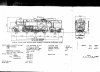
If there are any illegible dimensions, let me know.
Finally not particularly relevant to a model, but pleasant to watch, 80105 at the Wensleydale Railway with yours truly in charge, although not always driving.
Regards
Martin
Whilst I have no doubt about your view of museum practice being the correct way to go about things, personally I couldn't care less about how the material got to the archive, but rather more that it should be archived in a responsive way to it's origins that easily enables a researcher to access it. This obviously doesn't happen at the NRM, but given some of their recent decisions I'm hardly surprised. I could rant at length about the standards of museums in the UK, but it would be rather boring.
Graham
As you probably know the design effort for the std classes was spread around 4 main works, Brighton, Derby, Doncaster, and Swindon. Each works had a responsibility for one or more of the classes as well as the complete design of components used across the whole range of standard classes. This is why I felt that NRM Brighton list would be the most likely for a GA drawing. I had a further look through the lists and can't actually find anything that I recognise as a GA for any of the standards.
A posssible useful contact is BRSLOG, British Railways Standard Locomotive Owners Group, a cooperative the name of which is self explanatory. They have an arrangement with the NRM to obtain drawings and would certainly know what drawings are available.
I found this in the furthest recesses of my library, which has been reproduced in a number of publications, which is I think the diagram book drawing of the 4MTT and therefore really intended for operators rather than engineers.
If there are any illegible dimensions, let me know.
Finally not particularly relevant to a model, but pleasant to watch, 80105 at the Wensleydale Railway with yours truly in charge, although not always driving.
Regards
Martin
mickoo
Western Thunderer
I had a further look through the lists and can't actually find anything that I recognise as a GA for any of the standards.
Regards
Martin
A quick check in the NRM pdf's
Standard 5
SL-DN-P119 side and top elevation.
SL-DN-P120 cross sections.
Standard 4 2-6-0
SL-DN-P122
SL-DN-P123
Britannia
SL-DE-19881 side and top elevation.
SL-DE-19882 cross sections
Standard 3 2-6-2T
SL/SW/327 Pipe and Rod
SL/SW/360 General arrangement
SL/SW/367 Pie and Rod cross sections
Standard 3 2-6-0
SL/SW/540
I'm sure there are others but I can't find my notes on Standards at the moment.
After about 1946 most works change from the GA designation to pipe and rod and as such are much less cluttered and of more use in some cases.

Yorkshire Dave
Western Thunderer
Forgive the ignorance but wasn't this loco derived from Fairbairn's LMS 2-6-4T - could these drawings provide any clues/assistance?
AJC
Western Thunderer
Adam
Whilst I have no doubt about your view of museum practice being the correct way to go about things, personally I couldn't care less about how the material got to the archive, but rather more that it should be archived in a responsive way to it's origins that easily enables a researcher to access it. This obviously doesn't happen at the NRM, but given some of their recent decisions I'm hardly surprised. I could rant at length about the standards of museums in the UK, but it would be rather boring.
Martin - it's a reasonable point of view: there is a difference and in the world of those who work in the sector, the difference is fairly fundamental, between composition of museum displays - which I think is what you're referring to and the care and ordering and of collections of records which are maintained and made available to researchers. In the NRM they happen to be housed under the same roof. An archivist - with skills and training specific to that role - is generally a different skill set and training - often a different person - to a curator.
I happen not to like many trends in modern curatorial practise as it's enacted in lots of modern museums (including some of our best-known preservation sites and, for different reasons, some major institutions in other fields) and that's down to personal preference. These are places generally visit for pleasure rather than work.
I use a lot of archives and understand how they work because it pays the rent in a more interesting way than some things I've done. Hell I even drink with the odd archivist occasionally. In this instance, the archivists privilege/prioritise a different part of the life of that record to the bit that you, as an operator of an obsolete machine described by these records or a modelmaker would like them to. That's their choice because that's their job. In modern archival practise (the last 60 years or so) , the origin is the point the collection arrives at the archive; that's just how they work. The role of the catalogue is to bridge that gap, and let's face it, some are better than others.
The archive is there to hold the documents and to allow access in a way that enables their best preservation. Poor archival practise, by archivists and users, has trashed and continues to trash documents. Digitisation is the ideal, in many ways, but like a lot of things, you can have any two of quick, cheap, comprehensive or user friendly. Three on a good day. You want a catalogue that can be searched by literally anyone for any set of words that they think happen to go together? That's extra and there's naff all money for everyday archival work such as re-cataloguing, especially when researchers want that access (or have a right to expect it, in the case of national collections).
All the above is long and overwrought and worse, off topic. Sorry about that, it's the end of term.
Adam
Last edited:

adrian
Flying Squad
but an interesting insight nonetheless. An insight into this work is always appreciated.All the above is long and overwrought and worse, off topic.
AJC
Western Thunderer
but an interesting insight nonetheless. An insight into this work is always appreciated.
Thanks - I do use the difficulties faced by the NRM as an archival assemblage in talks to students occasionally. It's a good example of the conflicts in archival decision-making. I'm not an archivist but I couldn't do my job without them.
Adam
Martin Shaw
Western Thunderer
Adam
Not at all overwrought, I found it most interesting. Surely though the point of an archive is that it is a repository of information collected from a single or many sources that can be accessed by those so wishing to, in the easiest manner possible. That the archive is organised in a way that doesn't recognise the origin of the information, and so confuses any user is at best self serving, and otherwise just plain perverse. It may well be that it is done that way generally, but since I, you, and the rest of the UK are paying for this, in the sense of national archives, it would seem to me that it should at least serve the potential users as best as possible rather than the choice of the archivist. Having said that I don't suppose it's easy.
I do however appreciate that resources are finite and extremely limited, and in the scheme of things not very high on the list of things to do. Thanks for explaining it from the other point of view.
Mick
Thanks for the pointers, I need to look harder.
Dave
Pretty much the same as the Fairburn 2-6-4. So that they would fit the L1 loading gauge the cylinders were reduced by 1/2", and the boiler pressure upped by 25psi to compensate, although I have found that it is impossible to get the steam chest pressure gauge to coincide with the boiler pressure gauge. I know that a lot of the detail stuff is different. Retired railwaymen I have spoken too reckon the Fairburn was a better engine than the Std4, but from an engineering perspective I doubt there was much difference.
Regards
Martin
Not at all overwrought, I found it most interesting. Surely though the point of an archive is that it is a repository of information collected from a single or many sources that can be accessed by those so wishing to, in the easiest manner possible. That the archive is organised in a way that doesn't recognise the origin of the information, and so confuses any user is at best self serving, and otherwise just plain perverse. It may well be that it is done that way generally, but since I, you, and the rest of the UK are paying for this, in the sense of national archives, it would seem to me that it should at least serve the potential users as best as possible rather than the choice of the archivist. Having said that I don't suppose it's easy.
I do however appreciate that resources are finite and extremely limited, and in the scheme of things not very high on the list of things to do. Thanks for explaining it from the other point of view.
Mick
Thanks for the pointers, I need to look harder.
Dave
Pretty much the same as the Fairburn 2-6-4. So that they would fit the L1 loading gauge the cylinders were reduced by 1/2", and the boiler pressure upped by 25psi to compensate, although I have found that it is impossible to get the steam chest pressure gauge to coincide with the boiler pressure gauge. I know that a lot of the detail stuff is different. Retired railwaymen I have spoken too reckon the Fairburn was a better engine than the Std4, but from an engineering perspective I doubt there was much difference.
Regards
Martin
mickoo
Western Thunderer
Martin, no problems, I've been down your road often enough now to work out that much of it is there in plain sight....if you use the right words and that's the crux of any index system. Be it NRM railway drawings or the Port of Felixstowe stores system, both work 100% if you know what the guy who wrote the index called the item!

Steph Dale
Western Thunderer
A quick check in the NRM pdf's
After about 1946 most works change from the GA designation to pipe and rod and as such are much less cluttered and of more use in some cases.
On the Southern works they're resolutely different things, their dates are a reflection of their usefulness. Once a loco is together then a pipe and rod is going to be more use, and subject to more changes, than a GA. For this reason P&Rs tend to have later revision dates than GAs. As an example, the P&R for the LSWR T9s is dated in the early 1950s I think, due to a lubrication change; the latest GA will probably have been in the 1920s when the Maunsell superheaters were fitted.
The last locos designed will have had GAs, but they're also likely to have been the drawings that would have been 'spirited away'. You can almost certainly check this by looking through the Drawing Registers (a contemporaneous record of what drawings were created and when) rather then the Drawing Lists (a list of what survives, as in the NRM pdfs and spreadsheets).
Steph
Steph Dale
Western Thunderer
...work 100% if you know what the guy who wrote the index called the item!
For digital systems, that only holds true if both the index and search term are spelt correctly...!
Steph
Dog Star
Western Thunderer
For those with an interest in Swindon matters, the GWR DO created a drawing index for each class / lot - using a proforma presumably to ensure that nothing got forgotten. So if you are interested in, for example, the 2884 class then the relevant drawing index for that class (lot within class) provides a list of all of the drawings which were contemporary at the point of construction. The NRM has this information.The last locos designed will have had GAs... You can almost certainly check this by looking through the Drawing Registers (a contemporaneous record of what drawings were created and when) rather then the Drawing Lists (a list of what survives, as in the NRM pdfs and spreadsheets).
Now, if like me, you have a penchant for Churchward locomotives you have a quandary... for the relevant material in the NRM is marked as "do not produce" which rather negates the point of having the material. Please do not ask how I know, suffice to say that I had to push a bit to learn that I was not going to be able to see what is in the drawing store.
Last edited: