
You are using an out of date browser. It may not display this or other websites correctly.
You should upgrade or use an alternative browser.
You should upgrade or use an alternative browser.
S Port Dundas
- Thread starter JimG
- Start date


JimG
Western Thunderer
Looking good Jim! Sorry to hear about your hip, hope you are better soon.
Another month and I'll be back too.....
I've been following weather forecasts and it looks as though NW Scotland has been getting a lot of rain in July - hope you are not too wet.

I've just found out that teenuts don't work well in thin plywood - they fall out.
 So the thinking cap will be on for an alternative to hold the end covers on. Hopefully it will be sorted out by Tuesday and I'll get the lot back up to the clubhouse.
Jim.
JimG
Western Thunderer
Lets hope you learn to cope with your ailment and get back to some regular modelling.
I'm booked in to see a physiotherapist in a week's time so I'll see what happens at that meeting.
The main problem I find is trying to concentrate on something for any length of time when there is a constant dull ache in my left buttock - like toothache in my bum.
I might have to start researching ways of being able to work at the lathe, computer and workbench for long periods in some comfort. At least the CNC mill is no real problem to operate, but doing the CAD and CAM design on the computer is. Jim.

JimG
Western Thunderer
Jim,
my solution to thin ply and Tee nuts is to make a ply doubler, partially insert the nut to create the prong holes, remove it and then bond it in with epoxy while tightening it as far as it will go in. Don't ask why I had to develop this solution!!
Simon,
Many thanks for that. I was wondering if epoxy might do the job and you've just confirmed my course of action.
Jim.

Colin M
Western Thunderer
My trial and error found it's best to fit a short piece of softwood battern behind the thin ply. You can hammer the tee nut into the softwood before you fix it to the layout. That also allowed me to drill a large 25mm hole through the thin ply so that the face of the tee nut sits completely flush.
(I'm just off to visit the Sheredes exhibition, but I'll post a photo when a get back).
Colin
(I'm just off to visit the Sheredes exhibition, but I'll post a photo when a get back).
Colin
JimG
Western Thunderer
My trial and error found it's best to fit a short piece of softwood battern behind the thin ply. You can hammer the tee nut into the softwood before you fix it to the layout. That also allowed me to drill a large 25mm hole through the thin ply so that the face of the tee nut sits completely flush.
Colin,
I had thought about that as well but it would give me some problems where I'm short of space in some places behind the plywood to squeeze in the softwood, and I'd rather have the same solution at each point so that the screw lengths will be the same. The planning on this work has been of the "make it up as you go along" style - next time I'll plan a bit better to handle the teenuts.
Jim.
JimG
Western Thunderer
I've now got the end plates made and fitted.
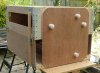

...with the teenuts epoxied in place for the 6mm holding screws. The two pairs of handle on each end give carrying options for both orientations. The tall thin orientation will be necessary to get through the average door.
I managed to heft it out to the car on my own and try out the fit. The first way was lengthways into the car...

...which came up to the seat hinge line...

...which definitely meant that I couldn't get the seats folded back up. I then tried it broadside on with a height of two feet...

...and it fitted quite easily with more clearance at the seat hinge line..

... but it just needed another inch to give enough space for the seats to lock back in their normal positions.
I had hoped to fit the boards in the back of the car without putting the seats down, which would have been in the broadside position with a height of 2' 8", but I got thwarted by the narrowing of the rear doorway at the top - by an inch. I haven't quite given up on that position but will wait to try with someone else to help. It might be possible to load the boards at a slant to avoid the narrow top of the doorway, then return them to the vertical once inside the door.
As a side issue, I used Devcon 2 ton Epoxy which I had got some time ago as a quick setting epoxy from the local B&Q. Both tubes were half full of air and I had to squash more than half of them before I got anything out of the nozzles. I can't remember what I paid for it, but I now suspect it was not a good buy. And the tube caps are the same colour so that's a disaster waiting to happen.
Jim.
...with the teenuts epoxied in place for the 6mm holding screws. The two pairs of handle on each end give carrying options for both orientations. The tall thin orientation will be necessary to get through the average door.
I managed to heft it out to the car on my own and try out the fit. The first way was lengthways into the car...
...which came up to the seat hinge line...
...which definitely meant that I couldn't get the seats folded back up. I then tried it broadside on with a height of two feet...
...and it fitted quite easily with more clearance at the seat hinge line..
... but it just needed another inch to give enough space for the seats to lock back in their normal positions.
I had hoped to fit the boards in the back of the car without putting the seats down, which would have been in the broadside position with a height of 2' 8", but I got thwarted by the narrowing of the rear doorway at the top - by an inch.
I haven't quite given up on that position but will wait to try with someone else to help. It might be possible to load the boards at a slant to avoid the narrow top of the doorway, then return them to the vertical once inside the door.As a side issue, I used Devcon 2 ton Epoxy which I had got some time ago as a quick setting epoxy from the local B&Q. Both tubes were half full of air and I had to squash more than half of them before I got anything out of the nozzles. I can't remember what I paid for it, but I now suspect it was not a good buy. And the tube caps are the same colour so that's a disaster waiting to happen.
Jim.
JimG
Western Thunderer
This is a follow on from making the MERG servo driving modules way back in May - the actual servo point operating units themselves. I took the basic idea from contributions on the MERG forum - basically the servo being bolted to a piece of angle and the operating wire being connected to the servo arm and pivoted through a hole in the angle.
One thing I wanted to do with the servos was to have them operate as close to their full 90 degree travel as possible. The MERG setup software for the control boards allows you to set the amount of travel of the servos as well as their speed. but there have been some reports of servos set to work at comparatively small angular rotations, but whanging out to full rotation under error conditions and causing damage to linkages and tiebars. If I wanted to drive the servos through their full 90 degree rotation with the operating wire connected directly to the servo arm, a significant vertical component would be imparted to the wire which could give problems if the wire operated the points tiebar directly. So I had a few experiments with the basic design to get round this. It also had to fit in the 35mm depth of the support framework of the Port Dundas baseboards and it had to house a micro switch to handle crossing polarity.

Here are the first two using the Tower SG90 servos and ex-Post Office Cherry microswitches which I picked up about forty years ago. The microswitches are operated by a short brass rod soldered to their operating arms which are deflected by the point operating wires. The microswitch holding screws are also in slots to allow adjustment of the switch to give operation at the correct place once the servo is set up to operate the point blades.

A closer shot of the main modification to the basic MERG design. A hole on the servo horn is tapped 10BA - the existing holes are a nice tight tapping fit - and a short 10BA screw is inserted from the rear to project by a nut's depth to the front. A 10BA nut is soldered to 20mm of brass tube and the nut is spun onto the screw as far as it will go, then wound back a part turn to give free angular motion. A length of 1mm wire is inserted through the tube and through the hole in the angle base to provide the operating arm. The tube imparts motion to the wire without any vertical component.

The wire has a collar soldered to it (same brass tube) to prevent it dropping through and I also put a short bit of sleeving on the other end to stop the rod dropping out when working with the assembly. The hole in the angle is drilled using a centre drill to give clearance to allow the wire to move through an angle but with little play.
Adjustment of movement can be made using different holes in the servo horn and a really coarse adjustment can be made by swinging the servo horn by 180 degrees, although I would have to move the microswitch operating rod to accommodate that. I'm also thinking of modifying the simple pivot hole in the angle to be in a small plate bolted to the angle. This small plate could be spaced up from the angle to give smaller incremental adjustments of the throw.
With a bit of luck I should get them fitted to the baseboard tomorrow.
Jim.
- the actual servo point operating units themselves. I took the basic idea from contributions on the MERG forum - basically the servo being bolted to a piece of angle and the operating wire being connected to the servo arm and pivoted through a hole in the angle.One thing I wanted to do with the servos was to have them operate as close to their full 90 degree travel as possible. The MERG setup software for the control boards allows you to set the amount of travel of the servos as well as their speed. but there have been some reports of servos set to work at comparatively small angular rotations, but whanging out to full rotation under error conditions and causing damage to linkages and tiebars. If I wanted to drive the servos through their full 90 degree rotation with the operating wire connected directly to the servo arm, a significant vertical component would be imparted to the wire which could give problems if the wire operated the points tiebar directly. So I had a few experiments with the basic design to get round this. It also had to fit in the 35mm depth of the support framework of the Port Dundas baseboards and it had to house a micro switch to handle crossing polarity.
Here are the first two using the Tower SG90 servos and ex-Post Office Cherry microswitches which I picked up about forty years ago. The microswitches are operated by a short brass rod soldered to their operating arms which are deflected by the point operating wires. The microswitch holding screws are also in slots to allow adjustment of the switch to give operation at the correct place once the servo is set up to operate the point blades.
A closer shot of the main modification to the basic MERG design. A hole on the servo horn is tapped 10BA - the existing holes are a nice tight tapping fit - and a short 10BA screw is inserted from the rear to project by a nut's depth to the front. A 10BA nut is soldered to 20mm of brass tube and the nut is spun onto the screw as far as it will go, then wound back a part turn to give free angular motion. A length of 1mm wire is inserted through the tube and through the hole in the angle base to provide the operating arm. The tube imparts motion to the wire without any vertical component.
The wire has a collar soldered to it (same brass tube) to prevent it dropping through and I also put a short bit of sleeving on the other end to stop the rod dropping out when working with the assembly. The hole in the angle is drilled using a centre drill to give clearance to allow the wire to move through an angle but with little play.
Adjustment of movement can be made using different holes in the servo horn and a really coarse adjustment can be made by swinging the servo horn by 180 degrees, although I would have to move the microswitch operating rod to accommodate that. I'm also thinking of modifying the simple pivot hole in the angle to be in a small plate bolted to the angle. This small plate could be spaced up from the angle to give smaller incremental adjustments of the throw.
With a bit of luck I should get them fitted to the baseboard tomorrow.
Jim.
chicofrank
New Member
I'm sure I have seen a rubber roller for making setts on American model railways I'll try and find the link.Bob,
That is another possibility.
We had a discussion about the matter at the club last night, including considering doing them all by hand with a scriber/scraper. TimC had done some samplers of his stonework for his buildings and the results looked really good. I had a quick try at doing some setts on a spare piece of DAS that he had, but soon realised that that might not be the best idea for twelve square feet.
I'm also trying to think of a system that will work when fitting the setts in and around all the railway trackwork where I might have to break up the placement into quite irregular chunks to fit round everything - as they did in real life. So if I go too far down the road of a system which will be excellent for doing a large area, like a roller of some form, then I might finish up spending a lot of time trying to make good use of it for the many "funny" areas. Another consideration when drawing up the relatively small size of the die already made was trying to balance a random placement of setts against an obvious repeating pattern.
This could be my project for the year, or should that be years.
Jim.
