4mm Monks Ferry LNWR

Phil O

Western Thunderer
Hi Jonte,

I and several others have found attending at least one of the Missenden Abbey modelling weekends a great help in breaking in the novice kit builder.


Other courses are available. I have just signed up for the autumn course, there's no pressure to complete something, you work at your own pace, but there's expert help and advice both from the experts and other attendees, it's not a cheap weekend, but it is full board, I have yet to sample the catering at the new venue, but it was very good at Missenden, I never left feeling hungary.
 

jonte

Western Thunderer
Hi Jonte,

I and several others have found attending at least one of the Missenden Abbey modelling weekends a great help in breaking in the novice kit builder.


Other courses are available. I have just signed up for the autumn course, there's no pressure to complete something, you work at your own pace, but there's expert help and advice both from the experts and other attendees, it's not a cheap weekend, but it is full board, I have yet to sample the catering at the new venue, but it was very good at Missenden, I never left feeling hungary.

Much appreciated, Phil

Unfortunately time is of the essence of late and for the foreseeable.

Will plod on when the time comes; hopefully with the help and guidance of my fellow WT-ers when I (inevitably) get stuck!

Cheers, Phil.

Jon
 

jonte

Western Thunderer
I posted a recent purchase earlier in this thread namely a Precent class loco in LNWR livery, a Bachmann/Rails joint enterprise or so I believe.

This morning, I got round to opening the box and having assimilated the accompanying instructions and diagrams, set about running it in as proscribed (it’s DCC Ready and I purchased the chip separately, however it remained DC for running-in).

Quite satisfied with this relatively smooth and quiet runner, I decided to exchange the factory fitted rubber tyre driving wheel set for a full metal rimmed version included in the box:

IMG_4495.jpeg

Still with factory fitted rubber jobs in photo.

Having done so, I cleaned all the wheels and pickups and applied a tiny amount of lubricant to the points illustrated in the instructions. I then reassembled it. Then I disassembled it: the conduit securing the wires twixt loco and tender were loose (the conduit thingy is also The two bar and hadn’t been located when I replaced the cover) bit of a fiddle.

Replacing it upon the test track, it moved off purposely as before in a forwards direction. Then I did the same in reverse, only nothing happened. I switched it off then gradually increased the power. Still nothing. Then I turned it off again before turning it onto full blast whereupon it burst into life! Each time I had to do the same to get it to go again.

Perplexed, I put it back in the box and wrote an email to Rails (from whence it came) asking for ‘help’.

I await a reply.

Cheers.

jonte
 

Phil O

Western Thunderer
Hi Jonte,

Have you tried replacing the original set of drivers, as a check? that'll prove that it's something to do with the drivers or some other problem.
 

jonte

Western Thunderer
Hi Jonte,

Have you tried replacing the original set of drivers, as a check? that'll prove that it's something to do with the drivers or some other problem.

Thanks, Phil.

It occurred to me but with new items I’s prefer not to mess.

Had a reply earlier from Rails who have asked me to complete a returns form and then they can investigate :thumbs:

Cheers

Jon
 

jonte

Western Thunderer
This evening I but the bullet and ventured out to the model room, not knowing how the layout had fared after its lengthy abandonment. With the valuable help of my wife, we managed to release it from its incarceration at the furthest end, where it had been hemmed in by two other forgotten projects, but it proved a bit of a struggle. If only I’d known then how my agility and strength would depart……

Considering it had lain for so long, it went back together fairly easily, although I had to borrow a bolt for a board connector from the GWR branchline which had been its fellow inmate (Sod’s Law, I found it afterwards!).

On the downside, the awful looking boards were soon apparent, despite having had the benefit of much remedial work (still not properly finished), although in my defence, I must remind you that this was mainly the work of a relative who insisted on helping. Sadly, patience isn’t/wasn’t a virtue although they were best intended. If you look back somewhere amongst the pages you can see the remedial work.

Anyway, a couple of photos of stuff I’ve noted thus far; no doubt more will come to light as I progress.

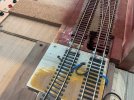
The first is of the joint between end board and fiddleyard:

IMG_4500.jpeg

I’ll need to revisit with the soldering iron (probably) although the addition of hinge connectors alone might rectify. This has been caused by the fact that only one brass dowel was used, relying on those catch thingies to hold it in vertical alignment. They haven’t. This was also the case with two main boards hence I soon replaced them with four sets of hinges with removable pins, supplemented by specifically designed bolts in barrels for accurate alignment:

IMG_4501.jpeg

Also, the joints on one of the tracks between the two main boards has failed. Scrutiny reveals that despite having drilled the sleeper ends on either side, I’d forgotten to add the pins!:

IMG_4499.jpeg

Otherwise, it appears okay. Just unfinished.

The delicate removable station roof has also sustained damage which I’ll also add to the list:

IMG_4497.jpeg

I think one of the first tasks will be to add the top section of the proscenium arch to each board.

Frankly, I should have preferred- starting again - to keep to C.J.’s original presentation of merely a frame to keep it in keeping with the spirit of the original theme, but I suppose it’s a case of ‘I’ve started……’.

Lighting will be LED as per the GWR branchline:

IMG_1337.jpegIMG_1336.jpegIMG_1340.jpegIMG_1338.jpeg

Finally, I’ll leave you with an overall shot of the layout on the bench:

IMG_4498.jpeg

Thanks for your interest.

jonte
 

jonte

Western Thunderer
The first couple, off the long list, of jobs have been completed.

First, the damaged joint of the inner set of rails between boards one and two as shown above, has been repaired:

IMG_4510.jpeg

Scrutiny of the earlier photo revealed the cause: one of the rails from the line in question from board one to two was overhanging the joint. When (clumsily) connecting the boards (forgotten sequence) it had been clobbered, the impact shattering the second rail’s soldered joint. This rail was reconnected then pared back with cutters once the boards had been separated. Consequently, the rail on board two on the other side of the joint was now too short. This was taken up and a new section of track wired and relaid. Hopefully this problem is now cured.

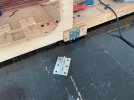
Second, the fiddleyard at its connection to board 2 was on a slant which meant the tracks between the two had become uneven. As mentioned previously, the single brass dowel and those ruddy awful catch thingies (these were meant for the job too and purchased at the time from a retailer) were at fault, so this task involved removing the catches and replacing with split hinges to assist vertical alignment and retention. Unfortunately, I only had the longer three holed variety in stock so they were cut to size with a hack saw. This is now solid:

IMG_4511.jpegIMG_4515.jpeg

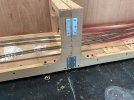
On the subject of hinges, I’ve always felt that the upper parts of the main boards needed securing as turning them fir access to wiring etc placed strain on the lower hinges as they seemed to drift at the joint there. Thus, that was another task while the hinges were out:

IMG_4512.jpegIMG_4514.jpeg

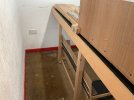
Finally, the rail joints between fiddleyard and board 2 needed re-doing now that the boards were true, which involved one track at the entrance to the fiddleyard being lifted and relaid as the brass screws to which they were attached were not sitting low enough to match the height of the rails on board 2. What a b*gger of job that was as the low beam above prevented using a robust set of pliers to remove them (and they were screwed in tightly!) thus I had to turn them bit by bit in awkward position using a smaller delicate set. Once removed I had to try and countersink the holes to add more leeway using a small screwdriver as the drill was also impeded by the beam above……… I couldn’t use a screwdriver to remove them as the slot had become clogged with solder. Normally a small hacksaw will do the trick, but the proximity of the track on board 2 put paid to that. Once accomplished, the tracks on the other side of the joint on board 2 were adjusted with the iron:


IMG_4516.jpeg

So that’s the first of many jobs tackled.

Now where’s that list gone……

Thanks for reading.

jonte
 

jonte

Western Thunderer
A change in rota this week saw me with a free day, so back to the layout (if it can be described as thus as such an early stage) it was.

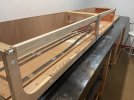
An early start saw me visiting the wood yard for an eight foot length of 2”x1” (or whatever the Common Market measures it at these days) as surprisingly I’d used up all my stock on the abandoned project. The intention was to enclose the top of the fascia with this simple addition; my earlier thoughts about matching the ply rounded edges below didn’t seem to work in my humble. As suggested in my previous, I think a simple straight frame is more in keeping with Mr. Freezer’s original theme, but I’ll leave it to your good selves to consider whether I’m right on this.

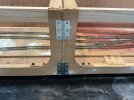
I seem to be getting better with the table saw as my measurements were bang on. Only problem with this, or so I understand, is that unless there is slight gap between surfaces the glue won’t bond, so I routed through wall ‘troughs’ in the workshop and found to my surprise an unopened packet of corner brackets:
IMG_4517.jpeg
IMG_4518.jpeg

Before fitting, I also drilled a hole each side of the joint where the beams will meet the frame, as this is where the wires from the led lighting will meet from either side before running down to baseboard (inside the fascia) level, hopefully also serving to cover that annoying gap………….
With mention of lighting, I ordered a cheap set of bedroom/kitchen strips without control/dimmer/ transformer as I’ll simply wire them myself and use as is. I ordered the slightly dearer ‘white light’ set rather than the cheaper ‘warm light’ version. I think the harsher white suits the industrial /city scape better than the other which I relate to countryside scenes on a sunny day.

As can be seen in the above photo, I also removed the screws before countersinking them and filling in. Hopefully this will improve aesthetics somewhat when painted.

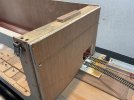
I also decided to address the partition on the exit from the fiddleyard. I only had 12mm ply left to do the job, so it had to do (a bit heavy).

But first I needed to remove the remnants of those supports which I cut off earlier in the build because of the obstructions they caused. Unfortunately, I was aware that there were screws inside. Chiselling off the remainders of wood to reveal them, I started to get cracking with the hacksaw. A five minute job, or so I thought. Once again, the top beams were in the way! So off to the garage to pick up my junior hacksaw. I’d have been better with my finger nail…….. Think I’ll need a whizzer to do the job. I used to have one for boat repairs but where it went is anyone’s guess. Not wishing to waste precious time, I decided to get on with the job anyway. I just screwed it on fir now, but once I find a whizzer or purchase one, I’ll glue it too:

IMG_4519.jpegIMG_4520.jpeg

So that was it for today. Not very exciting, but steadily chipping away at the to-do list.

I received this in the afternoon post, a reasonably priced unused article from a well known auction site:
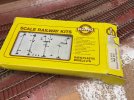
IMG_4521.jpeg

Having successfully ordered them, I immediately visited MSE/Wizard Models site to purchase a brass fret of LNWR signal parts to make the working parts.
This was a method I used successfully on the GWR branchline layout. Ratio signals redrilled for brass tubing and supplemented with Modelu finial, Wizard parts and scratchbuilt handrails, they were made to work with gadgets from Heathcote electronics. Here’s a video of a single post on the layout which you may remember:


Apologies once again for the half speed content (don’t know how that happened!).

The kit allows four signals to be completed which is enough fir the platform starters and a ‘mini’ version which I’m hoping will serve as a starter fir the shunting bay (there’s a picture of such a minute signal in my yesteryear book of Wirral lines).

Btw, I forgot to mention that after removing the contents from the packet I noticed that there was something remaining inside. A shake if the box revealed this:
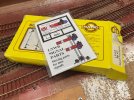
IMG_4522.jpeg

Whomever bought this kit originally must have had the same idea. There was no mention of them being included in the ad..

I suppose it’s too late to cancel my order with MSE. Ah, well.

Cheers for now.

jonte

 

John57sharp

Western Thunderer
I agree with Phil - all this progress is most encouraging and lucky you finding the packet of signals and the corner brackets. You can always use more signal parts I'm sure!
Cheers for now
John
 

jonte

Western Thunderer
Jonte,

Good to see that you have the mojo back and are cracking on with this project.

Thanks, Phil.

I think accepting what can be achieved in the time available and planning accordingly is key here, I’ve found.

Jon
I agree with Phil - all this progress is most encouraging and lucky you finding the packet of signals and the corner brackets. You can always use more signal parts I'm sure!
Cheers for now
John

Thanks, John.

I was thinking along the same lines about the signal bits.

Think I was due a bit of luck construction wise ;)

Jon
 

jonte

Western Thunderer
Made a start on fixing and wiring up the led lighting which arrived yesterday as mentioned.

However, a quick test revealed they were faulty. They were simply a 12v set minus the power pack and other accessories (and instructions although not required). A test of the 12V power pack used showed the fault lay with the lights themselves, so back they went! I’ve ordered a replacement set but this time with all the accessories as experience has shown these work.

In the meantime, what to do, as I didn’t want to waste valuable modelling time? So off I went to pay the brother in law a visit, cap in hand to borrow his new rechargeable and thus cordless whizzer.

Disconnecting the boards and tidying up afterwards took longer than removing the protruding screws which flew off in a stream of sparks.

Anyway, here are the boards minus those screws and remainder of the beams which proved such an eyesore:

IMG_0523.jpeg

Then I turned my attention to the signal kits to strategise. Incidentally, while I was out cadging the use of the b in law’s whizzer, the post arrived with my order from Wizard Models. To say these are now surplus to requirements would be an understatement.
Having studied the parts in detail (plastic and brass) I decided to just go with the plastic kit afterall. In, part perhaps just for ol’ time’s sake.

However, the decision was made for me: the instructions required the fitting of 0.13 mm brass wire to firm the corrugations on the arms. You see, I’m out of brass wire having recently used up the last of my stock. Indeed, I was even going to plump for those in the Ratio kit for operations. But this meant having to place another order with Wizard, who respectfully aren’t the swiftest with delivery, and I’m eager to get back to some modelling. So, I’ve decided on a compromise: I’m going with plastic kit, including arms (which do have the corrugations) however I’m going to replace the spectacle plates with those on the bras fret as Ive still got the coloured film for the lenses somewhere or other. I don’t think my hands are steady enough to paint those that are part of the mould on the plastic variety.

Elsewhere, thoughts have turned to the buildings at the terminus end which granted will have to be in relief, as per those of Mr. Freezer’s original plan. I had thought of creating a small but deep box that could bolt onto the end where the wooden end plate will go so as to have a ‘fuller’ building which would also ensure I keep the longest length of track in the platforms as possible. But frankly, I think this would be cheating somewhat and fly in the face of keeping everything (including feeds and controls) within the footprint of the boards, much like the original. I could make the upper storey of the planned station building overhang the buffers, but I think all in all, I’ll just opt for a low relief building to fit in the couple of inches or so available. I’ll enjoy the challenge.

So there we go. Not a lot to report really, and not as much progress as I would have liked, but at least that’s another item struck from the list.

Thanks for reading.

jonte
 
Top