
4mm Project Advent

James Spooner

Western Thunderer
So the paint has dried faster than I had anticipated and the ensemble is once again assembled on the dining room table. It still works! I have tested the Baldwin on every inch of the layout and am happy with the outcome. I think that is a successful conclusion to Project Advent.

Nigel
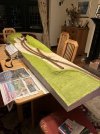
IMG_5430.jpegIMG_5432.jpeg
Looking nice, Nigel.

why ModRoc? I tend to papier mache, actually, woven strips of paketo cornflako, covered in strips of green paper hand towel or newspaper, sloshed through some watered down PVA. Does the ModRoc offer some benefit?

Merry Christmas
Simon
Hi Simon,

Thanks! I think it is just that I have been used to using Modroc and it has always proven strong and durable so decided to stick with what I knew! I am aware of other ways of doing things but, not being a great cornflake (or Weetabix or other cereals) eater, there is a shortage of said boxes in our household!

Nigel
 

Attachments

  • IMG_5433.jpeg
    IMG_5433.jpeg
    248.1 KB · Views: 13
  • IMG_5433.jpeg
    IMG_5433.jpeg
    248.1 KB · Views: 12

James Spooner

Western Thunderer
A lovely little layout, Nigel.
Will you be posting pictures of the buildings as your son progresses with them?
Thanks Tim. I will ask him if can send me photos as he progresses (he lives with his girlfriend in London), so don’t hold your breath! I’m going back to the Ivatt 4MT after Christmas…

Nigel
 

James Spooner

Western Thunderer
Can I please pick the brains of the assembled collective? We seem to have an electrical issue with the sections on Beddgelert. I have created a very simple and traditional wiring system for the layout. There are seven electrical sections, each controlled by a simple on/off switch (new and bought for the purpose). The controller is quite an old AMR feedback controller that has served faithfully for decades (until I went DCC for Elmham Market).

The issue seems to be that, when only one engine is on the layout, it behaves as one would expect (ie works when the switch is on but doesn’t when it is off). Put another loco on a different section and electricity seems to leak through so both will move (although the one on the section switched out will tend to move slower than the one with the section switched on). Taking all the locos off and putting a voltmeter to the switches, they seem to still let a couple of volts through the circuit. It seems to me that the switches are malfunctioning but in a slightly random way. I must be missing something but I really can’t figure out what. Help!

Many thanks in advance for any helpful advice.

Nigel
 

simond

Western Thunderer
I had a similar issue with flux residue on a connector years ago. The night shift was supposed to make 500 batteries, and about half of them failed end-of-line testing. There was some stress…. Smart foreman got a meter and checked the connectors, there was definite leakage.

Perhaps worth a check, and a clean up of the switch pins / soldering with an old toothbrush and some ipa?
 

James Spooner

Western Thunderer
I had a similar issue with flux residue on a connector years ago. The night shift was supposed to make 500 batteries, and about half of them failed end-of-line testing. There was some stress…. Smart foreman got a meter and checked the connectors, there was definite leakage.

Perhaps worth a check, and a clean up of the switch pins / soldering with an old toothbrush and some ipa?
Hi Simon,

Thanks for that. If I understand you correctly, does that mean I need to dismantle the switches to get to the contacts? They seem to be sealed in plastic blocks…

cheers

Nigel
 

simond

Western Thunderer
Nigel, no!

the flux that caused my production problem was that used to solder the wires to the tags on the connector. I suggest the same might affect your switches, but it seems a long shot. Our problem was a data bus that wouldn’t work. Even small motors would take (much) more current, so on reflection, I doubt that suggestion is going to help. In any case, I guess you could just give the back of your switches a wee scrub with ipa & the old toothbrush.

I guess if you have a switch from the same batch that you haven't used, it might be worth checking it out with a meter.

the other possibility that springs to mind is a poor earth/common return grounding connection, but without seeing the wiring, it’s difficult to offer more suggestions.

hth
Simon
 

James Spooner

Western Thunderer
Nigel, no!

the flux that caused my production problem was that used to solder the wires to the tags on the connector. I suggest the same might affect your switches, but it seems a long shot. Our problem was a data bus that wouldn’t work. Even small motors would take (much) more current, so on reflection, I doubt that suggestion is going to help. In any case, I guess you could just give the back of your switches a wee scrub with ipa & the old toothbrush.

I guess if you have a switch from the same batch that you haven't used, it might be worth checking it out with a meter.

the other possibility that springs to mind is a poor earth/common return grounding connection, but without seeing the wiring, it’s difficult to offer more suggestions.

hth
Simon
Hi Simon

I have taken a few photos of the control panel. Apologies in advance for my rather untidy wiring, but I don’t think anything is touching anything it shouldn’t! It’s a very simple and traditional DC control panel. The point motors are Peco solenoids under baseboard fitted and operated by a Peco probe. Most of the black wires in the box relate to the point motor switching (which all seems to work fine). I have used simple on/off switches for the sections. I daisy chain wired the positive side together from the controller feed, then took a wire from the other switch terminal to the track, via a connecting block and 6 din pin plugs to connect the control box to the baseboards. I’ll post up the photos below and any help gratefully received!

Cheers

Nigel

IMG_5468.jpegIMG_5469.jpegIMG_5470.jpegIMG_5471.jpegIMG_5472.jpeg
 

Joe's Garage

Western Thunderer
Untidy wiring Nigel...??!! No way is that untidy, have you seen the wiring on some of the Spanish buildings.....?!
The control unit looks very neat and logical.
Lovely progress on your layout.
Cheers Julian
 

James Spooner

Western Thunderer
Phew! Wiring issue sorted (and many thanks for your offer of help Simon!). I had initially not wired in the switches on the Peco points, but one of the Y points had a dodgy connection so I decided to wire up all of the switches anyway. My mistake was to pick the feeds for the switches up from any old positive and negative rail, rather than specifically from the rails at the heels of the relevant point. That caused the DC current to transfer from section to section. It was a case of me getting lazy having spent years wiring up DCC points and not DC. ‍♂️. All now seems to work as it should, thankfully!

Nigel
 
Top