Rowan Colliery 4mm/00

40057

Western Thunderer
The assembly of the Grainge & Hodder base-boards for ‘Rowan Colliery’ has commenced. Today.

I had intended to make a start ‘during the Christmas holiday’, so I am a little late. There are to be three base-boards:
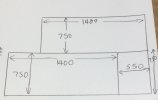
A7B66889-AB39-4D00-A585-525C52641300.jpeg

The sizes chosen are designed to minimise the number of tracks (ideally just one) crossing the joints between the different boards. However, I think there will have to be two tracks across the join between the two ‘front’ (scenic) boards — the main circuit and a head-shunt. Otherwise the head-shunt will be very short and severely limit train length in/out of the sidings on the main scenic board.

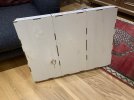
As this is a learning experience for me, I have started with the small board:
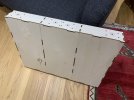
65F57A70-2BE1-4151-BD5D-0DF5D22EFB6A.jpeg

The main structure is complete.

I have also ordered some more of the track I will need. I will start track laying though with the FY board, the assembly of which is not yet begun.
 

Pencarrow

Western Thunderer
Neil,

Having read articles by Norman Solomon in which he used a firm foam rubber, I tried something similar, but found it difficult to glue.

Presumably your mat is not expanded polythene / polyethylene?

Do you know what kind of polymer it is, and what kind of glue do you use, please?

cheers
Simon

Late to the party... Yes, I also tried the firm foam as underlay but had a hell of a job getting it to stay flat. I also found that even the firm foam was a bit too squishy. I also didn't find it was any quieter than cork. In the end I removed it all and went back to cork.
 

40057

Western Thunderer
My journey into the unknown continues. The to me unknown world of modern model railways. Last time I posted a photo of the small base-board for Rowan Colliery, it looked like this:

5D3DD679-DC42-4E8D-9CA9-A81835D78053.jpeg

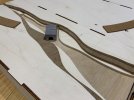
The front of this board is on the right. When photographed, I had not glued the right-hand flooring panel in place, intending to do so the next day. However, I then realised this would be the only place within the scenic area where I could have some of the ground surface below the level of the railway. So I have modified this panel to create a lower lying drainage channel:

F4B19B87-CA82-4770-94FE-4B7F0C4A5CDD.jpeg

I’m not planning a stream. There might be a bit of standing water under the culvert and a few puddles elsewhere, but the intention is rank wetland vegetation — rushes mainly. Obviously different to the vegetation in the better drained areas.

I will now need to build an embankment across the lower section. I have marked out the alignment of the track so I can position this correctly. The culvert is just resting on the board in the above photo but it will be incorporated into the embankment.

The overall plan for this board is starting to take shape:

10D0F3AF-6793-4EA9-933E-4D97E9F2DA2A.jpeg

The front of the board is to the left. Right at the front — the head-shunt for the sidings on the main scenic board. Then the running line (circuit). Across the middle of the board, a road on an embankment crossing the railway on an overbridge. Behind the road, rising ground with trees, to block the view of the running line disappearing into the FY.

Help, please! What is the recommended way of contouring the sides of my low-lying wet area? Plaster, papier-mâché or something else? Any advice gratefully received.

And I will need some small willow trees — sallows or similar. Does anyone sell such things?

Thank you in advance.
 

Pencarrow

Western Thunderer
Hi,

I've done the scenics on quite a few layouts over the years. Others may / will give differing advice based on their own preferences, but I've always liked forming contours and the landscape using polystyrene type materials. Light and easy to carve, and easy to amend if you change your mind. Also good for planting trees into.

The polystyrene layers are glued together using PVA. Weighted down whist the glue sets.

On top of the polystyrene I use a material bought from Wickes. It's a tub of premixed lightweight filler. For larger areas I embed some open weave bandage into the filler. No more than around 5mm is required for the filler thickness. Wickes Lightweight Ready Mixed Filler - 1L | Wickes.co.uk

Once the filler is dry is brush over a layer of grey or brown paint (not gloss) to hide the white colour. I will then brush some PVA over the top to harden the surface off. You can apply the base layer of green stuff at this stage...
 

Pencarrow

Western Thunderer
Regarding your search for a girder bridge, I don't know what span you are after but this looks ok: 300mm Steel Plate Bridge Model Kit. Brick Supports. Railway . OO/HO Gauge | eBay

Never used them but at least they don't have magic floating girders! You could always trim a bit off each side of the deck/ girders to shorten the span?

If you want to be a bit more creative you could build the girders from this kit: Pardon our interruption... (No idea why the link comes with that title, but it does work)

But that does leave you with the abutments to source.
 

40057

Western Thunderer
Regarding your search for a girder bridge, I don't know what span you are after but this looks ok: 300mm Steel Plate Bridge Model Kit. Brick Supports. Railway . OO/HO Gauge | eBay

Never used them but at least they don't have magic floating girders! You could always trim a bit off each side of the deck/ girders to shorten the span?

If you want to be a bit more creative you could build the girders from this kit: Pardon our interruption... (No idea why the link comes with that title, but it does work)

But that does leave you with the abutments to source.
Thank you. It’s very kind of you to take the trouble to post these links. I wasn’t aware of those kits. I would have to shorten the span considerably, or use a different deck. But that could be done.

This modelling lark, as currently practised, is certainly a learning experience for me. Firstly, there is so much stuff available. So choices have to be made. Do I want brick or stone abutments, an arch or a girder etc etc. I have already bought a ‘stone’ culvert. So is it OK to have a brick-built bridge a few scale yards away? Does my choice of building material for the bridge mean I should have similarly built buildings? In which case are kits available, in the right material, for the buildings I will need? It’s difficult to know where to start. But I don’t want to make a choice now I will regret later.

Life is much easier, strangely, in the vintage world of Rivermead Central. Bassett-Lowke, for instance, made two tunnel mouths — single and double — in brick. After WW2, finished to represent concrete. That’s it. Find one of those or scratch build. Other vintage buildings similarly. Use what you can find or make one.

The other eye-opener for me is prices. I’m buying bits and pieces for Rowan Colliery, and individually mostly costing only a few pounds. But it does add up. I never realised before how little, relatively speaking, vintage equipment sells for. The track I’m using for Rivermead Central, vintage 0 gauge, costs less to buy than the new 00 stuff I’m buying for Rowan Colliery. Sure, the vintage track has to be found, cleaned and (sometimes) repaired. But the price is low. Certainly, there are rare and valuable vintage locomotives. A Bassett-Lowke A4, if you can find one, will be many thousands of pounds. But generally, at current prices, I now realise vintage equipment, in nice condition, is relatively remarkably inexpensive.
 

andi4x4

Member
Referring to the first link you posted for the laser cut bridge - it is worth contacting these ebay sellers of laser cut stuff to ask if they can do you a 'one off' - if all you need is shorter sides ( you can cut the deck to length yourself ) they quite often are happy to oblige as it may only require a couple of minutes of their time sat at the computer to make the relevant alteration, and it potentially puts another product or variation in their portfolio.
 

40057

Western Thunderer
Well, I did say, in the very first post in this thread — there won’t be rapid progress and expect long gaps between postings. True to my word, seven months since the last posting and no progress at all. Until yesterday.

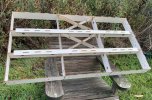
I am assembling the fiddle yard board:

C46ED27D-7450-4551-AF92-8865DF9D9AA9.jpeg

I should get this fully assembled today. I’m inclined to put a coat of paint on the top surface before track laying.

I’m going to build the fiddle yard next, essentially as a practice/learning experience at track laying before starting on the scenic boards. I will wire the track for running 12 V dc trains, though that is not the main purpose of the layout. I hope building in that provision won’t turn into another slippery slope …
 

40057

Western Thunderer
This is not a post I ever expected to make.

A further locomotive has been obtained for Rowan Colliery!

As explained in my post #1, the whole reason for this layout is to provide somewhere to run my two van Riemsdyk 00 gauge Pecketts. These two Peckett models were the only 00 gauge locomotives made by the manufacturer A. & J. van Riemsdyk. Since I have one of each, I was not expecting to add any further locos.

However, there was — sort of — a third 00 gauge clockwork model. At least, there was a third 00 model powered by a van Riemsdyk clockwork motor. This third model had a different origin and is quite unlike the two Pecketts. I knew this third model had been made but until last Saturday I had never even seen a photo of one.

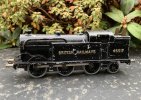
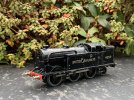
The ‘third model’ was produced at the behest of Walkers & Holtzapffel (later W&H) (see Walkers & Holtzapffel). This firm also commissioned the production of the Walker Riemsdyk 0 gauge 0-6-0T (see posts #7 and #42 in my Rivermead Central thread). Amongst the wide range of model railway equipment and components sold by Walkers & Holtzapffel were the 00 gauge cast locomotive bodies manufactured by/for Gaiety Models — a GWR pannier tank and an ex-LNER N2 (see Gaiety, Castle Art Products, JVM). At some time in the early 1950s, Walkers & Holtzapffel asked A. & J. van Riemsdyk to motorise a batch of the Gaiety N2 bodies. These were sold by Walkers as ready-to-run clockwork models. According to a letter written in 1985 by John van Riemsdyk and published in British Toy Trains volume 4 (written and published by Michael D. Foster, 2018), about 100 clockwork N2s were produced. This is one of them:

C298D50D-F2FE-4F17-8F88-F78E963E06C5.jpeg

DF0758CB-42ED-4BEB-8F4A-B0E53A6691D1.jpeg

It was offered for sale on a well-known internet auction site last week. I made an offer and bought it. It was not correctly identified in the listing but there is no doubt what it is.

It isn’t a very accurate model. The body casting was improved by van Riemsdyk by adding two coal rails to the bunker and the condenser pipes. The motor is, of course, cleverly designed and beautifully engineered. Forward and reverse, brake and variable speed control. All-steel gears and an indirect wind using a male key. The wheel spacing is wrong but has avoided using stub axles for the middle drivers. The wheels are Romford.

The motor in the 0-6-2 is differently configured to the motors in the 0-6-0 models but operates similarly.

I shall have to invent a back-story to explain a large-wheeled 0-6-2T entering colliery service. But this was a locomotive I had long wished to see, so the opportunity to buy one had to be taken.

The model is very dirty. The rear coupling is missing, the front coupling lacks its chain. No key so I will have to make one. The body casting is however intact, the motor turns over freely and the control levers move the expected parts in the motor. I expect the loco to work once I can wind it up.
 

AllenM

Active Member
I shall have to invent a back-story to explain a large-wheeled 0-6-2T entering colliery service. But this was a locomotive I had long wished to see, so the opportunity to buy one had to be taken.
Perhaps it just works in and out of the area on the interchange road.

Regards
Allen
 

40057

Western Thunderer
I have the components of a key for 46917:

C887B800-0C86-41B5-94C5-0F0C1A3EDE14.jpeg

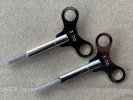
A standard female clock key with a 3.0 mm winding square bought for less than £4 via the internet. Plus a length of steel 3.0 mm square bar, one end filed down to 2.20 mm square.

The parts assembled:

543B7B27-D455-4B10-865C-434C68CEA493.jpeg

I’ll epoxy the square bar in place. Anyway, I have tested the key and it works. But in the process of testing the key, I have also tested the loco. The loco works as well. What I can’t say without a proper track test is how much the engine will pull, how long the run is on one winding and what range of speeds the loco has. I can see there is an accumulation of oily fluff inside the loco body, so I will dismantle and clean before trying the loco on a track.

Martin
 

40057

Western Thunderer
A long overdue update on Rowan Colliery, specifically on 46917 (see post #30 above).

I haven’t dismantled the loco to clean the motor or fitted it with a rear coupling. I have however given it a track test. Despite the filthy mech clogged in oil and fluff, light engine the loco runs smoothly in both forward and reverse. Running bunker first, it easily managed ten wagons for c.50 feet on one winding. The speed control allows good regulation of speed and even full speed is not ridiculously fast.

Once the mech is cleaned, I would expect significantly improved performance. It seems likely 15–20 wagons or three coaches would be well within the loco’s capability. That’s pretty good for such a tiny main-spring. The loco can almost certainly pull longer trains than the Rowan Colliery layout is designed to accommodate.

One unexpected finding of the testing process was that the key I had made was too short. I had measured — so I thought — the depth of the key hole. However, with repeated winding up, the key went further and further into the key hole. There must have been an obstruction, not surprising given the amount of crud inside the body. Anyway, the bottom line was that the body of the key holding the winding square was coming into contact with the raised lettering on the side tank — which would damage the paint around the key hole. So, irritatingly, I have had to make a second key:

53C861FA-2C4D-4E4B-8FDE-640BDDAC37E5.jpeg

The new key with the longer square is below.

Otherwise, I’m sorry to say, no progress at all with Rowan Colliery since my previous post.

Martin
 
Top