Jim,
Ok on the angle and tube cutting you need to be aware of the wall thickness and the teeth per inch (TPI) of the cutting implement.
For a good clean and smooth cut there must be at least three teeth in contact with the cutting surface at any one time, preferably more, the more there are the better the cut will be. Your razor saw should have a marking on it, or the packaging with the TPI.
Let's say for arguments sake it's 50 TPI, that is one tooth per 0.5 mm (roughly), using the 3 TPI figure then the thinnest material you can cut and get a good cut is 1.5 mm, I suspect though that your razor saw is designed for plastics and such and is more for ripping than sawing metals, so it's going to have a TPI around 30 or 40 which means your minimum material thickness jumps up to 2 or 3 mm thick.
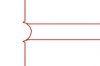
Here's a very rough picture to visualize it.

On the left is a tube with a wall thickness of 1 mm and we are using a 50 TPI...ish, when we begin the cut there are plenty of teeth in contact with the material, but as we get to mid depth then it becomes less than three, now if your really good then you can count the ones the other side but normally we humans can't make a level cut and cut on one side more than the other and never get the full 5 teeth across both faces, the end result is either a broken blade or more usually a ragged rough cut.
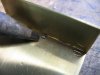
On the right is a piece of angle about 1.8 mm thick we can get three teeth to touch the material and it will cut but it'll be a mess in reality, however if we angle the blade like we have at the top then we get more teeth in contact with the material.
Good smooth cutting is about matching the blade to the material thickness and ensuring you have more than enough teeth in contact with the material, nothing more, nothing less, either angle the blade or get a finer blade, for stuff like that I'd use a piercing saw which have tens of teeth per inch, they are marked as 2/0, 4/0, 6/0 etc in the finer grades, I always have at least 20 or so in each size but go through the 4/0 the most as they are the general size for most materials, but I use a 6/0 on thin brass sheet for a very fine cut.
http://www.guildofjewellerydesigner...cing-blade-sizes&catid=46:reference&Itemid=56
As you can see a 6/0 has 76 TPI so the thinnest material you can cut on the edge should be 1 mm, however I have no problems cutting 0.005" half tabs on etches with that blade especially if angled at 30° or so. Why piercing saw blades do not snag like large blades with the same TPI I do not know. The only downside to piercing saw blades is that they are fragile and designed for detailed work and have a very narrow blade, which makes cutting straight lines difficult. Normal saws have a deep blade and it is the blade in the material already cut that guides it in a straight line.
I'd have to see your material to advise which saw would be best.
Flashing the solder, that depends on how you use the term, I use it to vocalize the solder actually flashing along the joint (bit of Mickism creeping in there maybe?). Some might refer it to the solder just changing state, usually about the same time the flux flashes to a vapor, some don't, some paste fluxes just change state but liquid ones usually flash off.
So long as your work is clean and fluxed and you have matched your flux to the solder you are using (some are critical, others are more general and robust in which fluxes they work with) then you should be fine. Heat is also important, many people namby pamby around with an iron that is either too small or too cold, get it hot and get in fast.
Preheating your metal first helps, which is why I creep up on my blob of solder before I touch it, the tip is already in contact with the metal and heating it up, if left long enough it would melt the solder, but by then all of your flux has flashed off and you'll end up with a dry joint as the solder will not run.....that's my experience.
The size of tip helps as well, in the above I used a big tip, this really holds the heat, when you touch the tip to the work it really soaks up any heat in it and the iron has to heat that all back up which takes time. It's easy to quench a match flame with your finger tips, try and quench a burning log...no don't....but you get my point, both are as hot as each other, just that one has a bigger kick.
Regarding the amount of solder, what I used there was way way too much, in fact if that was on a loco then I'd probably use only that first blob to solder both ends in place, remember, what ever doesn't go in the joint, you have to clean off.
That's why joint preparation is important, the flatter and squarer the joint and the smaller the gap then the less solder you need. There are guys here who use even less, and some use micro torches to heat the work, again very hot, very local and very fast, mine are on order and should arrive this weekend and I'm keen to try them out.
For a soldering iron to work it needs to transfer the heat, it does this by having a very thin layer of solder already on the tip, called tinning, you can have a tip temperature of 400°C but with a dirty tip it wouldn't even melt 150°C solder, the heat will not flow through the crap on the tip, so, a good clean tip is important, however when your soldering something onto a model you rely on this tinning to transfer the heat and melt your additional solder to make the joint, unfortunately even if you just used a whiff of solder for the joint the work will still have a residue of solder, this has come from the tinning and is a residue which is hard to stop.
With a micro flame you are not touching the work at all, so no tinning residue is left, you can either directly tin the parts first and hold in place, or use a solder paste, a very fine cream of solder and flux, smear the smallest amount between the surfaces and heat with the flame, because there is no excess flux the solder will not run all over the place and only go into the joint, leaving....one hopes.....a perfect clean joint requiring virtually no effort to clean up, that's how the silver soldering guys get such a neat joint, as do the guys on here who soft solder with a micro flame.
The other way to get neat joints is with an Resistance Soldering Unit (RSU) basically you electrocute the poor little blighter, as the current passes through the work it heats it up and flashes off the paste and the solder flows, unlike the micro flame you do have to touch the work, but unlike a soldering iron you do not have to tin the tip so no solder residue left from the tinning, RSU's get very very hot very very fast and can melt small detailed parts in an instant of your not careful.
Each tool has it's place, some work with one and are forever happy, I can foresee the use for all three in my techniques.
I will close by saying that I only dabble at this lark, there are others here who positively excel with exceptionally neat clean detailed work

and know considerably more than my half pot explanations above about soldering and the darker arts.
I'd be happy to be corrected if anything is wrong



 . Modern units equipped and intended for remote control operation are required to have the pair of orange strobes. I don't know if it is a rule that they go on the cab, but that's where I always see them. This includes road units with the spartan or safety cabs. It's also why there are so many antennae present on the roof. There will be additional equipment located in the cab for the R/C electronics as well.

















 .
. I'll start with the piu vise and bench vise.