7mm US model dabblings

Jordan or Plymouth Mad

Mid-Western Thunderer
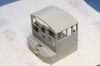
Talking of the OGR Forum, I found a picture of a resin cab someone had made for a CF7, to assist conversion of the Red Caboose GP9 into one (other modifications are also needed).
I believe it was a 'one off' , but that would be a useful component... 3d printed maybe? :) ;)
 

mickoo

Western Thunderer
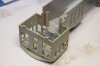
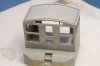
Spurred on by Jims, SW1500 and the forever time it's taking to upload all my files and backed up data onto the new PC I cleared the work bench (it had become a sort of dumping ground whilst I was doing CAD work) and set to the MP15DC.

As noted on Jim's thread I'm not overly happy with some aspects, primarily the big lump in the floor and Panzerplatten (armored tank plate) applied to the roof.

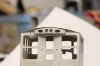
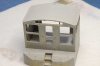
Cab rear
Img_7757a.jpg

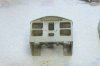
Cab front
Img_7760.jpg

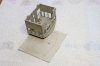
I whipped up a brass shim to mark the roof ready for cutting
Img_7765.jpg

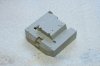
But before doing so decide to use some of Mr Kellogg's finest cardboard to mark out the shape for the new roof skin.
Img_7768.jpg

There are several lugs inside the roof area that held in the original glazing, these need trimming off as well, note slots in the wall for the glazing supports as well.
Img_7761.jpg

The four angled ones around the light bar molding remain as do the posts, the rest have been taken off.

Having prepped that part it was onto the cab floor and base, having decided to work upward and leave the cab roof until last to help prevent damage to the new roof skin.

The existing cab floor module
Img_7759.jpg

The trimmed cab floor module.
Img_7766.jpg

Next up is a new Plasticard cab floor and cab front bulkhead, some panels on the sides and backs to give a representation of 3D in there....and cover the ugly slots left by the glazing fixing points. I'm fairly sure the cab front is flat, but the model has the bonnet clipped to the cab in such a way that the bonnet protrudes inside the cab a couple of mm
Img_7770.jpg

The lip has already been partially damaged during destruction.....dis-assembly :rolleyes:
Img_7773.jpg

If I cut the lip flush then I'll loose the tight fit the cab has when it's all clipped together, having said that the bonnet is screwed quite firmly to the cast chassis, as is the cab base, it might work if it's trimmed back, problem is, if it does not, there's no going back, I shall ponder that as the PC chugs away adding more railway files to new hard drives.
 
Last edited:

Big Train James

Western Thunderer
I guess you have a couple of options for the cab to hood interface. You can remove all or part of the hood that forms a slot and captures the front cab wall and then glue the cab and hood together. The rear of the cab would still be clipped to the sub base, which is in turn screwed into the frame. The front of the cab would no longer be clipped to the back of the hood. Presuming the glue does its job though, the hood and cab would then be screwed into the frame. I can't say this is the worst idea, but it does limit flexibility in working on the cab interior somewhat.

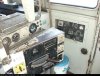
I think a better solution though is to leave it alone. From images I can find on the web, it appears that there may be some sort of electrical cabinet with a depth of 4-6" installed below the center windows at the front of the cab. If this is in fact true then I would rough in that cabinet with styrene, and use it as a shroud to cover the connection between cab and hood.
dscf2660.jpg
In the very top left of the photo you can see what appears to be a cabinet against the front wall. Here is a train sim version that would seem to corroborate this.
7953928_orig.jpg
I have no idea if that simulator image is accurate, but most of it looks good to my eye.

We are on the same page with all the other modifications you are suggesting, especially the roof. I also double checked the cab sub base "hump" against the location of the mounting pin for the rear truck. I don't see any clearance issues in there. I can only imagine that hump was necessitated by some sort of electronic board fitting underneath.

I can't wait to see how you handle the window glazing. I broke all of mine taking it out, but like most of the wall thickness in this casting, the windows were a scale +/-3" or so thick.

Jim
 
Last edited:

mickoo

Western Thunderer
Cheers Jim,

I can't access my railroad images at the moment as the hard drives are backing up, but I think the train sim image is a little suspect but for lack of detailed info, something similar will be required. I don't think there are raised floors under the seats, through a view through a front door might reveal more. I might have some images somewhere on the drives that might show a little more.

The control stand image is good as it confirms that you cannot walk around in front of it, like you could with the box model Atlas cab.

I was tempted with an open rear door, but the plastic is just too thick to make a decent frame around an open door, I'll have to leave that option for the etched metal kit later on.

I have a few ideas for the glazing, but essentially it'll go in once it has all been painted, I may add a very thin internal 0.005" Plasticard rim/ledge around the windows so that the glazing has something to butt up to when inserted, very fiddly but might be worth the effort.
 

mickoo

Western Thunderer
Not much progress due to PC rebuild and out today at Sudbury, but some progress none the less.

Ok, having stripped off the massively thick roof we're presented with another problem, I have confess, I didn't think this through until it was cut off, I knew there'd be a gap to fill but it didn't fully register how big it was or the potential issues it would throw up.

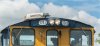
First off a look at the real deal
Image2.jpg

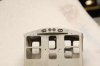
Of note here is the depth of the number board housing and the area above and below the light cluster, not very much. The housing is hard up against the roof and has minimal clearance above the rear access door.

The model
Img_7775.jpg

As can be seen there is a gap between the top of the number board and where the roof will sit, it's over 1 mm so quite a gap.

Img_7776.jpg

Without number board housing.
IMG_7777a.JPG

We can see the thickness of the roof....and where I slipped with the razor saw :rolleyes:

The number board from the rear
Image1.jpg

There are several ways around this problem, none of them perfect and none of them right, a case of choosing the right compromise.

If we just retain the number board housing as it is and trim a bit off the top of the housing we can move it up under the roof.
IMG_7780.JPG

And once fitted
IMG_7782.JPG

We can see that it leaves an overly large hole at the bottom, which can be filled but it places the housing above the wiper pivots. To compound this, when we add the glazing unit...
IMG_7783.JPG

..it protrudes higher then the cut housing, we could file this down but it would still give us an assembly too high, however, leaving the glazing alone the thickness pushes the assembly down a little.
IMG_7785.JPG

Not perfect but not too high either, the only choice now is to add a thin sliver of Plasticard above and below the number board assembly to 'fatten' it up so that it fits under the roof and reduces the gap to the cab door, that's the easy way.

The right, and much more complicated way is to re-profile the roof correctly, because of the thick roof used, Atlas have had to raise the centre to clear the number board assembly.
Img_7777a.jpg

The correct profile is in red and to achieve this we would have to remove the roof area in blue to leave just the walls and ends, then re-profile the ends from the green line (current) to the red (optimal) then insert the number board which will be the correct size and height.

This would be the right way but presents problems in how to fix the brass roof, there being very little wall top for the adhesive to adhere too and no where for the extra mechanical fixings to affix too.

Having already cut the number board to suit plan A then I'm halfway down that road, I'll temporarily add some 0.010" Plasticard top and bottom of the housing and offer it up and see what it looks like, if it really offends me then plan B will have to be invoked and I'll have to wrestle with the problems that throws up when I get too them.

I could I suppose make inner sides of brass that the roof solders too and drop that down inside the plastic shell, but, the side window pillars are very fine, so it'd be difficult to accomplish and wouldn't have a lot of strength in the risers to hold the roof down. Having said that, the sides are 1.85 mm thick so no reason to not drill a 0.8 mm hole and peg with associated wire soldered to the brass roof panel.
 
Last edited:

Dikitriki

Flying Squad
Mick,

Another alternative would be to fabricate an arced plastic card false roof that fits between the bulkheads/sides - bonded with plastic cement - and then glue the brass roof to that.

Richard
 

mickoo

Western Thunderer
Mick,

Another alternative would be to fabricate an arced plastic card false roof that fits between the bulkheads/sides - bonded with plastic cement - and then glue the brass roof to that.

Richard
Yup, good option :thumbs:

However, impetuous as I am, I did stick a piece of 0.010" Plasticard to the base of the cluster, let it set and began to trim, I'd used an overly average amount of EMA Plastic weld so that I got a fine bead squeezed out of the joint when pressed tight, however, during trimming the piece parted at one end :confused: a little tug and the whole piece came off :headbang:.

Going back to the cab floor, I picked at one corner thought to be securely stuck down, and it again started to peel off, clearly the glue isn't gluing. I've re-stuck the cab floor corner and a test piece of Plasticard to the old bit of floor cut off with Slaters MEK so we'll see what happens there.

Finally I do know that Cellulose thinners softens the Atlas plastic as I made that mistake when stripping the paint and briefly used that on some small parts (barely salvaged) but I've no idea what that'll do to the 0.010" Plasticard :eek: so a trial of that as an adhesive is also underway.

The point is, before cutting the roof off I'd better find an adhesive that bonds to the Atlas plastic first :thumbs:

A light sanding and the number board housing is none the worse for wear.

All the best

Mick
 
Last edited:

Jordan or Plymouth Mad

Mid-Western Thunderer
Blimey my head's beginning to hurt at the thought of the amount of thinking (if that makes sense) going in to all the US outline modelling going on here recently.... :confused:
Model Railroading is supposed to be fun, not hard work!!!
(biting tongue so I don't say leave all that to the S7 boys.... oh b*gg*r.... :) ;)
 

Big Train James

Western Thunderer
I must confess that at first I thought it your intention to remove the entire plastic cab roof and replace it with the brass version. At which point, reshaping the arc of the front and rear walls of the cab wouldn't have been too far a stretch. I guess it if thinning the edge of the roof is important - I think it is to both of us - then I still think that removing the entire cab roof and reshaping the walls is the way to go. In for a penny, in for a pound, right?

My question is similar to Richard's, except to add why does the roof need to be of brass at all. I believe you are planning on putting in a ceiling. Could you not cut styrene ribs, a la R/C plane wings, shaped to the correct curvature of the roof, and fit them in the interstitial space between the roof and cab ceiling? Then the entire assembly would function as a cap sitting down on top of the cab walls, perhaps with a rabbeted edge to fit just inside the walls and increase bonding surface area. Then the bond would be plastic to plastic, for which I would use MEK to finish the weld. Just thinking out loud here. You may have already considered all of these factors. Mind you, I've not tried to glue anything to the shell yet so I don't know if MEK will work. I have just always presumed it would be styrene to styrene, so MEK should do the trick.

I don't know what type of glue EMA plastic weld is. However, one of the conventions here for bonding plastic to metal is the use of Barge Cement. In a general way, it is a contact cement where you coat both sides, allow curing, and then press the two pieces together. It is frequently used to attach etch metal parts like roof walks to plastic models, where the difference in thermal expansion properties can lead to detachment of said metal parts. The barge cement maintains a degree of flexibility, so allows for some movement between the metal and substrate. It can also be used effectively to laminate metal and plastic sheets. Barge cement is a brand name available here in the states. There must be an equivalent for it available in the UK.

Frankly, I'm surprised you haven't just cranked out an etch for the entire cab above the battery boxes and called it a day. At one time I asked on another forum about the scale thickness of the Atlas cabs in relation to the prototype. The answer I got was that they weren't that far out of scale. But to my eye, the models look too thick, and the cab interior photo I posted clearly indicates that the cab walls aren't much thicker then the windows gasketed windows. The images you've posted of the spartan cab look much better if you ask me.

I shall have to look at these changes for my model as well. I was already concerned about the cab roof thickness. I'm sure it will continue to bother me until I just cave in and fix it.

Jim
 
Last edited:

AJC

Western Thunderer
It strikes me that - as a 4mm plastic basher - the nature of the problem is quite straight forward. I agree that replacing the roof wholesale is the way to go and that sheet metal is the right medium. Walls nearly 2mm thick as a surface area to accept an adhesive bond, from my perspective look very generous, but I would still seek a means of increasing the surface area and, preferably, taking it into more than one plane.

The simplest solution - which would have the benefit of providing positive location would be to curve some brass angle - 1mm would do, 2x1 if you're cautious - to match the roof arc, aligned inside the wall and to solder that across most of the internal width. You could then glue the whole thing in place quite happily, pinning if you see fit. Even with those big windows you'll never see it, but you would see a false ceiling.

Out of interest, how long did you leave the Plastic Weld (for Jim's benefit, this stuff: http://www.ema-models.co.uk/index.php/plastic-weld-cement-12x-57ml.html) joint? I'd regard that sort of thing as a leave alone for a minimum of two days in order to harden off properly. If I were in a hurry, I'd use cyano. Oh, and celly thinners will vapourise 10 thou'...

Adam
 

mickoo

Western Thunderer
Jordan,
Your a wicked man, stop poking the S7 brigade :cool:
I only want to modify three bits, but your right, it's begining to turn into a bit of a saga LOL.

Jim,
I came to that exact same conclusion last night, I'd of virtually done the artwork by now :rolleyes: Regarding the material, Plasticard is just too fragile I feel, it'd only take a glance with a sleeve or clumsy handling and a 0.010" Plasticard roof will just break.

Adam,
I didn't leave the number board cluster piece long to be fair, but the cab floor has been stuck down for a few days. I did try a quick MEK and celluose thinners test overnight, both held better than EMA, significantly better but both failed eventually with a firm tug. The Cellulose thinners were used on the cab floor which is two 0.025" laminated together so survived intact, but yes I think it'd just destroy 0.010".

Cyano is an option but I've heard that can fail too in time, it'd be ok for the cab floor I reckon. Loctite 460 will do but it's expensive and I'll be using a lot of it, it has a slightly flexible attribute which helps when stick different mediums and it worked really well sticking Plasticard webs to the A3 horn guides. The Atlas plastic is certainly quite resilient to most plastic adhesives it seems.

I like the idea of additional 'plane' surface areas and formed angle front and rear (or even just a plate ) soldered to the roof to give a tight fit would work really well, theres little room above the side windows for such an extension though.
 
Last edited:

mickoo

Western Thunderer
Mick, what about Butanone?
Richard,

I don't know, I've never had any or ever used it, if you (anyone) know a good quick reliable postage source I'll order some today right away :thumbs:

A quick web check shows Butanone is the same as MEK, is that the same as what Slaters sell? If so it sort of works but doesn't take much to part the materials.

The Plasticard cab floor laminate glued with EMA is a pretty good bond.

In all fairness, MEK would probably do if you were gluing a small detail to the Atlas plastic but large areas need something more robust I think.
 
Last edited:

Dikitriki

Flying Squad
Mick,

I use Butanone for track-making and bonding ABS. It is most definitely not the same as what Slater's sell as MEK, being a much stronger solvent.

Suppliers - Hobby Holidays, C&L.

Richard
 

mickoo

Western Thunderer
Much obliged, ordered :thumbs:

There's plenty to be getting on with before it arrives, not only the roof but I'd planned a Plasticard paper filter housing and radiator detail as well, all of which need to bond to the Atlas plastic and remain bonded long term.

I have to pop into Homebase later, we used to use an adhesive at my previous employment to bond plastic waste pipes, gutters and such like, I wonder if that is a trade derivative of Butanone ? Once that stuff bonds you'll never get the pipe fitting off! Might be worth a punt for a small tin, trade is generaly cheaper than hobbyist ;) Failing that I do need to redo some outside waste pipes so it wouldn't go to waste.

All the best

Mick
 
Last edited:

S-Club-7

Western Thunderer
The right, and much more complicated way is to re-profile the roof correctly, because of the thick roof used, Atlas have had to raise the centre to clear the number board assembly.
View attachment 46572

The correct profile is in red and to achieve this we would have to remove the roof area in blue to leave just the walls and ends, then re-profile the ends from the green line (current) to the red (optimal) then insert the number board which will be the correct size and height.

This would be the right way but presents problems in how to fix the brass roof, there being very little wall top for the adhesive to adhere too and no where for the extra mechanical fixings to affix too.

Why not ignore your blue line and just re-profile the entire roof? Whilst this may "break through" along the centre line there should be sufficient left to provide a large(-ish) area for glue etc.
 

mickoo

Western Thunderer
Why not ignore your blue line and just re-profile the entire roof? Whilst this may "break through" along the centre line there should be sufficient left to provide a large(-ish) area for glue etc.
David, I did initially think of doing that first, but almost instantly discounted it due to having to file a large area consistently and keep a reasonably uniform curve for the adhesive to bond to. It will almost certainly break through at the top, in fact, it is desirable as that is virtually the level required for the new profile :thumbs:
 

Big Train James

Western Thunderer
Well I struck out today. I tried to get permission from a local industrial switching company to access one of their sw1500's for photos and measurements as required. I was hoping for access to the cab and radiator section as they're the same for both of our projects. The answer was a negative as far as being allowed on the property or equipment. I can photograph to my heart's content from trackside where it is accessible from public areas.

I never thought I would say this, but I long for the 70's, even with the bad hair and fashion. You could do mostly what you pleased as long as you weren't stupid about it. And sometimes with invitation as well. Now under guise of security or liability concerns, I've been denied several times on information gathering efforts.:headbang:

Jim
 

Jordan or Plymouth Mad

Mid-Western Thunderer
I never thought I would say this, but I long for the 70's, even with the bad hair and fashion. You could do mostly what you pleased as long as you weren't stupid about it. And sometimes with invitation as well. Now under guise of security or liability concerns, I've been denied several times on information gathering efforts.:headbang:

Jim
Reminds me of a photo taken c.1980 by Steve Glischinski, published in Classic Trains a few years ago, of a Soo Line F-Unit on a turntable (possibly at Shoreham, memory fails me right now), & his caption comment was that he took the photo standing on top of a boxcar. The yard staff (visible in the photo) had simply waved at him & let him carry on.
I don't think things were ever that relaxed in the UK!!!
 

mickoo

Western Thunderer
Ok, taking the best answers from above I tackled the cab roof :thumbs: and proceeded to produce copious amounts of plastic swarf and general mess, this Atlas plastic is horrible and seems to have a nylon content in it.

Anyway, after much sweating, mess and general shouting the roof was filed to the new shape
IMG_7816.JPG

It didn't actually break through the crown which was a nice result, however as the top thinned it began to flex and deflect away from the file more than the thicker surrounds, so it took some care to get a uniform curvature, but get there it did. I also had to loose the sun shade moulding on the cab sides, they were pretty chunky anyway so not great loss.

With number board temporarily placed back in.
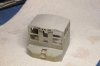
IMG_7817.JPG

IMG_7818.JPG

Perfect height and shape now.

Next step was the brass roof overlay, loosing the sun shade moulding was a double benefit and the choice to take it off was two fold, it was too chunky and was being damaged whilst filing close to the cab edge, it's removal therefore forced me to think of an alternative later on, until I decided to add it as a fold down to the roof skin, now the roof is attached on two planes, the roof and two fingers that form the sun shade fitting.
IMG_7819.JPG

There are very small lips either side that very slightly overhang the cab sides, not easily seen in the above, but when fitted
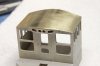
IMG_7820.JPG

IMG_7821.JPG

....can be seen overhanging the cab side front and rear of the sun shade fitting. They do need trimming a little before fnal fixing, but for a first pass everything is as planned.
Initially I was going to use some scrap L brass but suddenly remembered I had etched some sun shade rails for the EMD Spartan cab project and not used them, a quick rummage in that project box revealed two rails which were duly soldered on. I also had to loose the 'extra' flag holders, not an issue as many locos seem to be having these removed, usually when the side windows are plated over, but rule #1 applies here and I've taken them off anyway and kept the side windows.
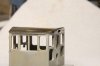
IMG_7825.JPG

The roof is only held on (gripped) by the sun shade fitting 'fingers' at the moment but hopefully some 460 on the roof and on these fingers will hold it all securely without the need to add additional mechanical fixings mentioned earlier, it's quite a tight grip even without adhesive and although it looks on the wonk above is quite square, the wonk being a bright highlight just noticed when uploading the image :rolleyes:

IMG_7822.JPG

The number board has slipped down a bit in this photo but does fit up under the roof and the small gap will go once the roof is pressed down and glued, as will the gash in the rear wall from the razor saw ;)

Also in the Spartan cab project box were two unused sun shades :thumbs:
IMG_7826.JPG

These will be soldered on near the end as they are only 0.005" thick and quite fragile.

Whats next? Well there's a couple of holes in the cab front to be filled where the original horns were fitted, then a couple of slabs of either 0.020" brass or Plasticard (probably brass, as I can then use the extra thickness to hold some rod passed through as staples to hold the roof....if required) to go on the roof as bases for the Winnebago AC units either side of the centre line, outboard of that I'm going to add some small 2 mm tube as bases for the orange beacons, not sure how best to replicate the lens on top, may just use a 1.8 mm LED with the top filed flat to replicate the lens.
Image2.jpg

This unit does not have AC units but does have horn insect covers, the photo does also show the cab front circular vent cover which I need to add and finally for the cab exterior an arm rest below the side windows and antenna / conduit plus mountings to suit.

I've no idea whether the orange roof beacons are strobes or rotating beacons, guess YouTube will answer that at some point, but looking at the shape and colour density I reckon they are strobes.

 
Top