
You are using an out of date browser. It may not display this or other websites correctly.
You should upgrade or use an alternative browser.
You should upgrade or use an alternative browser.
The Norwich & Mucklemouth Railway - Eastern Eccentricity in EM
- Thread starter Herb Garden
- Start date
-
- Tags
- 4mm scale em gauge ger pre-grouping


Herb Garden
Western Thunderer
Out of curiosity what's an air eraser?Supposing the paint is sound, how about an air eraser to remove the worst of the excess mechanically? Then re-prime over the newly-exposed flatter layer of paint.

RichardG
Western Thunderer
Out of curiosity what's an air eraser?
An air eraser is like a miniature sand blaster. The tool looks like an airbrush but uses an abrasive e.g. aluminium oxide grit instead of paint.
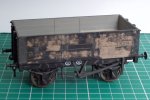
I used one on a Dapol wagon where I could not find a way to remove the printing and paint without fear of disolving or melting the plastic model, and adding more paint would round off the detail. The eraser is best used outdoors because the grit is quite unpleasant. I refinished this model a couple of times.
I suggest an air eraser because you can remove only layers of paint not the whole lot, to make something flat you can build up onto again. Maybe you could add weathering directly onto this new surface. Also if the model has been glued together, there are no chemicals involved to loosen the glue.


Herb Garden
Western Thunderer
Yes I am....
RichardG
Western Thunderer
Not at all. I post something, and you follow it up. Our posts balance each other out, and things are progressing their usual way


Lyndhurstman
Western Thunderer
Gawd. More things to tempt satisfaction of my tool fetish.. I'd never heard of these, either. Until now...Out of curiosity what's an air eraser?

Airbrush Air Eraser BARTSHARP Airbrush 178 - BartSharp Airbrush
BARTSHARP Airbrush 178 Airbrush Air Eraser Kit | Creating Weathering Effects On Models | Derusting | Mini Abrasive Gun | Glass Engraving FREE UK Shipping
 www.bartsharpairbrush.co.uk
Cheers
Jan

Rob R
Western Thunderer
Strip the 3F and start from a fresh pile of bits.
If I remember correctly, the kit was one of the K's "bodyline"? range designed for the then Wrenn R1 chassis.
You may have to do a bit of chopping to get a proper MR chassis under it, much easier to do before it is stuck together.
Have fun.
If I remember correctly, the kit was one of the K's "bodyline"? range designed for the then Wrenn R1 chassis.
You may have to do a bit of chopping to get a proper MR chassis under it, much easier to do before it is stuck together.
Have fun.
Herb Garden
Western Thunderer
Yeah Ive realised the Ks kit is tool long.... It's just the front footplate sticks out too much which should be easy enough.Strip the 3F and start from a fresh pile of bits.
If I remember correctly, the kit was one of the K's "bodyline"? range designed for the then Wrenn R1 chassis.
You may have to do a bit of chopping to get a proper MR chassis under it, much easier to do before it is stuck together.
Have fun.
Focus is on chassis at the moment anyhow
Herb Garden
Western Thunderer
So progress on 206 today
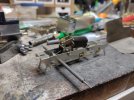
Gearbox is now complete

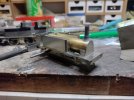
And the tidy up has started on the footplate.
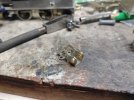
The third gearbox is coming together as well
Gearbox is now complete
And the tidy up has started on the footplate.
The third gearbox is coming together as well
Herb Garden
Western Thunderer
I seem to be on a roll which is probably quite healthy....
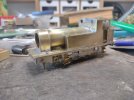
This morning I've finally (after building the parts last year) soldered together the body for the B32 essential to ensure the gearbox will fit.
Sadly I now have to stop modelling and start decorating.... It is a bank holiday weekend after all....
This morning I've finally (after building the parts last year) soldered together the body for the B32 essential to ensure the gearbox will fit.
Sadly I now have to stop modelling and start decorating.... It is a bank holiday weekend after all....

adrian
Flying Squad
Just a note of caution then. For plastic wagons and other items seems to work well however for thin sheet metal flat sides then the bead/shot blasting and peening effect can distort and place a pronounced bow in what was once a nice flat bit of panel work, like for example in a scratchbuilt tender, as I found out much to my chagrin.Gawd. More things to tempt satisfaction of my tool fetish.. I'd never heard of these, either. Until now...


Brian McKenzie
Western Thunderer
. . . however for thin sheet metal flat sides then the bead/shot blasting and peening effect can distort and place a pronounced bow in what was once a nice flat bit of panel work, like for example in a scratchbuilt tender, as I found out much to my chagrin.
To help prevent this, shot blast alternating between both sides - but obviously good access to interiors is necessary.
adrian
Flying Squad
It was extremely difficult to do on a completed tender.To help prevent this, shot blast alternating between both sides - but obviously good access to interiors is necessary.
No implication - that is exactly what is happening and being constrained by the inner side it bows outwards. That's why I said the bead blaster is peening the side.The implication is that your piece of metal, whist retaining its mass and volume, is getting thinner, and larger,
Brian McKenzie
Western Thunderer
No, can't agree with that SimonIndeed, but in response to Brian, it would not be better if you could blast both sides. Indeed, almost certainly worse.
 .
. Despite whatever you suggest is going on with the metal, several of us downunder use dedicated blasting cabinets and equipment for regularly cleaning up brass model assemblies, and soon learnt to blast both sides alternating quickly to avoid buckling - such as Adrian experienced. This is easier with larger scale models, but some pre-planning for access into small models is helpful.
I once made a mistake with a soldered nickel-silver lamination. Blasted both sides of the lamination, i.e. one side each of the two sheets - but when later unsoldered, the joint almost blew apart!
In my case, because I solder and silver-solder using gas torches most of the time, careful blasting helps restore rigidity and any loss of temper from such high temperature work.
Although not directly related, you might be interested in this:

simond
Western Thunderer
Thanks Brian,
I'm now confused. This is a regular occurrence.
so what is going on in the metal?
firstly, we’re talking thin stuff. Thick materials would presumably have enough stiffness to resist any surface effects. We can debate what “thin” means, but I’d submit that if the surface effects can overwhelm the form of the material, it’s thin. I guess that’s a bit circular as definitions go, but the best I can come up with at this moment.
for the material to buckle, I’m guessing that the blasting process has to introduce compressive stress perpendicular to the surface, and that will have the effect of trying to “spread out” the outer layer (make it thinner, but of bigger area), thus introducing compressive stress in the blasted surface, resisted by tensile stress in the remainder of the material hence shear stress across the thickness of the material. I can imagine that shear stress leading to buckling.
if you were to blast both sides, I suggest that the same process would happen on both sides. Perhaps, if the part gets bigger, because both surfaces are deformed, the layers in the middle will be stretched, it may end up that the stresses in the outer planes are close enough to equal, and the material does not buckle. I guess the actual deformations (in-plane and thickness) are microscopic.
Whilst the means are completely different, the effect seems to be akin to toughened glass where the rapid chilling of the outer layer (on both sides), followed by the slower cooling of the interior, leaves the outer layers in a state of (quite significant) compressive stress, balanced by the tensile stress in the inner body of the glass. This compressive stress prevents crack propagation, until a critical deformation/stress is reached, and then it turns to “sugar”. I recall a senior engineer at St Gobain Glass taking a very curved car window, placing it on the floor, removing his shoes and jumping up and down on it, and literally flattening the curve. An impressive demonstration of his faith in his product! (He had removed his shoes in case there was a bit of grit embedded in the sole, which might have been the source of the critical stress)
I do like the idea of restoring the temper/stiffness/rigidity of annealed parts by blasting.
thanks for the video, I’ll watch it later
cheers
Simon
I'm now confused. This is a regular occurrence.
so what is going on in the metal?
firstly, we’re talking thin stuff. Thick materials would presumably have enough stiffness to resist any surface effects. We can debate what “thin” means, but I’d submit that if the surface effects can overwhelm the form of the material, it’s thin. I guess that’s a bit circular as definitions go, but the best I can come up with at this moment.
for the material to buckle, I’m guessing that the blasting process has to introduce compressive stress perpendicular to the surface, and that will have the effect of trying to “spread out” the outer layer (make it thinner, but of bigger area), thus introducing compressive stress in the blasted surface, resisted by tensile stress in the remainder of the material hence shear stress across the thickness of the material. I can imagine that shear stress leading to buckling.
if you were to blast both sides, I suggest that the same process would happen on both sides. Perhaps, if the part gets bigger, because both surfaces are deformed, the layers in the middle will be stretched, it may end up that the stresses in the outer planes are close enough to equal, and the material does not buckle. I guess the actual deformations (in-plane and thickness) are microscopic.
Whilst the means are completely different, the effect seems to be akin to toughened glass where the rapid chilling of the outer layer (on both sides), followed by the slower cooling of the interior, leaves the outer layers in a state of (quite significant) compressive stress, balanced by the tensile stress in the inner body of the glass. This compressive stress prevents crack propagation, until a critical deformation/stress is reached, and then it turns to “sugar”. I recall a senior engineer at St Gobain Glass taking a very curved car window, placing it on the floor, removing his shoes and jumping up and down on it, and literally flattening the curve. An impressive demonstration of his faith in his product! (He had removed his shoes in case there was a bit of grit embedded in the sole, which might have been the source of the critical stress)
I do like the idea of restoring the temper/stiffness/rigidity of annealed parts by blasting.
thanks for the video, I’ll watch it later
cheers
Simon

Phil O
Western Thunderer
Hi Brian,
I would suggest that you try blasting some etch waste and try getting the pressure as low as possible. Low enough to clean up the job, without doing severe surface damage.
When we had some vent trunking shot blasted, was to cut the flanges off and use them as a template, due to excessive air pressure.
Some of the more experienced operators would look at the job and adjust the various settings according to their experience, novices would just crank everythingup to full and wreck it up completely.
I would suggest that you try blasting some etch waste and try getting the pressure as low as possible. Low enough to clean up the job, without doing severe surface damage.
When we had some vent trunking shot blasted, was to cut the flanges off and use them as a template, due to excessive air pressure.
Some of the more experienced operators would look at the job and adjust the various settings according to their experience, novices would just crank everythingup to full and wreck it up completely.
Brian McKenzie
Western Thunderer
. . . . I do like the idea of restoring the temper/stiffness/rigidity of annealed parts by blasting.
I don't know about the science of it, Simon. There will be those things you describe happening, but to help keep flat surfaces from distorting, carefully blast or peen both sides by swapping around during the process, so the forces even out.
Incidentally, I've watched panelbeaters remove dents by shrinking the steel, this by heating a small spot to dull red, then dumping a wet rag on it.

The old notion of blasting models to provide a 'key for paint', seems outdated now, but it's still useful for tidying some parts.
Cheers, Brian