Garden railway in 16mm: Wilmington Light Railway

Greengiant

Western Thunderer
I have been kicking around ideas for a garden line for a good few years now. During that time, various purchases have accumulated a large amount of track, a stack of steel roofing sheets and lengths of Filcris recycled plastic timbers in readiness. I will use this thread to document progress as and when it happens, but initially to bring it up to date.

I have operated on a number of ground level lines and quickly came of the view the ground is not for me, at least not in my flat garden. This railway has the focus on operation, majoring in the goods side of things. There will be indoor sections heavily industrial as well as radio controlled cranes and lorries to add to the fun. Think of it more as a conventional model railway that just happens to have most of it outside.

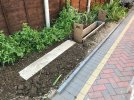
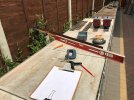
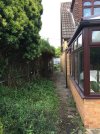
Back in 2017 we were having a new driveway installed, so we got the builders to continue along both sides of the house, which started to open up this side into a useful space. We had this bit of 'No man's land' down one side of the house, which as you can see, we have done nothing useful with it!
29619359028_0bc2d02649_c.jpg

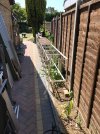
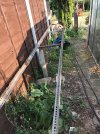
This soon cleared out to reveal a long triangle space to the left side, one foot wide at the tip, forty feet along widens out to about four feet.

29619361678_9a382dac67_c.jpg

Luckily our neighbours had their fence replaced, this gave me a good excuse to remove some of the shrubbery, but not all.

29619363128_de256b5ab6_c.jpg

With this as a start point, a basic track layout idea was penciled out. This initial long triangle forms Stage 1, with Stages 2, 3, 4 and 5 to follow, this then will give an out and back run of just over 300 feet. An emphasis of the line will be for operation although there will may be a roundy roundy bit in front of the main workshop when just sitting back and watching trains go by is required. Later on the plan evolves a little as thoughts change.

28603734627_acfec1fa91_c.jpg

Martin
 

David B

Western Thunderer
Looking forward to seeing this develop Martin - the plan looks full of interest and opportunity. A specific focus on operation will be interesting in a garden context. I am also interested to hear how you get on with the Filcris plastic timbers…and the radio controlled cranes and lorries sound great - I’ve loved each creation that @Giles has created to bring life to his industrial scenes, and I’m intrigued to see your large scale counterparts.
 

simond

Western Thunderer
Don’t want to be a prophet of doom, but I’d be wary of the Filcris, my late pal, John Matthews used it, and suffered horrendous thermal expansion issues.

He ended up cutting long planks intended to be laid lengthwise, into short planks which were then laid crosswise on wooden bearers.

hth
Simon
 

Greengiant

Western Thunderer
Looking forward to seeing this develop Martin - the plan looks full of interest and opportunity. A specific focus on operation will be interesting in a garden context. I am also interested to hear how you get on with the Filcris plastic timbers…and the radio controlled cranes and lorries sound great - I’ve loved each creation that @Giles has created to bring life to his industrial scenes, and I’m intrigued to see your large scale counterparts.
It will take me a while to bring the thread up to date. The Filcris so far has been used as a path edging only. A friend had built a part of his layout with Filcris, but ended up ripping it all out, too many problems with expansion and contraction. Some pieces I have left out for storage has twisted badly. I will not be using it for the railway surface as will become apparent.

Martin
 

Greengiant

Western Thunderer
Don’t want to be a prophet of doom, but I’d be wary of the Filcris, my late pal, John Matthews used it, and suffered horrendous thermal expansion issues.

He ended up cutting long planks intended to be laid lengthwise, into short planks which were then laid crosswise on wooden bearers.

hth
Simon
Simon,
I won't be using it for the layout itself for the reasons you have stated.

Martin
 

Greengiant

Western Thunderer
Track level is 29–34 inches above ground, depending on where you are along the line. The line is supported by metal in one way or another, I did not want to use timber. It was also helped by the fact I got a lot of metal for little or no money, always a great help.

Stage 1 was mainly supported by old greenhouse staging, donated from my Dad's old greenhouses. To support this, one side of legs sits on block paving, the other side sits on cast concrete bases.

Here is a cast block and shuttering for the next block.

42706093884_77f59e078f_c.jpg

A few days later there appeared some more cast blocks and the start of the greenhouse staging being put in place.

42706095514_e98d0716aa_c.jpg

Then later, then rest of the staging. A lot of this I was making up as I went along!

42518123265_fa804ac051_c.jpg

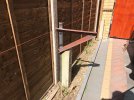
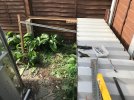
I ran out of staging before getting to the tip of the triangle, fortunately there are some concrete posts leftover from the netting frame that used to be there, so I welded up some steel angle support brackets which are then bolted to the posts. You will see I am not the greatest welder but it does for this project. The very tip is supported by a piece of Dexion screwed to the gate post.

28552720007_d00a75eba1_c.jpg

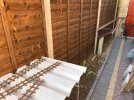
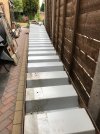
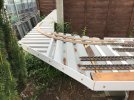
This then enabled me to bolt on some front and back Dexion angle which will support the upturned roofing sheet. The upturned roofing sheet forms the main railway support structure, giving a flat, rigid and light surface support.

28552721467_8ef44646b6_c.jpg

The roofing sheet was cut with a metal cutting disk in an angle grinder, this job is best done when the neighbours have gone out!

29551863338_be06179036_c.jpg

The staging has various tops and slightly different leg heights, so the legs were all cut to the same height rather than use different size packing pieces. The tops will give extra support to the roofing sheets.

42518124055_8a3c611ed2_c.jpg

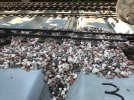
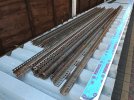
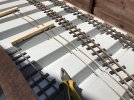
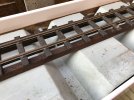
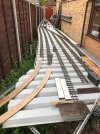
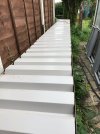
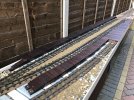
This shows how the track will be laid and how it helps align up track of different construction. I have a mix of hand built wooden sleeper track, Peco and Tenmille plastic sleeper track, I bought batches of track when they came up for sale at the right price over many years, hence the variety, yes it would be nice to have all of one type but it is just how it happened. As you will see in this picture, with the roofing sheet used upside down it gives large flat areas to support the track and small drainage gulleys to take away the rain water.

43375006312_6b9e68c467_c.jpg

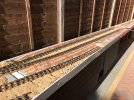
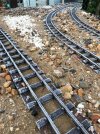
When covered with loose ballast it becomes harder to tell the various types of track apart. Keeping the ballast loose makes it easier to make changes to track layout if required at a later date. Although this method changed later in the build as things evolved.

43375007392_06196c140b_c.jpg

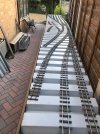
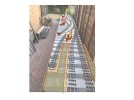
Here, most of the roofing sheet has been cut and placed in position. The foreground bit is just under 18 inches wide with another 6 foot behind the camera, while at the far end it goes out to just under 3.5 feet wide, the tree is about 40 feet away from this point.

29551867118_f0ef0ddbeb_c.jpg

This is the far end where the line turns through 90 degrees to go along the fence for about 18 feet past the greenhouse then will do a 90 degree left past the end of the greenhouse and work it ways up the garden. Luckily, here there were more redundant concrete posts to which I bolted brackets made from Dexion. The curved pieces of ply are templates of 5 foot radius so I can check out alignments as the line progresses. It is here I may have to build a large curved point, this is where the main line divides before approaching the goods yard and station.

42956166384_0ecc6a7b7b_c.jpg

I was surprised to get to do the greenhouse section because I had run out of Dexion. My supply was the old layout supports of a large loft layout I built with my Dad over 40 years ago, which Dad kept in his shed when the layout was broken up. Some other bits were given to me by my friend Ken, who had some spare. So I went onto Ebay to get some more, only to be shocked at the prices for this stuff now :(

While on Facebook I had a look on the Market Place section and searched Dexion, up came a secondhand job lot of 275 feet for £25, only problem it was over 80 miles away, luckily Ken was going to be within 15 miles from the location while on a business trip, so he was able to collect it in his truck. When he came back I was pleasantly surprised that not only was it the Dexion angle, there were over 50 of the 90 degree corner plates and 20 of the feet along with a large bucket of the correct size nuts and bolts.

This is the angle that I bought, the longest lengths are 10 feet.

42956165074_941cb91ee5_c.jpg

Martin
 

Greengiant

Western Thunderer
A few mates popped round and we roughed out a track plan. This changed later in the build.

43375011262_18e069bf68_c.jpg

With the good weather at the time (July 2018), advantage was taken of this, track was cut, pre curved and positioned to match.

A rail bender is a very useful tool, the downside of secondhand track is the slight difficulty removing the sleeper sections, natural weathering puts a coating on the rail and gives resistance to easy sliding off of the sleepers. Time was spent easing off the sleepers in smaller blocks and then cleaning the rail up to make refitting the sleepers a lot easier. A later found spraying with WD40 is a great help with taking track apart.

28783945297_397583801e_c.jpg

I knocked up a couple of track spacing jigs from some scrap wood, these give a track spacing of six inches which gives ample clearance for the widest stock.

42996011314_cacf63c824_c.jpg

Here I am curving the rails which lead into the engine shed area from the kick back siding.

42996016344_ff3662227c_c.jpg

I use a small mirror to help with eying the curves and checking track flow, this also enables views along the track that in some instances may not be physically possible to get a normal view.

42996014204_6e9ac8bfaf_c.jpg

Checked again with one rail forming half track, quite happy with the flow of the track here now.

42996017464_93e40f3c03_c.jpg

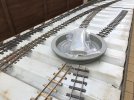
This shows the curved track from the other end and the location of the turntable, which will be moved slightly, after subsequent laying of the goods yard gave more spare room than originally expected.

42996020534_769d81dc6a_c.jpg

A view from the station end. I cannot get the loop as aligned as I would like yet until the main line is fixed down, then I can trim the loop to fit better. With the very hot weather I need to let the track cool and settle down to a more normal state, then check rail gaps.

42996023344_5e52a87fd8_c.jpg

Now we are half way along the station platforms with the bay platform siding on the left, behind that is the kick back siding to the engine shed, the kick back siding will also be used as a head shunt for the goods yard.

41903436650_c99c528ed6_c.jpg

Here we are at the goods yard end, the line on the far left is the main line, next to that is a passing/holding loop for the main line, to the right of that is a goods yard loop which at the camera end leads to the goods shed, the loop itself is to receive a goods train for marshalling and the same road for assembling a goods train. To the far right are three sidings, currently not at their full length, for marshalling the wagons.

42996021924_71165b9e2c_c.jpg

It was a good excuse to run a loco over the whole track, pleased to say it ran well. Next time I will get some stock out and try some train movements.

41903446630_5a0451a768_c.jpg

Martin
 

Greengiant

Western Thunderer
I have sketched in the proposed rough positions for a goods shed and a cattle dock. These changed later on.

28948757477_6b833143c1_c.jpg

Platforms, signal box, turntable and engine shed now make an appearance, again some of this changes later.

43837234462_eae7d39e79_c.jpg

I had a package arrive, 16 x 5m lengths of UPVC architrave trim, 6mm x 90mm in profile, this will form the front and back edges of the track bed. The amount is more than I need, but over a certain amount delivery was free, I had an amount to pay anyway, so had the extra as the trim, I am sure I will find a use for it, platforms sprang to mind!
I bought this in white, a decision I was later to regret!

28948760017_6d9881b5df_c.jpg

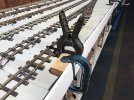
It was a bit unwieldy to pick up and manoeuvre on my own, but various blocks clamped to the layout helped with guiding and holding in place while fixing holes were drilled and nuts and bolts added. The blocks were cut also as height guides for the positioning of the trim, it purpose is really only to stop the ballast falling off the edge and to hide the Dexion framework from view.

28948762527_034e75b808_c.jpg

28948761057_26f447f6e6_c.jpg

Finishes it off rather neatly, although maybe I should have paid extra and gone for brown (or black), only time will tell (it did). If all else fails I can always spray it another colour (I obviously could see to the future!).

28948766477_1dfcd8ec5e_c.jpg

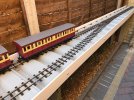
A view looking in the other direction. The train of coaches in the foreground is seven feet long, this will be the standard for the longest train plus loco for the line.

28948768217_aa9a36a01a_c.jpg

Next job is to cut some hardwood strips for the track to be fixed to, these will also need to be dipped in creosote. A couple of years ago my Mum had the hardwood windows replaced in her bungalow, I asked the window fitter to leave the timber of the frames to one side and I will collect them. Since then a friend of mine has also given me his hardwood frames that were replaced, the window fitter also came up with some larger bits when he replaced patio doors. I check them all for nails and screws, then true them up with a thicknesser planer before putting them through a bench saw.

28948756647_800778e933_c.jpg

I need to source something to hide the underside, originally I came across someone on FB Marketplace selling job lots of 100 x two foot lengths of shiplap for £45, I should have grabbed them while I could, a few days later they had gone, you snooze you lose!

Martin
 

Greengiant

Western Thunderer
I have cut up lots of hardwood into 10mm x 10mm strips, these will be dipped in creosote and used for the track supports.

43148246655_ba62fb0457_c.jpg

Had a result with the shiplap, the seller on FB had another batch, a different size, but enough to make all the panels needed. So I had a session painting this before assembly, this way if the timber shrinks it won't show an unpainted strip.

43148247405_b3f620b54a_c.jpg

A couple of days in the workshop had all the panels made, they just hook onto the staging framework underneath using upside down double picture hooks, but I now need to fit some grab handles so it is easier to lift out individual panels, when butted up there is nothing to grip, doh! At least it neatens up the support structure. I have also now restored the bench in the photo.

29282673817_ec1d88af51_c.jpg

29282675337_8f78e7fb2b_c.jpg

Martin
 

Greengiant

Western Thunderer
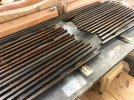
Well, the track support timbers I cut up were not enough, so had to do some more and creosote.

44211794682_3d939b3031_c.jpg

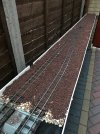
I have started screwing down the battening and fixing the track to said battening.

44445998682_c516d11021_c.jpg

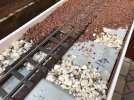
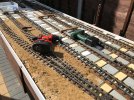
I bought some small size grit which maybe a bit too red, Jury is out on this one (it got changed later in the build), but impatience forced me to try some out. What was apparent is how much gets swallowed up by the channels, luckily I had some bags of larger stone which for further along the line I pre-filled with this to take up some of the volume.

44446000802_af97143ef5_c.jpg

44446002602_34e37e2fdf_c.jpg

44446006222_9569ff492c_c.jpg

What is interesting is the huge reduction in running noise when trains pass over the ballasted section.

Here I have got as far as the goods yard and engine shed headshunt. In the background is the bay platform road.

44446008062_463f379182_c.jpg

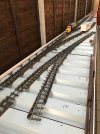
Looking in the other direction the main line and loop are now done as far as they can be until I get some more roof cladding sheet. The row of points forming the goods yard are now being done.

44446011662_29d6ea51e9_c.jpg

Looking back along the whole of this section. The curved plywood templates is where originally thoughts were for a custom built set of two curved points, but by moving a crossover further away from the camera and the initial entry point to this section now moved off to the bottom left of the photograph I can get away with two standard points, which made more sense considering I have them in stock. The plank of wood next to the radio is representing the cattle dock, the two sidings to the left have been shortened, the long siding in the middle will now curve and be extended, this is where the goods shed will be located. Now I will have some space around the goods shed for approach roads and vehicles.

44446012702_e790bd1886_c.jpg

I have been thinking about using strips of Cellotex foam to fill up some of the channels, but then I remembered I had a cubic yard of sand ballast at the end of the garden leftover from an over order when building a shed base!

Martin
 

Greengiant

Western Thunderer
In the end I went for a combination of foam infills, covered with a base layer of sand, topped off with ballast stones. Some of this will change again later in the build.

43669749965_bfc6933567_c.jpg

44602857322_030c0d622e_c.jpg

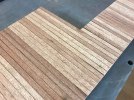
Work has started on the station platforms, this meant a session on the bench saw cutting platform supports and planking strips for the platform surface from old hardwood window frames.

44652898531_3bc86729a3_c.jpg

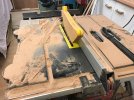
Cutting hardwood does produce a lot of dust! I must get around to fitting up the dust extractor.

44652899891_b6dbc3ae0e_c.jpg

I made up a platform gauge for setting the faces and board planking at the correct distance.

29808558537_b86b496447_c.jpg

All of the platform support work in position, way over engineered but there is method in my madness, I think!

29808559307_cdc1a1329f_c.jpg

29808560737_97c38a77e5_c.jpg

In the meantime some more steel roofing sheet has arrived, which means a start of the greenhouse curve can start.

30782455048_7acd67e149_c.jpg

The Dexion framework was put up in the usual way.

43837112585_a0e3b2836e_c.jpg

43837116695_572a61db7c_c.jpg

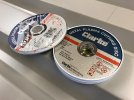
I had run out of cutting disks for the steel sheet so tried some of these disks, they are great, cuts the sheet like a hot knife through butter, better than the ones I was using.

44027303934_0ac254f2c1_c.jpg

It did not take long to round the curve and finish the straight.

44027308054_46dac18a60_c.jpg

44027310744_4124963e7e_c.jpg

A start has been made on the next bend round the back of the greenhouse, you can just make out the route of the mainline by the two blue lines. The leg at the end is only temporary, it will be replaced by a scaffold pole concreted into the ground which will support one end of the enclosed bridge that will be here (oh no it won't!), I just need to take down the washing line pole we have not used in 11 years to make the scaffold support, but that work is on hold, we are dog sitting my daughter's two Staffs this week and they get into everything, so concreting is not an option at the moment.

44027312514_a2bcafd402_c.jpg

I have run out of timber track support strips, so need to cut some more of those.

Martin
 

Greengiant

Western Thunderer
Hello Martin
Is the yellow shunter in the 6th photo post 10 an very old Triang BIG_BIG train?

Regards
Allen
Hi Allen,
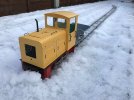
No, it is the one GRS released a few years ago that you could get with a set of skips, all made in brass, lovely models. My friend changed the motor in mine and fitted RC with sound. It is a lovely slow runner.
Martin
 

Greengiant

Western Thunderer
Is there provision for drainage? I can't help thinking that a few good downpours of rain are going to play havoc with loose ballast like that?
Drainage is fine, the troughs take the water and it runs off the ends. Although, as will become clear later, the loose ballast did have some issues, not all weather based, which I had to resolve. The whole build has not been without its problems which usually get fixed, hopefully!

Martin
 

Greengiant

Western Thunderer
Four months later...

Not a vast amount has happened with the garden line, apart from the greenhouse curve has now been laid and an opportunity to have a quick steam up on Christmas day (2019) came about.

45995470485_bb30c22353_c.jpg

39945191713_b16d9b1e84_c.jpg

46185085664_ed6cd2127c_c.jpg

Next project to do on the line involves some earthworks and the installation of supports for the 6 foot long covered rail bridge (that didn't happen), this will complete the negotiating of the greenhouse section. Once this is done then the next 30 foot of track can be laid up the garden to reach the next station. I still have a 3 foot girder a bridge and a 5 foot (later to become 10 foot) trestle bridge to fit in somewhere further up the line once the next station has been reached.

Martin
 

Greengiant

Western Thunderer
Back to the station platforms. These were built from hardwood rescued from old window frames from my Mother's house when she had the windows upgraded.

The basic platform supports were made including a bay platform facility.

50463756866_a5aec12af9_c.jpg

The thinner window trim bits were cut on a bandsaw to create the platform surface planks.

50463756811_b0a0883955_c.jpg

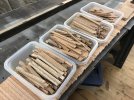
After a while a good selection of planks were available.

50463922162_393b6ba165_c.jpg

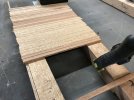
These were glued onto the frames with enough overhang that will be trued up later.

50463921767_87f07d60a9_c.jpg

The bay platform trimmed up.

50463062093_8d1f741fd4_c.jpg

Then treated with creosote.

50463062048_34b97e33ac_c.jpg

Here being installed, September.

50463758311_fbf66dcae8_c.jpg

Martin
 
Top