Sir Lamiel’s 777 Quest - A Scale7 Micro Layout Challenge

adrian

Flying Squad
In 7mm, a B7 turnout is c22" long, with double track requiring platform faces c6" apart, an island platform is going to be c4" wide. A small loco is c9" long while a decent passenger tender loco will be c18" long.
7mm scale is big and you're not going to get much in 7sq ft. That's why it's called a challenge!

Absolutely, Dave.

But key here was the phrase ‘selective compression’.

I can see how your proposal could work - but as you say it requires selective compression. The amusing thing I find with the challenge is that you're asking Scale7 modellers to compromise, a group that has an advertising banner line of "Why Compromise". :oops:

Personally I've never really done "challenges" nor understood why they always have to be size related instead of some other parameter or component, but fortunately in this case the 7sq ft. limit is tight enough to stop me launching into yet another project. Still it was a nice evening spent pondering on what could be possible. The one I thought I'd perhaps consider is "Maudland Curve" just North of Preston Station.

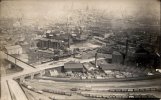
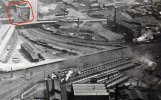
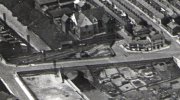
The area circled in the photo below. The photo is looking East so the tracks on the right are the northern approaches to Preston station. The lines curving of bottom left corner are the tracks to the Fylde and Blackpool. The line off to the left is the WCML to Lancaster, Shap and Scotland. In the middle of the photo is the Maudland Station Goods yard, the lines to the left of the good shed in the early days of the railways in Preston actually crossed over the Lancaster lines and joined up with the Blackpool (Preston & Wyre) lines.

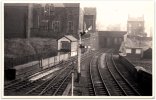
The top of the photo the lines drop into a tunnel and it's the branchline to Longridge or at Grimsargh change for Whittingham Hospital a.k.a. Hospital Gates.
maudland2.jpeg


maudland1.jpeg

maudland8.jpeg
maudland5.jpeg
maudland3.jpeg

"Fortunately" using the Scottish archive maps even this small diorama exceeds the Challenge being in the region of 6'x2' - just the trackbed would exceed the size limits, so more than happy to shelve this as another "virtual" project.
 

Tim Birch

Western Thunderer
I can see how your proposal could work - but as you say it requires selective compression. The amusing thing I find with the challenge is that you're asking Scale7 modellers to compromise, a group that has an advertising banner line of "Why Compromise". :oops:

Personally I've never really done "challenges" nor understood why they always have to be size related instead of some other parameter or component, but fortunately in this case the 7sq ft. limit is tight enough to stop me launching into yet another project. Still it was a nice evening spent pondering on what could be possible. The one I thought I'd perhaps consider is "Maudland Curve" just North of Preston Station.

The area circled in the photo below. The photo is looking East so the tracks on the right are the northern approaches to Preston station. The lines curving of bottom left corner are the tracks to the Fylde and Blackpool. The line off to the left is the WCML to Lancaster, Shap and Scotland. In the middle of the photo is the Maudland Station Goods yard, the lines to the left of the good shed in the early days of the railways in Preston actually crossed over the Lancaster lines and joined up with the Blackpool (Preston & Wyre) lines.

The top of the photo the lines drop into a tunnel and it's the branchline to Longridge or at Grimsargh change for Whittingham Hospital a.k.a. Hospital Gates.
View attachment 253679


View attachment 253684

View attachment 253682
View attachment 253687
View attachment 253681

"Fortunately" using the Scottish archive maps even this small diorama exceeds the Challenge being in the region of 6'x2' - just the trackbed would exceed the size limits, so more than happy to shelve this as another "virtual" project.
Why did I read this thread? It has given me some thoughts about a layout! The Longridge branch leading off from Maudland certainly has potential. This recent book might encourage someone to try it.
 

coal tank

Western Thunderer
I can see how your proposal could work - but as you say it requires selective compression. The amusing thing I find with the challenge is that you're asking Scale7 modellers to compromise, a group that has an advertising banner line of "Why Compromise". :oops:

Personally I've never really done "challenges" nor understood why they always have to be size related instead of some other parameter or component, but fortunately in this case the 7sq ft. limit is tight enough to stop me launching into yet another project. Still it was a nice evening spent pondering on what could be possible. The one I thought I'd perhaps consider is "Maudland Curve" just North of Preston Station.

The area circled in the photo below. The photo is looking East so the tracks on the right are the northern approaches to Preston station. The lines curving of bottom left corner are the tracks to the Fylde and Blackpool. The line off to the left is the WCML to Lancaster, Shap and Scotland. In the middle of the photo is the Maudland Station Goods yard, the lines to the left of the good shed in the early days of the railways in Preston actually crossed over the Lancaster lines and joined up with the Blackpool (Preston & Wyre) lines.

The top of the photo the lines drop into a tunnel and it's the branchline to Longridge or at Grimsargh change for Whittingham Hospital a.k.a. Hospital Gates.
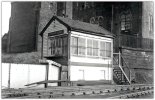
View attachment 253679


View attachment 253684

View attachment 253682
View attachment 253687
View attachment 253681

"Fortunately" using the Scottish archive maps even this small diorama exceeds the Challenge being in the region of 6'x2' - just the trackbed would exceed the size limits, so more than happy to shelve this as another "virtual" project.
Adrian, the middle photo is quite inspiring.
John
 

daifly

Western Thunderer
I’m planning to use 2 x 900x400mm boards giving 1800mm length and scenically cropped to 361.2896mm depth!

Dave
I ordered the baseboard kits on 14th December and in spite of my request not to send them until I got back from my holiday today, Grainge & Hodder despatched them in error on 5th February. I managed to talk with the Parcelforce delivery man from my holiday hotel in the Caribbean via my Ring doorbell and got the redelivery organised for today.
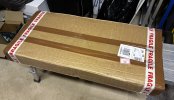
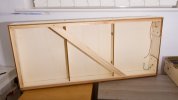
A box full of of anticipation:
Box.jpg

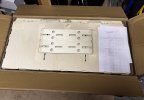
Contents and instructions. Now where's my glue?
Contents.jpg
There are actually 4x 900mm baseboards in the box - there's no limit on non-scenic area so there will be a 900 x 400mm fiddle yard at each end.

Dave
 

daifly

Western Thunderer
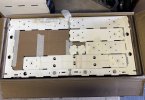
I dug down deeper into the box today.

IMG_4591.jpg
The impressive packing continued for perhaps 15 or so layers. Massive amounts of masking tape to hold everything in place.

A dry run showed that:
  • everything fits beautifully.
  • the instructions are pretty awful.
  • there are a lot of unexplained small holes.
  • more hands than I'm blessed with would be helpful
  • masking tape will be useful to hold bits in position whilst the glue dries.
  • the end result will be very light and, hopefully, square and sturdy.
An attempted assembly showed that several of my bottles of wood glue had deteriorated since they were last used but a bottle of Titebond was found to be adequately fluid to be applied where needed. I shall see in the morning if it lives up to its name. Photos later if the results are not too awful.

Dave
 

RichardG

Western Thunderer
  • more hands than I'm blessed with would be helpful
  • masking tape will be useful to hold bits in position whilst the glue dries.

I'm not sure about the usefulness of masking tape. I put panel pins at every joint as I put my modules together. The main thing is to assemble the frame on a flat surface. For me this is the living room floor, so plenty of newspapers over the carpet.

DSC_8060.jpeg
Adding a diagonal (and reinforcing the bottoms of the sides) has reduced the willingness of the module to twist.
 

RichardG

Western Thunderer
Dave I can see the front panel of the board is missing. Are you going to lop down the scenic boards to give you the 3.5 square feet on each one? This will leave a modest overhang on the pelmet, so the lighting can sit in front of the model.
 

daifly

Western Thunderer
No. It's just the assembly sequence for this type of board. I'm not doing any woodworking save to add a false vertical back panel to the module to reduce the 395mm depth to 361mm to comply with the area requirement. ((900mm + 900mm) x 361mm = 7sq ft). The false back could always be removed if the boards are reused.
 

daifly

Western Thunderer
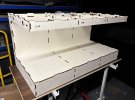
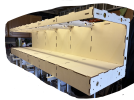
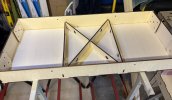
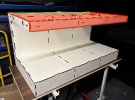
The first board is pretty well complete now. The instructions tell you to fit the horizontal triangular corner braces at the top rear at this stage! It's a geometric impossibility so a little surgery was required to allow the braces to be inserted. The top flat panel (not shown in this photo) will be made removeable rather than gluing into place. This will allow easy access from above during construction.

The top front rail is just placed in position. I was debating whether to fit it before completing the construction but because I ignored the instruction to fit and glue it in position I shall be able to add the braces at the same time as fitting the front rail. I've now decided to fit the front rail as those fore-and-aft frames will be much too vulnerable to breakage without being braced and tied together.
IMG_4600.jpg
It's very light but rigid and sturdy. One more like this to assemble starting tomorrow plus two more 900 x 400mm boards to build which will be for the fiddle yards.

Dave
 

daifly

Western Thunderer
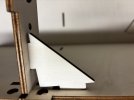
This is the problem with fitting the corner braces afterwards as the instructions say:
IMG_4606.jpg
You cannot insert both tongues simultaneously.

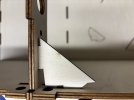
My solution:
IMG_4605.jpg
This allows the brace to be inserted into both parts of the frame at the same time. Add glue and the job's a good'un! The subterfuge is hidden at the back of the framing.

Dave
 
Last edited:

Yorkshire Dave

Western Thunderer
It's very light but rigid and sturdy.

How light, kg?

What are these built from - looks like Dreadnought belt armour :). Given the number of lightweight products around today I just don't understand why baseboards have to be built to withstand earthquakes and why we haven't borrowed from aircraft construction design.
I recall a visit to the then Monarch Airlines maintenance hanger at Luton many, many years ago and were invited to lift an aircraft (either an Airbus or Boeing) wing to which we all said no way. But sure enough it was possible to lift the wing from one end.

Anyway, this baseboard lends itself to adaptation to make things a bit easier.

Bracing - rather than use the front fascia perhaps a length of either suitable dowel rod or threaded rod could be inserted to the holes in the roof brackets.

baseboard 1.jpg

Which would allow the roof and fascia to be hinged at the rear to provide top down access at all times. The 'lid' could then be held open with small automotive gas struts.

baseboard.jpg
 

daifly

Western Thunderer
Dave, the board as pictured weighs 2.9kg. The missing top panel adds about another 0.8kg. A rigid baseboard at a shade over 8lbs is a great result.

Yes, the modifications you suggest are possible, but possibly at the price of rigidity. The entire thing is built from 5.5mm plywood and glue and, importantly for me, requires no great skill to construct!

Board number 2 is well on the way to being finished.

Dave

edit for update!
 
Last edited:

daifly

Western Thunderer
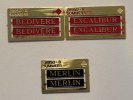
Ordered from Narrow Planet/Custom Nameplate Studio/Light Railway Stores on the 14th December, the same day as the baseboard kits, and with artwork approved on 1st February, these arrived today. Two of them have locos awaiting names and the third might one day be added to an Andrew Barclay Fireless. Dan?;) :D

IMG_4757.jpg

Dave
 
Last edited:

daifly

Western Thunderer
The two scenic boards have just about been finished and the pattern makers dowels aligners fitted and everything aligns! That's a testament mostly to the accuracy and relative ease of assembly designed in rather than any skill on the part of the assembler.
IMG_4758.png
Next job is to layout the Templot plan that I've designed and printed and to take a good look at it to see if it meets my intentions.

Dave
 

daifly

Western Thunderer
The 2 fiddleyard boards (900 x 400mm) have been assembled, the brass pattern makers dowels fitted and the legs glued and screwed.
IMG_5067.jpg
So here's the 'layout' in its entirety. 4 x 900mm long boards. I've cut a sheet of 5mm ply 900 x 610mm longitudinally into two pieces to create the false back seen here where they're just placed in position. The visible section of the scenic board is 395mm deep but I need to restrict that depth to 361mm to comply with the 7 sq ft restriction. A few packers c30mm deep behind the false back will help to keep everything in place.

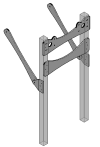
The legs are sold as kits lacking the vertical 35x35mm bits but the braces, brackets etc. are a joy to work with and have accurate etched holes for the screws, bolts etc. I positioned the cross-braces much closer to the floor than shown here. Contents of the kit are in the darker colour here:

2d6ff0_89d7c14ac6c9494d9dffcc0e20f3fd71~mv2.png.png

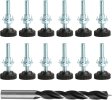
I also used these (from Amazon) to give adjustment of the legs.
71ZVXiDbIML._AC_SL1500_.jpg

I had originally planned to use a couple of the steel stands to support the centre of the layout but they're bulky and heavy and it needs at least three of them to give effective support in the centre of the layout so I've just ordered another 3 G&H laser cut leg kits to avoid using the steel stands.

In spite of the lightness, the boards seem very strong and have no tendency to twist as I added the supplied X-braces which were attached with copious quantities of Gorilla glue and weighted down inverted on a flat surface while the glue went off.
IMG_4957.jpg
I also have X-braces for the two scenic boards but won't fit them until the position of point motors etc. is finally established.

A minor revision to the trackplan has been made so I think I'm getting close to trackbuilding next! I'll show the trackplan next time.

Dave
 
Top