Dan
The photo of Cadbury castle is in "The book of the castle 4-6-0 s by Ian Sixsmith on page 316 and by the looks of it the plates supplied in the kit are the correct size.
A little progress a few days ago, saw the front drop footplate section fitted. It really didn't seem worth posting a picture at the time, but with further progress today, I thought I'd post one now....
(Please excuse the debris - it's fallout from today's activity with a carborundum disc!). The casting for the inside cylinders doesn't seem quite right to me - photographic evidence suggests that the front and top surfaces should be at 90 degrees to each other, but they're more like 92 degrees. Unfortunately, I didn't really notice until after I'd cleaned it up.....
The smokebox saddle is a two-piece affair, with the front part sitting on two prongs sprouting forwards from the rear part, of which there are two versions. My Castle has the later straight frames, but the other version caters for the earlier joggled frames, if required. The castings are pretty poor to be honest and the top edges that support the smokebox, are a larger radius than the smokebox, hence the unsightly gaps! I decided to draw a new one-piece saddle (which also incorporates the inside cylinder block), in TurboCAD and get it 3D printed. I'll post a picture tomorrow of the work so far, if I get a spare moment.
Edit: A couple of pictures of the 3D CAD so far....
There's no rivet/bolt detail on the drawing yet, because the material I intend to use for the print (nylon?), has the texture of an Extra Strong Mint and I'm not sure the rivets would be very well defined. It may be better to incorporate holes (18 each side) and use rivets/bolts from Grandt Line or Scale Hardware (if they're still available!). I intend to Araldite the saddle to the footplate, but there's also provision to insert (and make captive), an 8BA nut within the cylinder block. I still need to add another hole towards the rear, thus enabling the smokebox/footplate/frames to be bolted together.
Now for today's progress! Being on nights this week, I managed to grab a couple of hours at the workbench this morning and tackled a job that would be impossible in an evening session, for fear of waking my daughters up! I wanted to get the cab and boiler assembly sitting in their correct positions, so out came the mini-drill and carborundum disc. The first task was to unbolt the boiler from the firebox/cab, then grind away the taper on each side at the bottom of the front firebox former, thus enabling it to drop between the centre splashers. Next, I fettled the cutouts at the bottom of the firebox wrapper that accommodate the middle and rear splashers. With that done to my satisfaction, the boiler and firebox were bolted back together and I could finally grind away portions of the front and centre splasher tops to clear the boiler. If you're still with me, here are some pictures....
The drooping front frame extensions are due to the (temporary), sticky tape attaching them to the main frames becoming err, less sticky, over the past couple of years.
As is to be expected, there are some slight gaps at the firebox/splasher interface on both sides. I'll sort out the driver's side at some point, but the fireman's side wiĺl be left alone, as the fire iron tunnel will hide them nicely! With the boiler assembly in its proper place, I can now check the distance between the footplate and the bottom of the smokebox and if necessary, tweak my 3D drawing to ensure a perfect match once it's printed.
The buffer beam is ready to go on and the valance overlays need fitting still, but I think next job will be to attach the cab, as I want it to be bolted on, rather than soldered and will devise a means of doing so pretty soon.
Which is exactly what was done in the Factory - the top and back of those splashers has a "slice" removed so as to provide clearance for the boiler cleading. If you have access to MRJ then look for the Tony Reynalds articles on building 7mm Castles where you can find a cross-section in the vicinity of the safety valve and that section runs through a splasher so that the "slice" is included in the section.
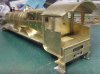
I had several tasks planned for today, but only actually managed to cross the first job off the list, which was to attach the cab to the footplate. No matter - it needed doing and now it's done! Although the instructions say to solder it on, I decided it might be worth having it removeable.
In order to accomplish this, I made a couple of brackets from scrap etch and drilled two 1mm diameter holes. The brackets were taped in their final position so that corresponding holes could be drilled through the footplate. Once this was done, the brackets were removed and their holes opened up to 8BA clearance. I then ran graphite from a pencil over the bolt threads (to repel solder), popped them through the holes in the brackets, firmly wound them into some 8BA nuts and soldered the nuts to the brackets. Here are the brackets, with the one on the right bolted in position on the footplate....
Here's the cab temporarily in position showing its relationship to the bracket....
The cab was removed to have its lower edges tinned, then repositioned and held securely in position with an elastic band. I then tacked it to the first bracket with a couple of blobs of solder. To eliminate any risk of soldering the cab to the footplate, the first bracket & cab assembly was then unbolted from the footplate and put in a clamp with a piece of wood for support....
Then a generous fillet of solder was applied.... (No prizes for neat soldering here - it's all about strength!).
The exercise was then repeated for the other side....
Having shortened the 8BA bolts (to clear the floor), here is the cab bolted securely in position....
The floor slid in temporarily....
Finally, a gratuitous 3/4 rear view, just for the hell of it!....
The cab's looking a little naked inside, so I now need to think about fitting the missing angle between the windows, ATC equipment, reverser, tip-up seats and of course, backhead and associated plumbing.
I've not done much actual modelling since the last update, as I've been revisiting an embarrassing number of unfinished 3D projects that fell by the wayside, whenever I thought of something else I wanted to design!
A number of them are "Top Secret" at the moment, but one that isn't, is the Castle smokebox saddle. Although the drawing is almost done, I began to think about what else needed to be done to the loco, once the finished (and hopefully successful), saddle print was fitted. I didn't have to look far to find another aspect of the kit that disappointed me - the outside steampipes....
I require the curlier BR variant and these (like the straighter GWR ones also supplied with the kit), are supplied in two parts. This is actually rather clever, because if you were trying to replicate them with a single piece of rod, you'd have a hell of a job on your hands, with them being such a fiendish shape. However, they're simply two sections of a "doughnut", that when attached to each other in the correct orientation, give the required form and I imagine the prototype was done in exactly the same way.
So, the concept was good, but there were three things I didn't like about them:
1) I perceived I would struggle to get the orientation right during the gluing or soldering process.
2) The castings were slightly eliptical in section rather than circular.
3) The slits to aid the forming of the original masters are somewhat visible.
With the 3D smokebox saddle drawing already on the go, I figured I might as well have a stab at the steampipes too, after all, how hard could it be to draw two sections of doughtnut and join them together? Actually, I found it very hard and really struggled to marry the curves from two different workplanes, into a single flowing Polyline! There was nothing for it, but to move on to another project.
That was a couple of weeks ago, but today, I stumbled across the first ever issue of "Great Western Railway Journal" in my railway room. I had a casual flick through it, as you do, when in the centre pages, I came across some GA drawings for a Castle Class! The main thing of interest to me was the side elevation, which showed the steampipes. Unfortunately, they were the earlier GWR type, but straight away, my interest in my stalled drawing was awakened and after a few hours of virtual hair-pulling (those who know me will understand!), I came up with this....
In order to (hopefully), ensure a good fit, I copied the existing smokebox saddle, then added a representation of the footplate and smokebox.
I'm pretty happy with the results and just need to "mirror" the steampipe and incorporate the pair of them into the original saddle drawing, which is fairly close to completion. I may incorporate a few other unrelated bits and bobs into the drawing as well, but hopefully, it won't be too long before I have some tangiable results to share.
That's all for now - happy modelling and a Happy New Year to everyone!
Regards
Dan
Edited 31st December to enlarge render sizes and add additional view.