From this to this in under a year. Rebuilding South Brooklyn

Neville

Active Member
I'm wondering where the freight cars went on the right side usually you drag them out so half are on the float and the other half are on the bridge then switch sides and drag the centre line out then keep going till the float is empty but always try to keep the float level as possible.
Seems like everything is on the left side.
An interesting photo.
I have many photos and books about New York Harbor could fill the forum with photos but I won't!
Now how can I restore float operation back on the BRHRR No! No!
Here are some very early photos of the BRHRR about 15 years ago?
Funny two photo show just what I was talking about but where is the loco??a.JPG e.JPG f.JPG
Nev.
 

adrian

Flying Squad
Funny two photo show just what I was talking about but where is the loco??
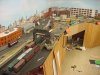
Fascinating operations but absolutely no idea as the the location of the loco. However reading through the link posted by @Osgood I'm left wondering why they didn't use cables to drag the cars off the barges and then the loco wouldn't have to run over the barges or bridge. Or have I missed something?
 

Neville

Active Member
Carfloat: A rail mounted barge. (Term was most common around New York Harbor)
Barge: A flat top vessel with no rails.
Common carfloats could hold up to 21 cars their length was from 250 feet to 350 feet long.
Most floats had three tracks some had two tracks and a platform in the centre this was handy for pushing alongside a wharf the platform meant that workers could unload the outer cars across the platform through the inner cars and then onto the wharf .

Cable?
Dangerous, cables breaking. Take much to long you can't just pull a complete train off one side as I mentioned above the float would tip over.

These blokes were experts at this type of thing.
They had it down to an art
The bridge was Hinged at one end the other end locked onto the float there had to be a bridge to compensate for the rise and fall of the tides in New York harbor (not as dramatic as the Thames!) the whole thing was called a transfer bridge
Most of the time the locomotive never went onto the barge they had "idler" cars usually old flat cars or gondolas that the loco would push onto the Float eventually the complete train would be pulled off and taken to the yard to be sorted.
5300 freight cars were moved PER day in the 30's even in the early 60's in it's decline 1600 cars were floated PER day in New York Harbor.
Towards the end some locos went with the float to switch both sides with the one loco and also leaving in certain spots left it open to vandalisim.
Here are more of my vintage photos.MVC-194F.JPG z1.JPG z2.JPG
Nev.
 
Top