
You are using an out of date browser. It may not display this or other websites correctly.
You should upgrade or use an alternative browser.
You should upgrade or use an alternative browser.


James
Western Thunderer
Handle for closing the bottom doors."Monkey handle"?

Quintus
Western Thunderer
A better view of the monkey handle (or monkey tail) on this kit built Parkside 8 planker.
The handle is provided with the kit, and having built a few without bottom doors, I had enough left over to equip my Lionheart models.
The etched brake rack with the chain and pin is a big improvement over that supplied with the kit, especially in this close up view.
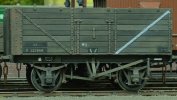
The handle is provided with the kit, and having built a few without bottom doors, I had enough left over to equip my Lionheart models.
The etched brake rack with the chain and pin is a big improvement over that supplied with the kit, especially in this close up view.
Quintus
Western Thunderer
With the introduction of more modern motive power, in the form of the BR 3MT and Ivatt tank locos, the coaling facilities at Bradstock have been found to be rather inadequate, due to the higher bunkers of these locos, throwing a shovel full of coal from the coal stage into the bunker results in most of the coal ending up on the ground.
Management have therefore sanctioned a coal hoist to be installed.
Looking for photos of such a device, they seem to be rather rare (at least on the GWR), and I was only able to find one at Neyland, photographed in the 1920's, a pretty archaic looking device and not the sort of thing I had in mind,
It occurred to me that the coal hoist at Templecombe loco shed was probably installed in 1950, when the shed was rebuilt by B.R.
This was just what I had in mind, and my good friend Ian Mathews (Mr. Templecombe) provided me with enough photos to be able to work out dimensions.
I do not propose an exact replica and have slightly altered the dimensions to suit the site.


Construction has begun.
Management have therefore sanctioned a coal hoist to be installed.
Looking for photos of such a device, they seem to be rather rare (at least on the GWR), and I was only able to find one at Neyland, photographed in the 1920's, a pretty archaic looking device and not the sort of thing I had in mind,
It occurred to me that the coal hoist at Templecombe loco shed was probably installed in 1950, when the shed was rebuilt by B.R.
This was just what I had in mind, and my good friend Ian Mathews (Mr. Templecombe) provided me with enough photos to be able to work out dimensions.
I do not propose an exact replica and have slightly altered the dimensions to suit the site.
Construction has begun.
Quintus
Western Thunderer
A bit more progress on the coal hoist. Preliminary trials are encouraging regarding a working model, so I have left a length of rod which will pass through the baseboard to enable the jib to be raised and slewed. At the moment I am undecided on this, as I think it would be perhaps a step too far to a actually fill the tubs with coal and empty them in the tender/bunker of a loco!!
In the meantime I will carry on with the project. I am awaiting some etched handwheels, and I have to sort out some coal tubs.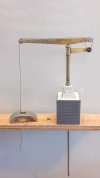
In the meantime I will carry on with the project. I am awaiting some etched handwheels, and I have to sort out some coal tubs.

paulc
Western Thunderer
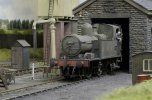
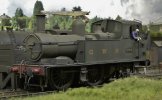
Thats proper filthy Mike , nice job .5802 has now joined the roster at Bradstock, correct cabside numberplates have been fitted, together with Youchoos sound decoder.
View attachment 241220View attachment 241221
Quintus
Western Thunderer
More progress on the coal hoist but still plenty to do, I need to make a small platform for the operator, and this will probably use old sleepers. The base is higher than the one at Templecombe to bring it up to the height of the coal stage.
Weathering has begun, but will need more. I remember it as basically grey, but years of oil, coal dust, smoke, water and weather made it rather a non-descript colour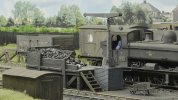
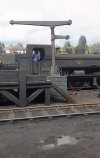
Weathering has begun, but will need more. I remember it as basically grey, but years of oil, coal dust, smoke, water and weather made it rather a non-descript colour
paulc
Western Thunderer
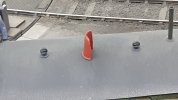
Hi Mike , whats the rusty brown object laying on the ground in photo two next to the coal hoist ?More progress on the coal hoist but still plenty to do, I need to make a small platform for the operator, and this will probably use old sleepers. The base is higher than the one at Templecombe to bring it up to the height of the coal stage.
Weathering has begun, but will need more. I remember it as basically grey, but years of oil, coal dust, smoke, water and weather made it rather a non-descript colourView attachment 241596View attachment 241597
Just me being nosy .


Quintus
Western Thunderer
These were fitted in the firehole to deflect the air over the fire. Called baffle plates, deflector plates (we called them smoke plates).Hi Mike , whats the rusty brown object laying on the ground in photo two next to the coal hoist ?
Just me being nosy .
They would burn away and get thrown out, or sometimes get thrown out anyway, as they were not always popular with firemen, as they prevented building a high fire in the back of the firebox.
They could be put in or removed with the shovel.


Compton castle
Western Thunderer
Is it a casting or something you’ve knocked up?These were fitted in the firehole to deflect the air over the fire. Called baffle plates, deflector plates (we called them smoke plates).
They would burn away and get thrown out, or sometimes get thrown out anyway, as they were not always popular with firemen, as they prevented building a high fire in the back of the firebox.
They could be put in or removed with the shovel.
I’ve got pics of them strewn around Canton
Quintus
Western Thunderer
Hi Steve,
I made a couple using a short length of 10mm copper tube cut lengthways. The flange is (iirc) 0.5mm brass wire soldered to the rear end. A taper is filed either side towards the front , which is rounded off and can be distressed ( burnt).
The dimensions look about right but are a bit of a guess!
Seems like Canton men didn't like them either!!
Regards
Mike
I made a couple using a short length of 10mm copper tube cut lengthways. The flange is (iirc) 0.5mm brass wire soldered to the rear end. A taper is filed either side towards the front , which is rounded off and can be distressed ( burnt).
The dimensions look about right but are a bit of a guess!
Seems like Canton men didn't like them either!!
Regards
Mike
paulc
Western Thunderer
Thanks Mike, I've got a bit of copper pipe although it's still got an old tap attatched . Out with the pipe cutter methinks .Hi Steve,
I made a couple using a short length of 10mm copper tube cut lengthways. The flange is (iirc) 0.5mm brass wire soldered to the rear end. A taper is filed either side towards the front , which is rounded off and can be distressed ( burnt).
The dimensions look about right but are a bit of a guess!
Seems like Canton men didn't like them either!!
Regards
Mike
Quintus
Western Thunderer
The coal hoist is being re-sited between the arrival road and the coal road, there is just enough room between the tracks and this will be more prototypical. Coal tubs were filled directly from the wagon, so the existing coal stage is now due for demolishion.
The shed staff are really happy with the introduction of semi mechanical coaling, much less labour intensive than the original. 3D printed coal tubs will complete the scene.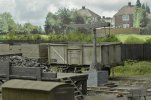
The shed staff are really happy with the introduction of semi mechanical coaling, much less labour intensive than the original. 3D printed coal tubs will complete the scene.
Last edited:
Quintus
Western Thunderer
Something that has been niggling me lately is the rather chunky pull rods on my Lionheart 64 and 74XX panniers, compared with the rather finer ones on the Dapol 57XX.
A pal who models in gauge 1 was having some etching done in .028" material, so I supplied a drawing and he kindly added a couple of sets of pull rods.
I wasn't sure how I was going to fit them, as the brake hangars and pull rods are moulded as one, but I eventually plucked up courage and snipped of the plastic pull rods and cleaned up the bottom of the brake hangars. I attached the etched ones with my remaining stock of 16BA nuts and screws, having first drilled a hole in the bottom of the hangars.
Before attacking the 74XX, I thought a photo of the "improvement" might be in order.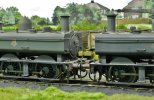
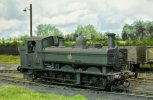
A pal who models in gauge 1 was having some etching done in .028" material, so I supplied a drawing and he kindly added a couple of sets of pull rods.
I wasn't sure how I was going to fit them, as the brake hangars and pull rods are moulded as one, but I eventually plucked up courage and snipped of the plastic pull rods and cleaned up the bottom of the brake hangars. I attached the etched ones with my remaining stock of 16BA nuts and screws, having first drilled a hole in the bottom of the hangars.
Before attacking the 74XX, I thought a photo of the "improvement" might be in order.