Breaking Ground - Finescale - of a sort

Peter Insole

Western Thunderer
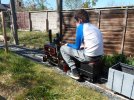
And a big bunch of kids, particularly this one, are still able to get out and play on sunny days!

It was good to see you Tom, and indeed all the others, including some neighbours and their grandchildren that came over yesterday afternoon. It was such a busy time that I am utterly cream crackered now!

It also makes me rather tired just thinking about how fit I must have been to clock up so many miles on that old bike... but it's last mission was over twenty five years ago!

Pete.
 

Peter Insole

Western Thunderer
Oh how I wish there was an easier way to make points and crossings...

hkSAM_1753.JPGhkSAM_1754.JPG

The vast difference in the cost of 5 inch gauge off-the-shelf, self assembly kits, let alone bespoke services, and with the total for materials coming in (in this case anyway) at marginally less than £40, there is absolutely no competition!

I do though fully concede that anyone who sets themselves up to commercially manufacture these things certainly earns every single bean that they charge!

My wife laughed at me, saying:

"I remember just how much you grumbled and complained the first time round"...

"And you still want to do another one?!"

Pete.
 

John Bruce

Western Thunderer
Just came across this thread, I have 32mm in the garden myself, but this...well who wouldn't given half the chance.
Do keep going and good luck with the further extension.

John.
 

Peter Insole

Western Thunderer
Thank you John or your kind words. I must admit to becoming a little concerned that by declaring just how difficult, to almost impossible, making the points and crossings was for me, that the main reason for posting in the first place is to be an encouragement!

It is perhaps not unreasonable to assume that building a miniature railway would require, as a minimum, a healthy pot of disposable income, a significant landholding, and a fairly well established engineering background - plus the workshop and appropriate tools to hand?

While I do accept that I am very lucky to claim a long garden, despite the problems associated with it's restrictively narrow width, and the fact that it had become a long neglected storage area (that is polite for what was in effect a dumping ground!) may otherwise in part fulfil one of the conditions, but I had set out to prove, mainly to myself it has to be said, that a lack of previous or practical experience, and an almost unbelievably meagre budget need not be a particular hinderance.

Having said all that, I am going to continue with the story of hard slog. While the sun shines and all that!

I can't help wondering how we have managed to accumulate so much rubble and rubbish in so small a space? The problem now is that it has been steadily cleared from the upper end of the garden, only to become piled up right where I need to work on the extension! It has got to go, but the precise arrangements for disposal have yet to be agreeably sorted amongst the various family members!

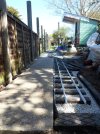
Meanwhile, I can at least continue struggling with realigning the uneven path and main line formation alongside. I'm afraid the points will have to remain clipped and somewhat pointless for the time being!

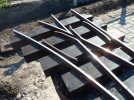
It does seem strange to be "weathering" track that will be permanently outdoors...

hkSAM_1765.JPG

One curious neighbour came down to see what I was doing, and asked me why I hadn't made it out of steel in the first place... that would naturally go rusty?

I think he went away shortly thereafter, satisfied with the answer that it was too much b****y hard work bending and grinding ally! Either that, or the fact that I was flicking paint everywhere with a coarse brush?!
hkSAM_1770.JPG
hkSAM_1769.JPG

By the way, here is a conundrum:

Fence paint is supposedly meant for the preservation and beautification of wood, yet it fails fairly rapidly on such surfaces... however, when applied accidentally or otherwise on concrete, steel and in our case aluminium, it turns out to be incredibly durable!

Am I missing something here?

Sloshing a brown/black mix of the stuff on the sleepers might make them look nicer than the greenish yellow shade of freshly tanalised timber, but I am now only too aware that there will be not the tiniest trace of pigment remaining in little more than two years time, so that part is a complete a waste of effort.

Definitely missing something then!

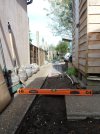
Having gone to all the trouble of building the beast, I was dead keen to get it out of the house and installed, but when the day dawned, I decided that it might be prudent to sort out the level crossing instead.

I am glad I did as it happened.

hkSAM_1773.JPG

Despite taking some care, I was unable to avoid disturbing the newly laid ballast and rails!

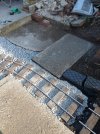
The old six foot path slabs were laid many years ago between the brickwork edge of the driveway and that infamous studio step, but did not fit the length. Back then, a friendly neighbour offered to cut a partly damaged one down with his power saw. With all the remodelling, that section is now redundant, but it has turned out to be of just the right proportions (almost to the millimetre!) for providing a new approach to the platform!
hkSAM_1779.JPG

The slightly peculiar geometry going on here will hopefully make more sense when the footway is boarded over and further landscaping is completed.

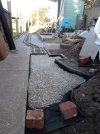
Setting out the formation on this part of the extension is complicated by an awful lot of combined tree roots growing just beneath the surface. Mercifully, all appear to be peripheral, and I have been assured that cutting them should do no significant harm to their owners.

hkSAM_1809.JPG

I am getting down to the last remnants of a bulk bag of essential limestone chippings, with just enough for bedding two more sections of rail beyond the points. Sourcing a local supplier of smaller bags to finish the job will be both urgent and awkward!

hkSAM_1815.JPG
hkSAM_1820.JPG

The pennies required have been ringfenced, but approval has not yet been granted for the preferred 15-20mm top ballast.

I made a mistake when choosing the type, grade and colour for the station area, finding myself occasionally being given gentle reminders of that error!

Pete.

 

Nick C

Western Thunderer
It is perhaps not unreasonable to assume that building a miniature railway would require, as a minimum, a healthy pot of disposable income, a significant landholding, and a fairly well established engineering background - plus the workshop and appropriate tools to hand?
I've been watching a YouTube channel of a guy in Ireland building his own field railway from first principles, on a very low budget - he's got plenty of land and engineering knowledge, and comes up with some very inventive uses of cheap and second-hand materials.
 

Peter Insole

Western Thunderer
Thank you Giles and Nick. Making those points was a little bit like having teeth pulled, where you remain numb for a while, but the worst of the pain is soon forgotten! Is the Youtuber the same chap that even had a go at welding scrap steel to build up his own wheels Nick?!

On Monday last I was expecting a quiet time, and was all set to lay the first straight length of rail beyond the points, but as a result of the happy coincidence of it being the Easter holidays and Rich having a rarely consecutive couple of days off from his coach driving job, we were able to enjoy a full running session instead!

Once it was all set up and everyone was busy, I carried on with the original task.

hkSAM_1822.JPG

After tightening up the last fishplate bolt, and even as I was making final adjustments with the tamping, a train arrived back at the station.

The driver seemed impatient, so I chucked the tools out of the way, grabbed my camera, and waved him on:

hkSAM_1825.JPG

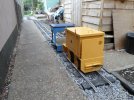
Much fun was had by all for the rest of the day:

hkSAM_1827com20250407_135342Rich.jpg
hkSAM_1827com20250407_135901Rich.jpg
hkSAM_1828.JPG
hkSAM_1831.JPGhkSAM_1836.JPG

Sadly, there was one fly in the ointment:

The "Speeder" has had quite a hammering during this run of good weather, but shortly before the close of play the motor started intermittently cutting out. It then failed completely.

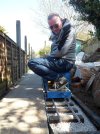
When everybody had gone home I took the opportunity to sit down and investigate. I assumed it most likely that a loose connection was the cause of the problem - and indeed found one on the reversing switch. After dealing with it, and checking all the others, there was still no power.

Removing the circuit board from its cover revealed the issue:

One of the capacitors has burst!

hkSAM_1837.JPG

Strangely, rather than bulging and splitting the frangible cover, this one seems to have a collapsed hole in one segment of the top?! It is however quite clear that the electrolyte has evaporated away, leaving visible a dry, brown crystalline content.

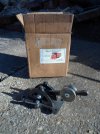
The mood took a bit of a plunge... but was quickly revived again with an earlier than expected delivery:

hkSAM_1839.JPGhkSAM_1840.JPG

Oooooh, aaahh!

Such a wicked, wicked indulgence... I know... and a terribly disappointing break of every rule in the book!

But I was gifted a generous donation, specifically for the benefit of the railway, and originally provided for just such a purpose!

It is still going to require a degree of ingenuity, and some slightly awkward "modification" to adapt the "throw" from 5 inch gauge standard to our own peculiar requirements!

If only being naughty were not so thoroughly pleasurable?!

Pete.
 
Last edited:

Peter Insole

Western Thunderer
Thank you to all! Yes Rob, that fence paint comes in massive tubs - so there is more than enough "rust" to go all the way round!

Yes to that too Class27! In yards where horse or rope shunting was carried out, point levers were frequently protected from snagging by handrails - with rounded corners, and usually everything was painted white for good measure. I am thinking it might be wise to do something similar here...

I bet I'll be the one to fall over it first before then?!

Pete.
 

Peter Insole

Western Thunderer
I am not quite sure whether a desperate situation is actually a blessing in disguise?! The most agreeable weather has been encouraging work on the extension to continue without interruption, but that comes with a heavy price tag.

My good lady says;

"You've done ever so well"

Which experience, and if I'm prepared to listen, should tell me is wife speak for "you need to give it a rest"!

That situation has, to some degree been enforced by circumstance:

hkSAM_1841.JPG
hkSAM_1842.JPG

The above images show the very last dregs of 10mm Limestone chippings from the original bulk bag ordered for the loop.

Such a sound foundation is essential for support and good drainage under the timber sleepers, but from now on I shall have to rely on the more expensive individual bags to complete the job... and a co-opted member of the family to go pick 'em up for me!

By incredibly good fortune though, there was just enough of the stuff to lay one last section of rail...

hkSAM_1845.JPGhkSAM_1846.JPG

Until fresh supplies can be obtained, I will be taking an enforced break... from the civil engineering anyway!

At least I could concentrate on fitting up the new point lever:

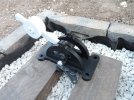
hkSAM_1852.JPG

The design is slightly awkward as a result of poor planning on my part, and our railway not being constructed to normal, 5 inch gauge standards.

Although it offends my eye a bit, the assembly will have to be installed in an off-set position on the extended sleepers to reduce the degree of bends in the linkage, as well as keeping same, for the most part within the narrow gap.

I felt the crank lever also needed to be reversed in the bracket so the whole thing could be mounted forward, and away from the the branch - both to change the direction of the handle when set for the straight (main) line, and to provide a little extra clearance for carriage and wagon footboards when taking the curve.

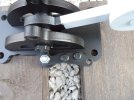
The manufactured, and non adjustable 12mm throw was even more problematic, as our peculiar flange profiles (pretty damned close to seven and a quarter inch gauge) require a precise 18mm! A straight extension of the crank, however short, was impossible to fit though, as it would mean that a clevis attached to it would foul one of the bracket lugs and screws!

After doing a carefully measured geometry drawing on paper, I came up with a little three hole, triangular plate arrangement:

hkSAM_1854.JPGhkSAM_1856.JPG

It does overlap the sleeper edge a bit, but the images don't show that it is just high enough to clear the structure and offending fixing now.

Connecting it up will be a bit of fun, but at least not too strenuous an activity I trust?!

One neat feature included in the design is a pair of lugs on top of the quadrant for locking the lever with a bolt or pin. I don't doubt the children will be terribly disappointed not to be able to play with it... and possibly cause hilarious derailments... for the time being anyway!

Pete.
 

Peter Insole

Western Thunderer
A run of good weather has encouraged me to continue with more or less uninterrupted work on the extension, albeit rather slowly due to progressively poor health. I am afraid that in my enthusiasm for pressing on I have perhaps been overdoing it a bit, and have frequently been too exhausted to even think about posting reports in the evenings!

I have taken rather a lot of photos, but I fear that as a result of the nature of the work, many look too much alike? I have therefore made a selection.

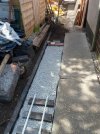
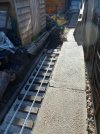
hkSAM_1897.JPG

A significant hindrance to raising the last pair of path slabs was a spare one that was lodged between the two and propped up against the wall for ages. Those slabs "weigh a ton", and really require two people to lift, let alone shift them over any distance whatsoever, so after preparing the ground I had to wait until a willing volunteer (Mr. O., as usual) was available to assist.

That spare has turned out to be useful, and being set at right angles to the main path, will create a second level crossing that provides access to the door on the front of the planned "engine shed".

Bearing in mind a degree of uncertainty (to put it mildly) in global markets at the moment, I thought it might be wise to source and order as much material as funds would allow for the extension, including picking up more timber battens for sleepers: For once, and as luck would have it, my local retailer - with whom I am privileged to enjoy a respectable discount, only had four sufficiently decent lengths left in the rack!

Chopping up and starting the (almost pointless) painting job on the short order nonetheless kept me occupied for a while...

hkSAM_2000.JPG

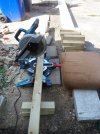
By the way; the use of Mr. O's wonderful saw is a boon... and the old cushion for kneeling on is an absolutely indispensable requirement for all low level operations these days.

Both do the job something lovely, but lifting the monster - and getting back off the latter can be a bit of an adventure sometimes!

hkSAM_2001.JPG
hkSAM_2009.JPG

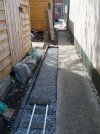
Fortunately, I have just enough of the "Staffordshire" blue pavers in stock to complete the track formation, right up to the driveway, tramline section, but less so; it soon became apparent that the six bags of chippings picked up on a special trip will not quite be sufficient!

hkSAM_2003.JPG
hkSAM_2013.JPG

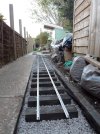
Finally, after laying in the last panel, the new length had to be thoroughly tested - which also just happened to include several full line, return trips - before any passenger services can be permitted of course!

hkSAM_2021.JPGhkSAM_2024.JPG

Part of my much needed rest therapy at the end of all this effort was some time out for a very pleasant, and rather prolonged lunch with a friend.

Later that afternoon, after a steady stroll home and when turning at the front gate I momentarily panicked...

What I saw immediately was a long, white tape with a repeated red message across the door.

"Oh nooo... what the..."

After several heart beats, I realised the "what" was me being a chump.

It was a parcel that I wasn't expecting to arrive for at least another day, or more likely two - according to the manifest:

hkSAM_2030.JPG

We have all had a jolly good chuckle at both my own silliness, and the brave attempt by the delivery driver to "hide" it behind the plant tub.

It must have been fun, as ten, tightly bundled, two and a half metre lengths of aluminium rail are surprisingly unwieldy!

Pete.
 
Last edited:
Top