Ah, beat me to it by one minute...!Just wondering how this is going? Thought it might have been done by now!

You are using an out of date browser. It may not display this or other websites correctly.
You should upgrade or use an alternative browser.
You should upgrade or use an alternative browser.
Crook Street Works - Gladiator LNWR Coal Engine
- Thread starter Allan
- Start date
Hi All,
What with Christmas and lots of stuff on, I haven't got round to updating this but I reached this stage in bits and bobs over the festive period and just into the new year.
So I started the engine chassis before Christmas and as usual (and per instructions) made the coupling rods first:

As I've mentioned on previous posts here, I think pick-ups are an uncertain science, in fact they may actually reside more correctly in the realm of magic. I'm not a magician... So in my ever continuing experiment, I've gone down the scraper route again but with a busbar made of copper-clad in the hope of remaining unobtrusive. The dog-legs are to enable wires to pass through the motion plate when I install it. The springing is also visible, again I've opted for simplicity rather than installing correct hornblocks:
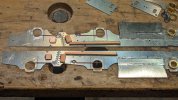
All soldered up using the coupling rods as guides, flat filed on the bearings and angle section soldered in place to act as hornblocks:
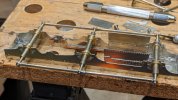
A bit of opening out of the crank pin holes, And Lo!, we have a push-along...:
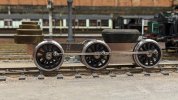
...And with a motor installed, a go-er - on DC to show up any problems:

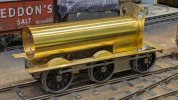
Rather than complete the chassis at this point I moved on to the footplate and boiler to make sure these two major sub-asemblies form up and fit together nicely. I tried to make the spectacle plate nice and square. At this point I needn't have bothered as it's soldered to tiny nubs of the footplate so moves at the slightest provocation - It'll be firmed up later as the cab sides are installed. At this stage, however, I need it for boiler alignment:

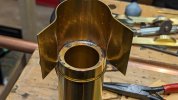
I recessed the front former to give better strength to the structure and cut a hole in the rear former as I want access for decoders and any weight it might need and, last but not least, to clear the motor flywheel. I cut a similar hole in the front firebox former for the same reasons. The rear one, I soldered in a nut to enable it to be bolted to the cab after painting. This is a picture of the rear boiler former with it's hole:
And it all assembed ok... I did find, however, that the centre drivers shorted on the splashers due to the excessive swing I'd allowed to get round my curves, so some thicker washers stopped that and thankfully still allowed it to traverse the curves:
I'm making a Crook Street movie at the moment but hope to get back to the honest pursuit of engine building soon.
Cheers
Allan
What with Christmas and lots of stuff on, I haven't got round to updating this but I reached this stage in bits and bobs over the festive period and just into the new year.
So I started the engine chassis before Christmas and as usual (and per instructions) made the coupling rods first:
As I've mentioned on previous posts here, I think pick-ups are an uncertain science, in fact they may actually reside more correctly in the realm of magic. I'm not a magician... So in my ever continuing experiment, I've gone down the scraper route again but with a busbar made of copper-clad in the hope of remaining unobtrusive. The dog-legs are to enable wires to pass through the motion plate when I install it. The springing is also visible, again I've opted for simplicity rather than installing correct hornblocks:
All soldered up using the coupling rods as guides, flat filed on the bearings and angle section soldered in place to act as hornblocks:
A bit of opening out of the crank pin holes, And Lo!, we have a push-along...:
...And with a motor installed, a go-er - on DC to show up any problems:
Rather than complete the chassis at this point I moved on to the footplate and boiler to make sure these two major sub-asemblies form up and fit together nicely. I tried to make the spectacle plate nice and square. At this point I needn't have bothered as it's soldered to tiny nubs of the footplate so moves at the slightest provocation - It'll be firmed up later as the cab sides are installed. At this stage, however, I need it for boiler alignment:
I recessed the front former to give better strength to the structure and cut a hole in the rear former as I want access for decoders and any weight it might need and, last but not least, to clear the motor flywheel. I cut a similar hole in the front firebox former for the same reasons. The rear one, I soldered in a nut to enable it to be bolted to the cab after painting. This is a picture of the rear boiler former with it's hole:
And it all assembed ok... I did find, however, that the centre drivers shorted on the splashers due to the excessive swing I'd allowed to get round my curves, so some thicker washers stopped that and thankfully still allowed it to traverse the curves:
I'm making a Crook Street movie at the moment but hope to get back to the honest pursuit of engine building soon.
Cheers
Allan

paulc
Western Thunderer
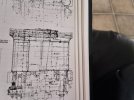
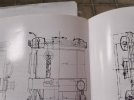
Hi Allan , all this talk of tenders and coal plates got the better of me so out came the LNWR loco bible . It appears that the 1500, 1800 and 2000 gallon tenders had curved plates then they went to flat plates from the Whale 3000 gallon onwards .Ah! I'm in good company indeed... I suspect, however, that's the only thing I share with Mr Beeson's masterful company...
Good , i can get some sleep now
 .
.

Mike W
Western Thunderer
When built new that is correct. Although that tender drawing does appear to show a curved coal plate wih coal rails, I can find no evidence of that in photographs or other records and the explanation I gave before I believe to be correct, i.e. the drawing was done when the tenders were built (without coal rails) and although on some drawings the curved line has been scrubbed out, it is still visible. In this case it may even have been enhanced for publication.
paulc
Western Thunderer
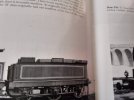
Like this Mike ? Mind you it's the only shot i can find in Eddie Talbots LNWR Engines book . Most of the rear of the tenders are covered in coal in most photos so the plank was hidden anyway and not really working as a stop board .When built new that is correct. Although that tender drawing does appear to show a curved coal plate wih coal rails, I can find no evidence of that in photographs or other records and the explanation I gave before I believe to be correct, i.e. the drawing was done when the tenders were built (without coal rails) and although on some drawings the curved line has been scrubbed out, it is still visible. In this case it may even have been enhanced for publication.
Mike W
Western Thunderer
Well, the background has been whited out, so I'm not convinced. Coal rails were fitted from 1895 and that 2500 tender didn't come out until 1902, so one would have expected it to have the straight plate by then anyway, even if there was a short changeover period. It also seems so logical - coal rails need new supports and there, in just the right place, was a coal plate which could provide that support. But I've seen nothing official to say so.
Last edited:
I reckon you have to be a bit careful with the 'official' drawings. The weight diagram for the coal engine (ok, not the official drawing) included in Ted Talbot's book, also included in the kit instructions, has the boiler band spacing incorrect, whereas the other drawing in the Talbot book, I guess done by an amateur enthusiast, is actually correct compared the the multiple photos.Well, the background has been whited out, so I'm not convinced. Coal rails were fitted from 1895 and that 2500 tender didn't come out until 1902, so one would have expected it to have the straight plate by then anyway, even if there was a short changeover period. It also seems so logical - coal rails need new supports and there, in just the right place, was a coal plate which could provide that support. But I've seen nothing official to say so.
Cheers
Allan
Hi All,
Remaining on the superstructure, I cut out slots in the smokebox inner wrapper to accomodate the handrail knobs having broken several drills in the past trying to do that with the front soldered on:
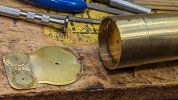
And attached a smokebox floor with captive nuts to enable the boiler to be removed for painting - the bolts were trimmed later:

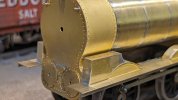
With the boiler attached - I glued it as I was too scared to solder such a detail encrusted large heatsink - I made up the sandboxes. They formed up nicely (they don't always) and a little narrowing of the smokebox floor made a nice tight, but not too tight, fit:
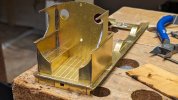
I then made up the cab, again all went together easily:
However, I did find earlier that there was a gap between footplate and firebox, despite using the formers. The one illustrated in the instructions didn't have that problem so I put it down to user error in some way I can't work out:
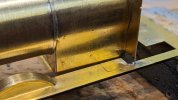
This was rectified easily enough by adding a bit of etch and with some judicious filing, all was remedied satisfactorily:
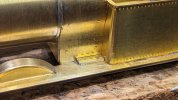
On to the boiler and there's some critical marking out to do here to ensure all the pipery and operating rods are aligned and positioned correctly:

Most of this is not attached at this point as it'll be done after painting. One novel thing included in the kit that impressed me was the handrail wire supplied is indeed tube like the prototype, so I guess, you could make the sanding gear actually work! (no I'm not that masochistic...):
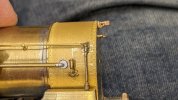
Moving back to the rear, I added my usual toy-train-set coupling post and eye set-up:
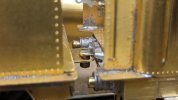
And finally the cab roof. There's provision in the kit to make a laminate, so I reduced the size on the inner so that it acts as locating tabs if I want to make it removable - you'll note the paranoid modeller like things to be removable...
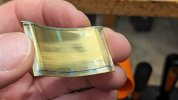
I've returned to the chassis now but I'll post about that later.
Cheers
Allan
Remaining on the superstructure, I cut out slots in the smokebox inner wrapper to accomodate the handrail knobs having broken several drills in the past trying to do that with the front soldered on:
And attached a smokebox floor with captive nuts to enable the boiler to be removed for painting - the bolts were trimmed later:
With the boiler attached - I glued it as I was too scared to solder such a detail encrusted large heatsink - I made up the sandboxes. They formed up nicely (they don't always) and a little narrowing of the smokebox floor made a nice tight, but not too tight, fit:
I then made up the cab, again all went together easily:
However, I did find earlier that there was a gap between footplate and firebox, despite using the formers. The one illustrated in the instructions didn't have that problem so I put it down to user error in some way I can't work out:
This was rectified easily enough by adding a bit of etch and with some judicious filing, all was remedied satisfactorily:
On to the boiler and there's some critical marking out to do here to ensure all the pipery and operating rods are aligned and positioned correctly:
Most of this is not attached at this point as it'll be done after painting. One novel thing included in the kit that impressed me was the handrail wire supplied is indeed tube like the prototype, so I guess, you could make the sanding gear actually work! (no I'm not that masochistic...):
Moving back to the rear, I added my usual toy-train-set coupling post and eye set-up:
And finally the cab roof. There's provision in the kit to make a laminate, so I reduced the size on the inner so that it acts as locating tabs if I want to make it removable - you'll note the paranoid modeller like things to be removable...
I've returned to the chassis now but I'll post about that later.
Cheers
Allan
Hi All,
Back to the chassis to fit the brake rodding. The kit provides cross beams as fitted to a number of LNW engines but these coal engines, however, didn't have them as they're driven by the external brake rods. It should have a cross beam and a rod linking with the brake cylinder but there's a pesky motor in the way...:
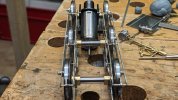
When the slide bar assembly is fitted, I could connect the separate pick-up busbars together through conveniently positioned holes in the motion plate:
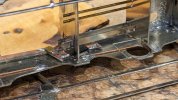
...And fit the springs. You have to cut down the front ones to clear the smokebox - a consequnce of the narrower 0 finescale dimensions:

I also added a front damper rod:
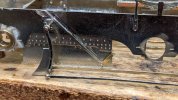
...and water filler pipes and rear sand pipes. The fake bend in the sand pipes enabling them to be located on the chassis rather than the body and will be hidden by the rear steps:
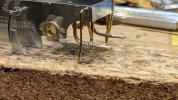
I made up some splasher brackets and glued them on as I didn't trust myself not to un-solder the neighbouring details!:
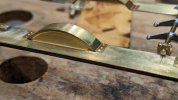
And a few of the cab features that are best attached before the backhead. Clockwise from left to right: the blower handle, the front sanders and down below the front and rear damper treadles and the blowdown valve handle:
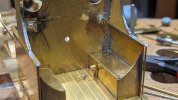
And so... it's off to the paintshop...:

...but not before soldering the brake rod stay omitted from the tender earlier:
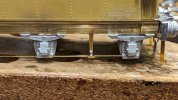
Cheers
Allan
Back to the chassis to fit the brake rodding. The kit provides cross beams as fitted to a number of LNW engines but these coal engines, however, didn't have them as they're driven by the external brake rods. It should have a cross beam and a rod linking with the brake cylinder but there's a pesky motor in the way...:
When the slide bar assembly is fitted, I could connect the separate pick-up busbars together through conveniently positioned holes in the motion plate:
...And fit the springs. You have to cut down the front ones to clear the smokebox - a consequnce of the narrower 0 finescale dimensions:
I also added a front damper rod:
...and water filler pipes and rear sand pipes. The fake bend in the sand pipes enabling them to be located on the chassis rather than the body and will be hidden by the rear steps:
I made up some splasher brackets and glued them on as I didn't trust myself not to un-solder the neighbouring details!:
And a few of the cab features that are best attached before the backhead. Clockwise from left to right: the blower handle, the front sanders and down below the front and rear damper treadles and the blowdown valve handle:
And so... it's off to the paintshop...:
...but not before soldering the brake rod stay omitted from the tender earlier:
Cheers
Allan
paulc
Western Thunderer
H
HI Allan , wonderfull work . The LNWR brake connecting rods are a modelling nightmare as they always end up bent. My two coal tanks are a case in point and the rods look like someone has attacked them with a sledge hammer , albeit a 7mm one .Hi All,
Back to the chassis to fit the brake rodding. The kit provides cross beams as fitted to a number of LNW engines but these coal engines, however, didn't have them as they're driven by the external brake rods. It should have a cross beam and a rod linking with the brake cylinder but there's a pesky motor in the way...:
View attachment 256861
When the slide bar assembly is fitted, I could connect the separate pick-up busbars together through conveniently positioned holes in the motion plate:
View attachment 256862
...And fit the springs. You have to cut down the front ones to clear the smokebox - a consequnce of the narrower 0 finescale dimensions:
View attachment 256863
I also added a front damper rod:
View attachment 256864
...and water filler pipes and rear sand pipes. The fake bend in the sand pipes enabling them to be located on the chassis rather than the body and will be hidden by the rear steps:
View attachment 256865
I made up some splasher brackets and glued them on as I didn't trust myself not to un-solder the neighbouring details!:
View attachment 256866
And a few of the cab features that are best attached before the backhead. Clockwise from left to right: the blower handle, the front sanders and down below the front and rear damper treadles and the blowdown valve handle:
View attachment 256867
And so... it's off to the paintshop...:
View attachment 256868
...but not before soldering the brake rod stay omitted from the tender earlier:
View attachment 256869
Cheers
Allan
Hi All,
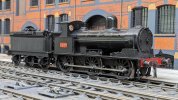
Back from the paintshop (I had a run on the boiler and had to rub it off and paint it again, that'll teach me for being impatient, grrr!) and reassembled, numbered, shed code allocated, coaled and ready to be rostered for duty. This one's unadorned, just plain black:

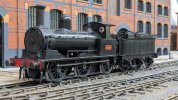
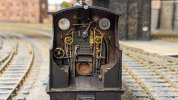
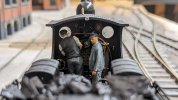
Shame the pipery has to bend to avoid the unprototypically wide splashers - that's finescale for you... The crew's feet hide it though:
That's it for this one, a nice straightforward build. It took 137 hours over 9 weeks.
Cheers
Allan
Back from the paintshop (I had a run on the boiler and had to rub it off and paint it again, that'll teach me for being impatient, grrr!) and reassembled, numbered, shed code allocated, coaled and ready to be rostered for duty. This one's unadorned, just plain black:
Shame the pipery has to bend to avoid the unprototypically wide splashers - that's finescale for you... The crew's feet hide it though:
That's it for this one, a nice straightforward build. It took 137 hours over 9 weeks.
Cheers
Allan

I have a soft spot for this kit. Adrian Rowland decided to come out of retirement to draw this. It was my first ever test build. Just one revision of the etches required.
It's nice to see one built up and painted so well. Well done Allan! I look forward to seeing it on a video.
David
It's nice to see one built up and painted so well. Well done Allan! I look forward to seeing it on a video.
David
Thanks James.Allan, that's a beautiful result!
Thanks to you and Adrian too, it was a nice build. It's been rostered for Crook Street now!I have a soft spot for this kit. Adrian Rowland decided to come out of retirement to draw this. It was my first ever test build. Just one revision of the etches required.
It's nice to see one built up and painted so well. Well done Allan! I look forward to seeing it on a video.
David
Cheers
Allan