
You are using an out of date browser. It may not display this or other websites correctly.
You should upgrade or use an alternative browser.
You should upgrade or use an alternative browser.
Downton Train Crash of 1884 in EM Gauge
- Thread starter Stevers
- Start date


Stevers
Western Thunderer
These photos have all been featured on my workbench thread, but I also need to update the dedicated DTC thread...

Lots of 3D printing resulting in one of the close coupled '3-sets'; this one two Thirds 'piggy backed' to a First. The close coupling is via a single normal length buffer and a pad. Each Third has full length buffers one end and a pad the other making it possible to add a coach whilst maintaining the correct orientation of the assymetrical Newall brake shaft - I don't know if this was the actual arrangement but it seems most likely to me. The buffer housings are all 3D printed and the sprung buffers AGW coach ones turned down in my cordless drill to wagon dimensions. I had thought that the foot boards would need shortening, but that's not the case. A tad wavy for my liking, if they are to be 3D printed then they could benefit from an extra (unprotypical) support at each end. The first and third class coaches are the same length and it's astonishing that what is effectively a whole extra compartment has been squeezed in. Running on pinpoints the coaches vary in their free running, but are so short that propelling them through my crossover works well.
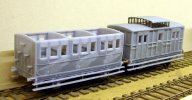
A revised 1862 First with the extra unprototypical footboard brackets at each end to keep them straight(er). Close inspection of the tumblehome will reveal the pixellated steps that Anti-Aliasing (if genuinely available on the Mono 4K) might soften. 3D printed steps for access to the oil lamps and fillers are provided at one end of the unbraked First Class coaches. The intention is still to fit suspension to my train via my own W Iron etches, so these are really test prints to iron out any problems with the CAD models and limits of the resin material and my 3D printer. This side of the coach is partially unhinged, but I can't remember if the central bottom hinge didn't print, or has just pinged off.
Beyond it is an 1859 Pass. Brake sporting what may be a 'Nine Elms' style caboose, painted, glazed and most importantly, safely separated from the edge supports and fitted without accident. This is the version raised by 0.5mm compared with the Weddell drawings to better match photos. Happily the templates I made for the original version now fitted perfectly! The double sided tape that I used to secure template to glazing had a more sticky and less sticky side. The stickier side needs to be on the template not the glazing - don't ask me how I know! The use of a brand new Swann Morton blade being essential when attempting to cut this (or probably any) sort of 'Plastiglaze'.

More 3D printing fug, and I had the other flavour of close coupled 3-set for the Downton Train Crash. Nearest is an 1862 First, then an 1862 Second and finally an 1865 Third. The First is unbraked, the Second and Third are braked and have pads on the nearer ends. All have the extra brackets to keep the footboards nice and straight. The First class was printed without Anti-Aliasing (AA), the Second and Third was printed with some measure of AA. The settings used were AA=4 and Gray Level=1. With AA on, the 'Cones of Calibration' tests became the 'Cones of Contradiction'. The cones would suggest over exposure when the sword fitted beautifully in the skull and wouldn't fit in either rock. Similarly the ale was a perfect fit in the mug. With AA exposure was increased from 2s to 2.4s. AA has softened the pixellated lines with no apparent loss of detail. It is striking how low the roofline of these coaches is compared with the AW diseasel, W Class or other modern stock. These coaches are very free running in both directions - the W Irons being a tad thicker, the pinpoint pockets slightly closer together and the wheel scallops in the floor a little deeper.
Lots of 3D printing resulting in one of the close coupled '3-sets'; this one two Thirds 'piggy backed' to a First. The close coupling is via a single normal length buffer and a pad. Each Third has full length buffers one end and a pad the other making it possible to add a coach whilst maintaining the correct orientation of the assymetrical Newall brake shaft - I don't know if this was the actual arrangement but it seems most likely to me. The buffer housings are all 3D printed and the sprung buffers AGW coach ones turned down in my cordless drill to wagon dimensions. I had thought that the foot boards would need shortening, but that's not the case. A tad wavy for my liking, if they are to be 3D printed then they could benefit from an extra (unprotypical) support at each end. The first and third class coaches are the same length and it's astonishing that what is effectively a whole extra compartment has been squeezed in. Running on pinpoints the coaches vary in their free running, but are so short that propelling them through my crossover works well.
A revised 1862 First with the extra unprototypical footboard brackets at each end to keep them straight(er). Close inspection of the tumblehome will reveal the pixellated steps that Anti-Aliasing (if genuinely available on the Mono 4K) might soften. 3D printed steps for access to the oil lamps and fillers are provided at one end of the unbraked First Class coaches. The intention is still to fit suspension to my train via my own W Iron etches, so these are really test prints to iron out any problems with the CAD models and limits of the resin material and my 3D printer. This side of the coach is partially unhinged, but I can't remember if the central bottom hinge didn't print, or has just pinged off.
Beyond it is an 1859 Pass. Brake sporting what may be a 'Nine Elms' style caboose, painted, glazed and most importantly, safely separated from the edge supports and fitted without accident. This is the version raised by 0.5mm compared with the Weddell drawings to better match photos. Happily the templates I made for the original version now fitted perfectly! The double sided tape that I used to secure template to glazing had a more sticky and less sticky side. The stickier side needs to be on the template not the glazing - don't ask me how I know! The use of a brand new Swann Morton blade being essential when attempting to cut this (or probably any) sort of 'Plastiglaze'.
More 3D printing fug, and I had the other flavour of close coupled 3-set for the Downton Train Crash. Nearest is an 1862 First, then an 1862 Second and finally an 1865 Third. The First is unbraked, the Second and Third are braked and have pads on the nearer ends. All have the extra brackets to keep the footboards nice and straight. The First class was printed without Anti-Aliasing (AA), the Second and Third was printed with some measure of AA. The settings used were AA=4 and Gray Level=1. With AA on, the 'Cones of Calibration' tests became the 'Cones of Contradiction'. The cones would suggest over exposure when the sword fitted beautifully in the skull and wouldn't fit in either rock. Similarly the ale was a perfect fit in the mug. With AA exposure was increased from 2s to 2.4s. AA has softened the pixellated lines with no apparent loss of detail. It is striking how low the roofline of these coaches is compared with the AW diseasel, W Class or other modern stock. These coaches are very free running in both directions - the W Irons being a tad thicker, the pinpoint pockets slightly closer together and the wheel scallops in the floor a little deeper.
Stevers
Western Thunderer

Courtesy of Keith, not the Downton Train Crash formation, but a very close coupled rake of 3D printed coaches of the required types crossing Bob Alderman's viaduct on South Junction. The 1864 Passenger Brake is leading two 1865 Thirds, an 1862 Second and 1862 First, with the 1859 Passenger Brake bringing up the rear.
The Black Motor 30692 is the least inappropriate engine that I currently have to haul them, although it is at least a Sal&D engine. Built from a Jidenco kit by someone who really knew what they were doing and bought secondhand. The somewhat undercooked Jidenco 00 Gauge underpinnings were replaced using Persy chassis kits built to EM Gauge. Those familiar with my projects will guess that this could be made more complicated than it really needed to be:
Black Motor re-chassis in EM Gauge
Last edited:
Stevers
Western Thunderer

A slightly cruel close up of the the 1864 Passenger Brake, showing that the roof line is even lower than the 1862 First that's next to it. This van is seriously diminuitive with doors scaling at just 5'6", a photo of one at Crediton in 1906 next to a later van appears to confirm just how small it was. Visible in a window is the seat for the guard, also visible on the prototype. There are a lot of horizontal rounded beads on these and I suspect that it was another vehicle of teak construction, though painted by my time frame.

An 1862 First close coupled at one end by virtue of a set of buffer housings being replaced by pads. My little Anycubic Photon Mono 4K doing well with the tumblehome on this one with a degree of Anti-Aliasing.

There was much agonising over how these should be close coupled. Being a fixed rake there is no need to be able to auto uncouple them in normal service, and magnetic couplings seemed the most promising option. These are Porterhouse Models #21 and perfect for this application. They're set so that the buffers or pads just kiss and set like that a 3' 6" curve can be negotiated with ease. Two pieces of lead are epoxied at each end and a 1/16" inch hole can be screwed into with an 8BA brass bolt to secure the coupling. Seeing the closely coupled rake snake its way round South Junction through use of these couplings was a very pleasing sight.
