Elmham Market in EM

James Spooner

Western Thunderer
It’s been a bit of a challenging day today, modelmaking wise. The morning was spent taking my youngest son back to uni but on the way back I diverted through Alton to see whether Paul had any 4mm round rod, ideally in plastic but other materials would do.

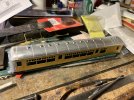
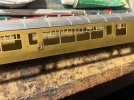
The Wickham units had quite a distinctive set of covers sitting on the roof for the interior lighting units. From the available drawings they are about 4mm round and about 1.5mm high. Paul didn’t have anything suitable but pointed me in the direction of an engineering business in the town. I popped in there and the very helpful proprietor found some 4mm silver steel bar offcuts, which he was happy to let me have for the price of a box of chocolate biscuits.

My next enquiry was to a friend in the village who has a small lathe. He was happy to help and we got six lamp holders cut (out of the roughly two dozen needed) before the drive band on his lathe gave up the ghost and collapsed in a heap of perished rubber and tangled cord. After tidying up the mess (and he is going to buy a new drive band!) I took the half dozen pieces home with the steel bar. This evening I have hand made another five using files and saws and glued enough on to complete one carriage. I think I’ll go back to hand rails tomorrow…

Photo attached.

Nigel
IMG_0679.jpeg
 

James Spooner

Western Thunderer
You’d have whizzed them off on a Myford :))
Yes, I know!! Still thinking along the lines of upgrading my equipment but more along the lines of a micro lathe than a Myford. I’m tempted to take a look at the Warco range, if only because they are a short drive down the A3 from me and if there is a problem I can take it down to them quite easily…

Nigel
 

Ian@StEnochs

Western Thunderer
The really frustrating things with my original Unimat set up was the tiny cut one could take, the 8 minute cooling wait after two minutes cutting and the frequent belt breakages. I just didn't have the patience to persist and have absolutly no regrets at getting a Myford.

Having said that I did have access to one of the bigger Emco machines with the milling column for a while and it was very good but in the end decided to buy British.

Ian
 

Dave Holt

Western Thunderer
Nigel,
Don't know much about DMUs, but you look to have made a nice job of marrying the printed cabs, extruded roof and etched brass sides. I'm sure it will look just the part on Elmham.
Good luck with the chassis/drive arrangements. I've got a Bachmann twin power Cravens, converted to P4 (drop-in wheels, but I can't remember whose make) and it runs very nicely indeed.
Dave.
 

James Spooner

Western Thunderer
Nigel,
Don't know much about DMUs, but you look to have made a nice job of marrying the printed cabs, extruded roof and etched brass sides. I'm sure it will look just the part on Elmham.
Good luck with the chassis/drive arrangements. I've got a Bachmann twin power Cravens, converted to P4 (drop-in wheels, but I can't remember whose make) and it runs very nicely indeed.
Dave.
Thanks Dave. I haven’t done much on it today (just added the lavatory water pipe and some more handrails) as I have been gathering stuff together to help out on the EMGS stand at the Southampton show tomorrow. I try to demonstrate track (points) and re-gauging stuff in the possibly rather naive hope it might encourage others to dip their toes into the finer scale pool…

Nigel
 

James Spooner

Western Thunderer
I had a very enjoyable (and quite productive) day on the EM Gauge Society stand yesterday. I caught up with some friends, had some good conversations on moving to a finer scale level of modelling, managed to make progress on a point I am constructing (for a putative quayside extension to Stratford St James) and purchased some items that will help me progress a few projects. Key amongst the latter was the purchase of six mini motor mounts and servo motors to drive the ground signals under construction (and that will give me an impetus to finish the remaining three).

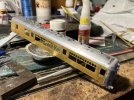
Today I have done some more to the point (rather stupidly, when packing for the show, I omitted to include my pack of track gauges so I couldn’t glue the chairs to the sleepers) and have finished detailing one half of the Wickham set. I have just given it a coat of primer; a photo of the current state of play is attached.

Nigel

IMG_0698.jpeg
 

James Spooner

Western Thunderer
Having got one body to a stage I felt it would be best to see whether my broad theory about fitting it to a Bachmann Derby lightweight underframe and bogies would work.

Careful measurement from both the dimensions on the Wickham drawings and the Bachmann underframe showed that both types of DMU had the same bogie centres (40’) and the inner bogie pivot point was also the same distance from the end (8’6”). That was a helpful start.

The Derby units had vertical tapers on both ends, which to my mind gave them quite an attractive look. It does mean that I will have to fill the gap in the corners at the inner ends with some plasticard. At the outer ends, the 3d printed shape meant I had to resort to the razor saw to cut the end and buffers off. I then had to match the profile of the underframe at the end with the underside of the 3d print, which I did with the judicious use of a file.

I now have an underframe which fits into the body, which is another result! There will be a reasonable amount of reshaping work to be done yet because the door steps are in the wrong place and the Derby had deeper flanges beneath the steps, which the Wickham didn’t. That bit of the project is still outstanding.

Having got an underframe that fitted I decided to regauge a pair of bogies to go under it. The Bachmann wheel flange profiles are very similar to the Alan Gibson EM profiles, although the tyre tread is wider. It then became a toss up either to change the wheelsets (which also means fitting new bearing points etc inside the bogies because the Bachmann wheels are split axle and the axles run in pressed brass sheets that act as a pickup as well as a bearing) or to push the wheels out on the axles.

I took the line of least resistance and drove the provided wheels out using my tried and tested route of placing the pin point bearing in a brass bearing cup (with a recess drilled in the end), which sits in a lump of wood, placing the wheels and axle upright onto that bearing, resting some pliers on the lower wheel and clouting the pliers with a small hammer.

I need next to do some more carving of the underframe and find some nuts, bolts and washers to fix the bogies to the underframe. I also need to do a bit of gentle tidying to the body before painting as well as work out some way of attaching the body to the underframe. A photo of progress to date is attached.

Nigel

IMG_0705.jpeg
 

James Spooner

Western Thunderer
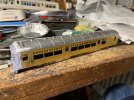
Given the atrocious weather hereabouts recently, with a small break in the rain I took a walk around the commons to clear my head. On my return the rain made a reappearance so I resigned myself to hitting the job that I didn’t really want to do: the creation of another dozen light housings by hand for the motor brake. Classic FM was duly put on, a mug of tea brewed and I set to work. By supper time I had just about completed the dozen and they are shown placed on the roof unglued in the attached photo. I needed a couple of glasses of wine after that marathon so decided to call work to a halt until tomorrow…

Nigel

IMG_0706.jpeg
 

James Spooner

Western Thunderer
Well worth the effort (and wine) I'm sure.
The side windows on these units appear ever so close together, with very thin bars between, which makes them quite distinctive, i think.
Dave.
Thanks Dave. Yes, the look of these units, both in terms of the closeness of the windows and also the quite distinctive ‘frown’ at the ends created by the guttering line dipping in the centre is what appeals to me. Add to that their documented use on the Stour Valley lines and the temptation to try to build a set became irresistible!

Nigel
 

James Spooner

Western Thunderer
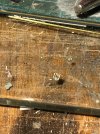
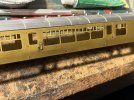
On looking more closely at some of the photos of these units I realised they had fuel tank fillers within the bodywork of the DMBS coaches. The etches don’t allow for them per se and I was in two minds as to whether or not to attempt them. I decided to see if it was within my skillset by taking a line of low risk.

I measured and cut out from some scrap etch brass a 2.5mm square with three tabs, two tapered ones at each side and a rectangular one at the top. The bend lines were then gently sawed and the tabs bent up. Some 1.5mm tube was then soldered in (I’ll fill the hole with some filler). Having proven to myself that I could make a representation of the filler recess I marked out a square 2.5mm where the filler should be and drilled increasing sized holes before finally squaring it off with files. The bent scrap etch was then soldered behind the hole. The photos show better what I have done.

Nigel

IMG_0719.jpeg

IMG_0720.jpegIMG_0722.jpeg
IMG_0723.jpeg
 

Attachments

  • IMG_0723.jpeg
    IMG_0723.jpeg
    392.3 KB · Views: 5

James Spooner

Western Thunderer
I’ve been chipping away at the remaining tasks on the DMBS over the weekend and have finally got to the stage where I have given it a coat of primer. I’ll let that harden for a few days before attempting any further painting.

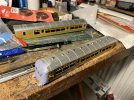
On the underframe side, I have pinged an email to Bachmann in the hope they can supply me with some screws to attach the bogies to the underframe as well as all the mounting screws for the motor block and bogie. Otherwise I might need to improvise. A photo of the two primed bodies is attached.

Nigel

IMG_0730.jpeg
 

cctransuk

Western Thunderer
I’ve been chipping away at the remaining tasks on the DMBS over the weekend and have finally got to the stage where I have given it a coat of primer. I’ll let that harden for a few days before attempting any further painting.

On the underframe side, I have pinged an email to Bachmann in the hope they can supply me with some screws to attach the bogies to the underframe as well as all the mounting screws for the motor block and bogie. Otherwise I might need to improvise. A photo of the two primed bodies is attached.

Nigel

View attachment 256620

Are these the DMUs that ended up in Trinidad?

John Isherwood.
 

Chris Veitch

Western Thunderer
Yes, I know!! Still thinking along the lines of upgrading my equipment but more along the lines of a micro lathe than a Myford. I’m tempted to take a look at the Warco range, if only because they are a short drive down the A3 from me and if there is a problem I can take it down to them quite easily…

Nigel
I presume you're looking at something Unimat-sized - I think Warco used to do something this size but the smallest they now list is their Mini Lathe, which is one version of the ubiquitous rebadged Chinese 7x12s. These are somewhere between a Unimat and Myford and as you probably know, they have a reputation for requiring quite a lot of fettling before they can be really useful and accurate, and probably larger than you need for 4mm scale. I have one of these and also a couple of smaller machines and frankly, I've never really used the Warco much - although it would be different if I'd done any 16mm NG as I'd intended when I bought it. There used to be quite a few smaller Chinese clone machines like the Sieg C0 but these seem to be less common nowadays.

For what you're doing I suspect that a better bet would looking for a well-cared-for used Unimat or Cowells 90 with plenty of accessories - although I'm sure others might have different advice.
 
Last edited:

James Spooner

Western Thunderer
I presume you're looking at something Unimat-sized - I think Warco used to do something this size but the smallest they now list is their Mini Lathe, which is one version of the ubiquitous rebadged Chinese 7x12s. These are somewhere between a Unimat and Myford and as you probably know, they have a reputation for requiring quite a lot of fettling before they can be really useful and accurate, and probably larger than you need for 4mm scale. I have one of these and also a couple of smaller machines and frankly, I've never really used the Warco much - although it would be different if I'd done any 16mm NG as I'd intended when I bought it. There used to be quite a few smaller Chinese clone machines like the Sieg C0 but these seem to be less common nowadays.

For what you're doing I suspect that a better bet would looking for a well-cared-for used Unimat or Cowells 90 with plenty of accessories - although I'm sure others might have different advice.
Thanks for that Chris. Masterly inaction seems to be the order of the day on this putative purchase! It took me longer to hand make the light mounts, but I did it and the need for a lathe seems to come along so rarely my interest in a purchase waxes and wanes!

Nigel
 
Top