
You are using an out of date browser. It may not display this or other websites correctly.
You should upgrade or use an alternative browser.
You should upgrade or use an alternative browser.



AJC
Western Thunderer
And here you are, ready for any EM layout that might welcome them, or the Ffarquar branch (barring a spot of weathering). I suppose the back story - I daresay Awdry had a different one - might go a little like this: the NWR bought a selection of LB&SCR four wheelers at the turn of the 20th century for secondary services and most lasted only a few years before replacement, a handful being retained for branch working. Obviously it's actually a straight lift of the Tenmille kits used in the TV series. In the '30s, the SR withdrew a few fixed sets of six-wheelers from service and two ended up on Sodor, being split in various ways and replacing most of the ragbag of 19th century coaches that included the Stroudley vehicles. Hence this mixed pair. Am I overthinking this? Probably. The brake is depicted as recently overhauled, hence the white roof, the compo' as a bit more workworn.
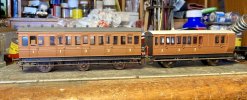

NB - for those interested in liveries, these have a 50:50 mix of Stroudley Improved Engine Green(!) and Precision Weathered Teak. It looks a little like 'Stratford Brown' as it appears in photos to me, but others' mileage may vary... Now, I happen to have an ex-NLR third to dig out for use as a strengthener, built a looong time ago. Should I repaint it?
Adam
NB - for those interested in liveries, these have a 50:50 mix of Stroudley Improved Engine Green(!) and Precision Weathered Teak. It looks a little like 'Stratford Brown' as it appears in photos to me, but others' mileage may vary... Now, I happen to have an ex-NLR third to dig out for use as a strengthener, built a looong time ago. Should I repaint it?
Adam
Last edited:
AJC
Western Thunderer
The Hornby four wheeler looks like HO scale in comparison to the kit built composite - gives me an idea, maybe, with a new six wheel underframe and smaller wheels.
btw the composite looks good.
Thanks - having seen the real thing under restoration at the Bluebell only the other week, I can confirm that they really are pretty tiny, and why not pop one on an H0 chassis? It'd certainly be in proportion. The composite has come out pretty well, the Cleminson arrangement underneath works nicely and my five-year-old has warmed to it. He's very excited that it's done which is part of the point.
Adam
Last edited:

Overseer
Western Thunderer

I think a little height reduction through the windows and it might be pretty close, starting with the five compartment third. There were also 4 compartment first class of the same length. Designed by Stroudley based on the LBSCR carriages, droplights to all windows and double roof were concessions to the different climate.
AJC
Western Thunderer
It’s happened again. The eldest suggested that Thomas on his own wouldn’t do.
Now, a glance in the spares box revealed some Sharman wheels meant for a 9F. I’m not really likely to build that, and well, sufficient wheels for something six-coupled without a wobbly one… a Comet chassis for a Fowler tender, some 14mm spoked wheels I’d ordered in error and a few very cheap bits and bobs, we have something that isn’t quite a Fowler tender. A prize of smug satisfaction available to anyone who can identify the plastic bits.


Hence NWR no. 5 (and some reflections on the Sodor loco fleet…).
Adam
Now, a glance in the spares box revealed some Sharman wheels meant for a 9F. I’m not really likely to build that, and well, sufficient wheels for something six-coupled without a wobbly one… a Comet chassis for a Fowler tender, some 14mm spoked wheels I’d ordered in error and a few very cheap bits and bobs, we have something that isn’t quite a Fowler tender. A prize of smug satisfaction available to anyone who can identify the plastic bits.
Hence NWR no. 5 (and some reflections on the Sodor loco fleet…).
Adam
Last edited:
AJC
Western Thunderer
The Awdry's take on the history of Sodor and its railways is an interesting read. You can find it in PDF form, here:
Looking at it as a historian - I can't help it, it's the job - there's some fairly significant holes, but the medieval stuff is broadly plausible, and I can just about accept that something like the NWR (as it became), might have escaped the Grouping, there's no way on earth Nationalisation would have evaded it.
Let's consider the known facts from the books, enlarged upon by the Awdry's in their 'History'.
1. A glance at the map of Sodor reveals a railway route mileage of over 50 miles of mainline and six branches. A lot since none of the towns appear to be of any size at all.
2. The railway operations of the island demonstrate some BR involvement: the extent is never made clear.
3. The operations seem to require just a handful of consecutively numbered locos which is added to for very specific reasons and accompanied by reopenings ('Thomas' is relocated from station pilot working to branch working for example, 'Duck' and 'Oliver' end up running a branchline that has been reopened - what happened to the station pilot work 'Duck' was acquired for?). Hmm.
4. All this overseen by three generations of the same family running the show spanning a period of over 70 years (the 'Topham-Hatt' problem). Awdry has this being down to an implausible degree of operational independence(!) That's private company behaviour... I can't see Marylebone wearing this.
5. The governance of Sodor is only described in the Awdry's 'History' (and strongly echoes that of the Isle of Man - since we're only a mile or two off Barrow, and Furness was Lancashire North of the Sands - that doesn't wash. Lancashire was eccentric, in local government terms, but not *that* idiosyncratic.
6. The geology of Sodor includes, in no particular order: China Clay, Lead ores, Uranium(!), Slate, Aluminium ore and, apparently iron ore, too.
So before I look at what 'James' might be, a little sample of a history that makes some sense of what the books show.
Sodor Oral History Project 1975 (Interview with Charles Topham-Hatt) [EXCERPT]
INTERVIEWER: You are the second generation of your family to oversee the railways here... how did that come about and what sort of railway did your father run?
T-H: Pa [Sir Topham-Hatt I, d.1956] was a premium apprentice at Swindon in [George Jackson] Churchward's time, before the Great War and came, through the various industries that dominated Sodor, to oversee the standard gauge railways that were left out of the Grouping in 1923. Come 1947, the finances were difficult, the various industries in effect - and later in reality - acquired by the State and this took time to unpick [The Sodor Development Act received royal assent in 1950]. Sodor was deprived and backward. The last war - and the dramatic growth of Barrow - changed the centre of gravity. Minerals apart, the passenger traffic was seasonal - day trippers and so on - and commuters into Furness, which the LMS had cornered through their traffic agreement in the '20s. The through traffic was ours, but the buses had eroded much of that by the late '30s and the last War saw off much of the rest...
INTERVIEWER: The Reverend Awdry has made the railways famous. Can you tell me what you make of that?
T-H: Wilbert never did grasp that Sodor's railways are essentially private. On Nationalisation all the public passenger services, more or less, passed to British Railways. So did much of the common carrier freight, on the main line, anyway. What Wilbert saw, when he first came here in 1950* was the aftermath of that. We hadn't much left, being effectively a subsidy of the Development Corporation. Bluntly, we scrapped almost everything - what locomotives we had left, most hopelessly unsuited, really, we renumbered - and added to, essentially as finances allowed or, in the case of the Ffarquar tramway, because of legal trouble. After Pa retired we managed to get a pannier from Swindon, and to supplement that small fleet - and the Ministry of Supply, who ran much of the railway into the early '50s left us with about a dozen of their saddletanks, which we later sold to the coal board, but basically, our job was to shift private freight.
INTERVIEWER: But that's not what Awdry showed in the books? What accounts for the difference?
T-H: Wilbert is a romantic! He recounts stories Pa told him - which relate to the interwar period mostly - and mixed that with railwaymens' yarns. The briefings for the illustrator were obviously based on his holiday photos, so reflect what you could see in the '50s. Never a BR loco to be seen, of course, but who can blame him? One Stanier five is much like another. He only started paying proper attention when Pa acquired number 7 - which he knew from his time on the Fens, of course - came. It is his favourite, despite everyone's obsession with our number 1; for his sons, too...
...that changed come '63 when it was pretty obvious that Dr Beeching had little use for the passenger railway west of Barrow, all DMUs by then, like all local services around Barrow. To my surprise there is still a BR passenger service, only a handful of trains a day, but even so. Of course the various small railways were coming into their own as tourist attractions and diesels and lorries had taken over the freight, so we diversified. We're now pretty much a tourist concern, which is fairly remarkable, though that's summer only. The buses have seen to that. The North Western has transitioned into a cornerstone of the tourist economy and the growing railway preservation movement. We do run some of the mineral traffic though: commercial steam-hauled freight in the 1970s? Unique in western Europe, I'm told.
More on 'James' when I've invented it!
Adam
* I have Awdry visiting before the Second World War, too (because I can): Scattergun - EM Whimsy: Home James!
Looking at it as a historian - I can't help it, it's the job - there's some fairly significant holes, but the medieval stuff is broadly plausible, and I can just about accept that something like the NWR (as it became), might have escaped the Grouping, there's no way on earth Nationalisation would have evaded it.
Let's consider the known facts from the books, enlarged upon by the Awdry's in their 'History'.
1. A glance at the map of Sodor reveals a railway route mileage of over 50 miles of mainline and six branches. A lot since none of the towns appear to be of any size at all.
2. The railway operations of the island demonstrate some BR involvement: the extent is never made clear.
3. The operations seem to require just a handful of consecutively numbered locos which is added to for very specific reasons and accompanied by reopenings ('Thomas' is relocated from station pilot working to branch working for example, 'Duck' and 'Oliver' end up running a branchline that has been reopened - what happened to the station pilot work 'Duck' was acquired for?). Hmm.
4. All this overseen by three generations of the same family running the show spanning a period of over 70 years (the 'Topham-Hatt' problem). Awdry has this being down to an implausible degree of operational independence(!) That's private company behaviour... I can't see Marylebone wearing this.
5. The governance of Sodor is only described in the Awdry's 'History' (and strongly echoes that of the Isle of Man - since we're only a mile or two off Barrow, and Furness was Lancashire North of the Sands - that doesn't wash. Lancashire was eccentric, in local government terms, but not *that* idiosyncratic.
6. The geology of Sodor includes, in no particular order: China Clay, Lead ores, Uranium(!), Slate, Aluminium ore and, apparently iron ore, too.
So before I look at what 'James' might be, a little sample of a history that makes some sense of what the books show.
Sodor Oral History Project 1975 (Interview with Charles Topham-Hatt) [EXCERPT]
INTERVIEWER: You are the second generation of your family to oversee the railways here... how did that come about and what sort of railway did your father run?
T-H: Pa [Sir Topham-Hatt I, d.1956] was a premium apprentice at Swindon in [George Jackson] Churchward's time, before the Great War and came, through the various industries that dominated Sodor, to oversee the standard gauge railways that were left out of the Grouping in 1923. Come 1947, the finances were difficult, the various industries in effect - and later in reality - acquired by the State and this took time to unpick [The Sodor Development Act received royal assent in 1950]. Sodor was deprived and backward. The last war - and the dramatic growth of Barrow - changed the centre of gravity. Minerals apart, the passenger traffic was seasonal - day trippers and so on - and commuters into Furness, which the LMS had cornered through their traffic agreement in the '20s. The through traffic was ours, but the buses had eroded much of that by the late '30s and the last War saw off much of the rest...
INTERVIEWER: The Reverend Awdry has made the railways famous. Can you tell me what you make of that?
T-H: Wilbert never did grasp that Sodor's railways are essentially private. On Nationalisation all the public passenger services, more or less, passed to British Railways. So did much of the common carrier freight, on the main line, anyway. What Wilbert saw, when he first came here in 1950* was the aftermath of that. We hadn't much left, being effectively a subsidy of the Development Corporation. Bluntly, we scrapped almost everything - what locomotives we had left, most hopelessly unsuited, really, we renumbered - and added to, essentially as finances allowed or, in the case of the Ffarquar tramway, because of legal trouble. After Pa retired we managed to get a pannier from Swindon, and to supplement that small fleet - and the Ministry of Supply, who ran much of the railway into the early '50s left us with about a dozen of their saddletanks, which we later sold to the coal board, but basically, our job was to shift private freight.
INTERVIEWER: But that's not what Awdry showed in the books? What accounts for the difference?
T-H: Wilbert is a romantic! He recounts stories Pa told him - which relate to the interwar period mostly - and mixed that with railwaymens' yarns. The briefings for the illustrator were obviously based on his holiday photos, so reflect what you could see in the '50s. Never a BR loco to be seen, of course, but who can blame him? One Stanier five is much like another. He only started paying proper attention when Pa acquired number 7 - which he knew from his time on the Fens, of course - came. It is his favourite, despite everyone's obsession with our number 1; for his sons, too...
...that changed come '63 when it was pretty obvious that Dr Beeching had little use for the passenger railway west of Barrow, all DMUs by then, like all local services around Barrow. To my surprise there is still a BR passenger service, only a handful of trains a day, but even so. Of course the various small railways were coming into their own as tourist attractions and diesels and lorries had taken over the freight, so we diversified. We're now pretty much a tourist concern, which is fairly remarkable, though that's summer only. The buses have seen to that. The North Western has transitioned into a cornerstone of the tourist economy and the growing railway preservation movement. We do run some of the mineral traffic though: commercial steam-hauled freight in the 1970s? Unique in western Europe, I'm told.
More on 'James' when I've invented it!
Adam
* I have Awdry visiting before the Second World War, too (because I can): Scattergun - EM Whimsy: Home James!
Last edited:

Yorkshire Dave
Western Thunderer
Then of course if the railways of Sodor were nationalised and later privatised the follow up would be Thomas The Privatised Engine by Incledon Clark (written in a similar style to W Awdry). It was originally published in Private Eye during in 1993 and then became a book (ISBN 1857800222/978-1857800227).
AJC
Western Thunderer
Then of course if the railways of Sodor were nationalised and later privatised the follow up would be Thomas The Privatised Engine by Incledon Clark (written in a similar style to W Awdry). It was originally published in Private Eye during in 1993 and then became a book (ISBN 1857800222/978-1857800227).
I dimly remember seeing that - I wasn’t even in my teens then! - obviously there are lots of skits on Sodor, it’s a convenient vehicle.
What interested me about the Awdry’s history is that it was very much stronger in the Middle Ages and the pre-Railway age than the period after 1948 when what was published doesn’t look like a believable railway existing in the UK, unless it sort of becomes a preservation scheme of one form or another. And the Reverend’s later books, which I’ve become reacquainted with recently, tack firmly in that direction, because they’re contemporary with that early preservation scene. So no rationalisation, no Derby Lightweights or BR-liveried Black Fives, or Claytons, but there is a CoBo.
Thomas’ fans have taken it as lore, in the manner in which fans of various film franchises have, in recent years which is quite interesting. Obviously, it exists in exactly that way today!
Being uninterested in that, I’ve gone back to the source material and sketched something that matches what is known. That is a bit less far fetched, something that stands alongside the big NCB systems (Philidelphia or Wemyss), or the latter days of the Shropshire and Montgomery run, smartly, by the army.
Adam
Last edited:
AJC
Western Thunderer
I rather suspect the good Reverend was the master of Rule #1, indeed, he may well have written it!
I'm absolutely aware that I'm invoking this too, of course!
Adam

simond
Western Thunderer
Well…

the kids enjoyed banging a few troublesome trucks (Lima/Big Big minerals & a Lima Toad) on my railway, and a couple of pals let them have running rights too. Both DCC (allows parental control of Vmax) and both plasticard & bits. The “Drewry” was an Atlas, and the Tram engine is Lima-powered.
young Master D is now 27, and Miss D is 25, and neither has shown the least interest in railways in twenty years…
the kids enjoyed banging a few troublesome trucks (Lima/Big Big minerals & a Lima Toad) on my railway, and a couple of pals let them have running rights too. Both DCC (allows parental control of Vmax) and both plasticard & bits. The “Drewry” was an Atlas, and the Tram engine is Lima-powered.
young Master D is now 27, and Miss D is 25, and neither has shown the least interest in railways in twenty years…
AJC
Western Thunderer
Frames erected, with a wheel offered up for appearance’s sake. I have a few scraps of brass that will make good the firebox and ashpan detail, rods from @Dave F.'s erstwhile range (for a Caley Jumbo), and some brakeshoes left over from something else.
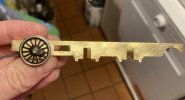
Quite a compact sort of engine is the aim. What few inside-cylindered 2-6-0s that were out there tend to look like 0-6-0s boilered up beyond what would easily steer and that look matters, I think (Awdry's own model, well, the one that wasn't simply a G&SWR 403 class - and Hornby's - started out as a Tri-ang 3f), get this closer than the book illustrators that stick an extra driver under a 4-4-0.
Adam
Quite a compact sort of engine is the aim. What few inside-cylindered 2-6-0s that were out there tend to look like 0-6-0s boilered up beyond what would easily steer and that look matters, I think (Awdry's own model, well, the one that wasn't simply a G&SWR 403 class - and Hornby's - started out as a Tri-ang 3f), get this closer than the book illustrators that stick an extra driver under a 4-4-0.
Adam
Last edited:
AJC
Western Thunderer
A bit of brass wrangling in the odd ten minutes (the online workplace: I couldn't access the Sharepoint). The very simple - firebox and ashpan detail - from scrap etch:

The slightly more involved. A pony truck, probably better than it needs to be, but ultimately, it's a short length of tube just shy of EM back to back, some brass sheet and a spare 00 frame spacer. I'll load it up with lead later.
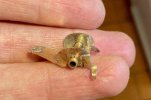
And in place:
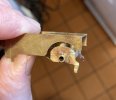
I might be able to resist dummy axlebox detail, but I doubt it - another 10 minutes. Hornguide assemblies are also done, but they came out of a packet. I think I'm now (almost - have to make up the gearbox and compensation beam), ready to assemble all the bits and see if I can make it work...
Adam
The slightly more involved. A pony truck, probably better than it needs to be, but ultimately, it's a short length of tube just shy of EM back to back, some brass sheet and a spare 00 frame spacer. I'll load it up with lead later.
And in place:
I might be able to resist dummy axlebox detail, but I doubt it - another 10 minutes. Hornguide assemblies are also done, but they came out of a packet. I think I'm now (almost - have to make up the gearbox and compensation beam), ready to assemble all the bits and see if I can make it work...
Adam
Last edited:
AJC
Western Thunderer
With the axleboxes in, and an extra spacer popped in amidships, thoughts turn towards the body beautiful. The static ‘Great British Locomotives’ models have provided some of the bits, in the form of a Midland Compound (boiler) and SECR C (cab, tender chassis). There was change from a tenner for those two and leaning quite heavily on the excellent Bachmann models they're very good. There's a brass dome and a better chimney to go with it. The smokebox door? Martin Finney. Sorry Mr Finney.
Not sure about the quite nice surplus Deeley tender; did these only run with Compounds? I think somewhere around in the 'Chapman collection' of bits there's probably a Will's 4F so if one of those had one, a very quick/cheap job could result, assuming that something more appropriate for the SW wasn't a better use of time!

Adam
Not sure about the quite nice surplus Deeley tender; did these only run with Compounds? I think somewhere around in the 'Chapman collection' of bits there's probably a Will's 4F so if one of those had one, a very quick/cheap job could result, assuming that something more appropriate for the SW wasn't a better use of time!
Adam
Last edited:
Not sure about the quite nice surplus Deeley tender; did these only run with Compounds? I think somewhere around in the 'Chapman collection' of bits there's probably a Will's 4F so if one of those had one, a very quick/cheap job could result,
Summerson's Midland Railway Locomotives Volume 4 lists the 11 ex-Midland 4Fs that received tenders from Compounds between 1954 and 1963 on page 96, so the answer is yes, but not many.
AJC
Western Thunderer
Summerson's Midland Railway Locomotives Volume 4 lists the 11 ex-Midland 4Fs that received tenders from Compounds between 1954 and 1963 on page 96, so the answer is yes, but not many.
Marvellous - would you be able to say which ones, by any chance? This obviously is not a book I have...
Adam
