Freelance early steel wagon

Mike W

Western Thunderer
John - the Gauge 3 market is very small, but most of what you mention is not scale specific and probably left from your days of selling metal sections etc? I'd gladly buy 14BA in quantity from you but somebody else may like a wider range.

Jon - A few website now have scanned RCH drawings. The LMS Society is one and here's a typical axle, though later than your period. https://www.lmssociety.org.uk/assets/RCH_1907/RCH_1907_Dwg152.png

Mike
 

NickB

Western Thunderer
Subtract the minimum radius of the tapered portion of the axle from the maximum radius. Divide that by the linear distance between the positions of the two radii. The angle is the inverse tangent (often labelled ATAN on calculators) of that. Or just make trial cuts on a scrap piece of material until you get it right.

Nick
 

Ian_T

Western Thunderer
Jon, the taper is very slight.

Using an RCH axle as an example - the axle tapers down from 5.1/2" to 4.7/8th in the centre - a 5/8th difference. Thats over 50.25" total length "between tyres", so half that in effect.

A quick calculatation gives, if a=.326 and b=25.31 then angle A = 0.74° - it's a very slight taper.

In scale terms you are reducing 6.2mm down to 5.5mm (.7mm) over 28.45mm......you could see this if you looked closely - but would anyone ever do so in practice? Of course you'd know the taper was there! :)

Regards,


IanT
 

Ian_T

Western Thunderer
I was referencing a Standard RCH 12t wagon axle - Dwg No 1020 - April 1923. :)

Regards,


IanT
 

Bigjohn

Western Thunderer
John……I once mentioned to Alan GIbson why he did not taper his axles…….he gave me a very odd look.
My best(?) effort to make the axle in 4 mm rod, then make the tapered part separately before parting off bored to 4mm to make a B to B spacer. Then glue that 4mm rod centrally to complete the axle. Two or four was tolerable before newly invented expletives became necessary.. the spacers might be produced by the 3 D printing brigade. I know nothing of such matters
BigJ
 

Jon Nazareth

Western Thunderer
Thanks to all who replied to this one. I’m going to attempt putting a taper on some brass axles. I’m using brass as it’s easy to machine and, besides, it’s raining today so, no gardening.
Another question. Does anyone know why wagon axles were tapered? It’s such a small reduction that, to me at least, it hardly seems worth doing full size.

Jon
 

Overseer

Western Thunderer
Thanks to all who replied to this one. I’m going to attempt putting a taper on some brass axles. I’m using brass as it’s easy to machine and, besides, it’s raining today so, no gardening.
Another question. Does anyone know why wagon axles were tapered? It’s such a small reduction that, to me at least, it hardly seems worth doing full size.

Jon
At the time your wagon would have been built all axles were parallel. It was found they tended to break near the centre and the solution was found to be tapering the axle to allow some flexibility. The problem is mainly torsional forces due to wheels trying to go different speeds around curves.
 

Jon Nazareth

Western Thunderer
At the time your wagon would have been built all axles were parallel. It was found they tended to break near the centre and the solution was found to be tapering the axle to allow some flexibility. The problem is mainly torsional forces due to wheels trying to go different speeds around curves.
Thank you for that, Overseer.
Ah, that means that I won’t be gaining anything, aesthetically, if I taper them. Mm, more thinking to be done.

Jon
 

Bigjohn

Western Thunderer
I was referencing a Standard RCH 12t wagon axle - Dwg No 1020 - April 1923. :)

Regards,


IanT
John - the Gauge 3 market is very small, but most of what you mention is not scale specific and probably left from your days of selling metal sections etc? I'd gladly buy 14BA in quantity from you but somebody else may like a wider range.

Jon - A few website now have scanned RCH drawings. The LMS Society is one and here's a typical axle, though later than your period. https://www.lmssociety.org.uk/assets/RCH_1907/RCH_1907_Dwg152.png

Mike
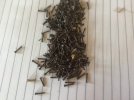
Mike……..14BA, these of any use? They are probably worth £20 more than you are willing to pay. The middle brass are washers. Please don’t ask me to count them. Some more junk added, including some finished bogie wheels.
12BA also available……….john
 

Attachments

  • IMG_0683.jpeg
    IMG_0683.jpeg
    373.1 KB · Views: 15
  • IMG_0680.jpeg
    IMG_0680.jpeg
    396.3 KB · Views: 14
  • IMG_0676.jpeg
    IMG_0676.jpeg
    315 KB · Views: 14
  • IMG_0726.jpeg
    IMG_0726.jpeg
    340.7 KB · Views: 12
  • IMG_0713.jpeg
    IMG_0713.jpeg
    323.7 KB · Views: 13

Bigjohn

Western Thunderer
Thanks to all who replied to this one. I’m going to attempt putting a taper on some brass axles. I’m using brass as it’s easy to machine and, besides, it’s raining today so, no gardening.
Another question. Does anyone know why wagon axles were tapered? It’s such a small reduction that, to me at least, it hardly seems worth doing full size.

Jon
Jon…….to avoid wasting brass I have some finished 8mm dia axles. If you let me have your address I will pop a few in the post
to play with, you will have to work out how to mount them in the lathe!!!!!!!!
ATB….john
 

simond

Western Thunderer
At the time your wagon would have been built all axles were parallel. It was found they tended to break near the centre and the solution was found to be tapering the axle to allow some flexibility. The problem is mainly torsional forces due to wheels trying to go different speeds around curves.
This is curious. A torsional load would (assuming a constant section) be evenly distributed along the axle, whereas the taper would appear to concentrate the stress at the narrowest section.

From a bending perspective, and ignoring cornering forces, the axle is in four-point bending and thus has a constant bending moment between the wheels. Again, the taper would appear to concentrate stresses at the smallest diameter. I suspect cornering forces are small compared to the weight.

I'm intrigued.
Simon
 

Jon Nazareth

Western Thunderer
This week, I have been mostly messing about experimenting with scrap pieces of 1/4” stuff in an attempt to make tapered axles. The picture shows how they turned out.
In the end, I made the axles as per my usual way and centred the ends. One taper was formed with the body of one of the axles gripped in the three jaw and supported the other end in a revolving centre. I plunged into the middle of the axle about .025 with a round nosed cutter and used the same cutter to machine the taper. For the other taper on the same axle, I gripped the section that passes through the wheel in the chuck, supported the other end with the revolving centre and machined the taper carefully stopping the cut in the middle of the axle. The dimensions of the taper were based on the page supplied here by Pete S.
I soldered a piece of copper wire into the drilled out centre of each axle. This made something to keep a hold of while I dipped the brass axles into a blackening solution.

Jon

IMG_4021.jpegIMG_4020.jpeg
 
Last edited:

timbowales

Western Thunderer
I admire your machining endeavours but, once the wheelset is underneath a wagon, is it actually visible?
Seems a lot of effort for something that cannot easily be seen?
 

Mike W

Western Thunderer
Very interesting Jon as I've wanted to try this for a long time. You have made up my mind for rme - its not worth doing!

Mike
 

Jon Nazareth

Western Thunderer
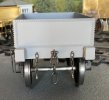
I managed to take advantage of the recent warm weather to get some paint onto the second wagon. I’ve stopped using black, for when I do paint ironwork, here I’ve used Railmatch roof dirt. I took an end-on picture to see if the taper on the axle showed up. Mm, not really and the links from the hook tend to disguise it a bit.
All in all, I’m pleased how the wagon has turned out

Jon

IMG_4099.jpegIMG_4100.jpegIMG_4101.jpeg
 
Top