
Heljan class 45/0, conversion to S7

RichardG

Western Thunderer
I am half-way through converting a Heljan class 45/0 to ScaleSeven. I am using the original Heljan parts throughout; so far there are no new parts.
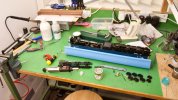
DSC_2655.jpeg
I tidied my workbench for this photo. I think I've got everything in here except the lathe and its trappings. The microflame torch and the pot of vegetable oil are for colouring the outermost axles. The hammer is for getting wheels off and for getting the outermost axles back in. Nothing too subtle.

DSC_2649.jpeg
A method of setting up two wheels on their axle. The centre is adjusting the left-most wheel. Home-made B2B gauge.

I am thinking of posting photos of my own methods and techniques, not a detailed blow-by-blow account. If people would like photos of particular details, do say. I can take them while I do the second bogie.
 

RichardG

Western Thunderer
That would be useful, and you should include the hammering activities if they are integral to the process (but agreed, not every blow).

Yes. There is an established principle of technical illustration, to show special tools but to omit common hand tools unless they are being used in a non-standard way. For example, a hammer being used to set up a wheelset is okay, but knocking in a nail punch is irrelevant.

Let me wait and see if people ask for anything. Then I can post existing photos in a logical sort of sequence, and take fresh ones while the second bogie is underway.
 

simond

Western Thunderer
I'd like to see how the two-handled hammer is used. Never seen such a thing before.

I appreciate that might be more Tony's world than Richard's...
 

richard carr

Western Thunderer
Well I would just say that having converted over 50 heljan locos to S7, never have I had the need to use a hammer to put the wheels back on.
I would say that using a hammer is a sure way to end up with a wobbly wheel.

Richard
 

RichardG

Western Thunderer
Well I would just say that having converted over 50 heljan locos to S7, never have I had the need to use a hammer to put the wheels back on.
I would say that using a hammer is a sure way to end up with a wobbly wheel.

Richard, you haven't got a clue what the hammer is for, but it sounds like you want to damn me as soon as you can, before I have written a word.

With 50 locos behind you, I reckon you are a professional modeller. I have already been cut to shreds by another so called "professional" on WT. Do you want to do the same? Because if yes, I will stop posting here right now. Life is short enough without having to field the know-alls.
 

Eastsidepilot

Western Thunderer
As an apprentice carpenter to my Father he used to say "the only thing you use a hammer for is to knock a nail home and to pull it out if you bend it .... but you'll learn not to bend it !" :D
As for converting to S7 a hammer should be seen and not used :))
 

RichardG

Western Thunderer
SorryI don't want to damn you, I just don't want you to end up with wobbly wheels.
Sorry Richard. I understand completely and I didn't mean to sound quite so "reactive". All of the wheels on my first bogie are looking good :thumbs:

I have written a foreword to explain the context of my efforts. I'd like to post this soon, but I'll wait a wee while in case the "big hammer" people wish to continue a bit.
 
Last edited:

richard carr

Western Thunderer
Richard

Your wheels are indeed looking very good, but I know from experience that the most difficult task with this is getting the wheels back on the axles without a wobble.

using the lathe to help is a good way of doing this and you photo with the back to back gauge seems to show us how you are doing it, but I am totally flummoxed as to why you would need a hammer to assist that ?

The other issue I have had (and many others as I understand it) is the front carrying axle of each bogie has a tendency to derail.
The only thing that seems to help is to reduce the side play to a minimum and add some weight to the truck.

I hope that helps

Richard
 

RichardG

Western Thunderer
Richard


What are you suggesting?


:))
I am trying to suggest, it is better for people to finish discussing off-topic hammers now, rather than returning to the subject later. Because the thread will then become almost impossible to follow.

I emphasise, I am not trying to "tease" people, rather to set the scene.

The whole point of mentioning the hammer early on was because I wanted to include a comprehensive photograph of hand tools at the start of the thread, by way of a simple introduction. That is all. There is nothing clever going on here.

As an apprentice carpenter to my Father he used to say "the only thing you use a hammer for is to knock a nail home and to pull it out if you bend it .... but you'll learn not to bend it !" :D
As for converting to S7 a hammer should be seen and not used :))
I used the hammer with a nail punch to knock axles out of wheels. I don't see a problem with this.

I also used the hammer for another task, which I will try my very best to explain later, in its proper context. But it is daft to go even further off-topic right now, before I have posted my foreword and described my special-to-type tools.

Your wheels are indeed looking very good, but I know from experience that the most difficult task with this is getting the wheels back on the axles without a wobble.

Thanks Richard.

using the lathe to help is a good way of doing this and you photo with the back to back gauge seems to show us how you are doing it, but I am totally flummoxed as to why you would need a hammer to assist that

Richard, I posted the photo of the lathe to set the scene and to see if the thread generated interest.

Please don't be flummoxed. I have written detailed notes to explain what I did, and it would be a shame to throw them away. I really would like write my story in my own words, to describe what I did in the sequence I did things. Otherwise, I am going to be writing dozens of reactive responses to queries, the thread will end up containing duplication and most likely contradictions. The hammer has nothing to do with the use of the lathe to set up the driving wheels.

The other issue I have had (and many others as I understand it) is the front carrying axle of each bogie has a tendency to derail.
The only thing that seems to help is to reduce the side play to a minimum and add some weight to the truck.
I haven't got it on the track yet. The loco ran fine at NEEGOG (0 gauge track) but I can see the design of the pony truck is pretty weak.

I'll post my foreword tomorrow. I think I will find the thread easier to handle if people are able to comment on what I have written.
 
Last edited:

RichardG

Western Thunderer
I can always split (branch) these posts off to a new thread if you want to keep this thread focussed on the modelling.
This might help a lot.

I am finding this thread really difficult to manage because every time someone asks a question I have to decide how to answer it without contradicting the material I have written but not yet posted. And then we have people posting about industrial hammers - perfectly valid but nothing to do with the modelling.

My plan when I started this thread was to post my account in sections over a few days, and then use any feedback to improve my techniques for the second bogie. But the posts are coming in at random, and are taking so much effort to answer, I have carried on regardless with the second bogie. The timing has all gone to pot.
 

RichardG

Western Thunderer
I'll post my foreword tomorrow. I think I will find the thread easier to handle if people are able to comment on what I have written.

Foreword.

This is an account of my first conversion of a loco to ScaleSeven. I am concentrating on details I have not seen written up elsewhere. The account is not intended to be definitive or prescriptive; but is rather an opportunity for me to share some of my own methods and mistakes. When I use the imperative tense, this is for brevity not as a directive.

This entire model, bought brand new after the takeover of Heljan by Accurascale, cost barely more than eight axles of wheels from Slater’s. The design and manufacturing processes have made obvious economies.

DSC_2620.jpeg
In particular, the tyres are plated and carry marks from the factory tooling. Underneath the plating the wheels are solid brass, and a very hard grade of brass at that, and they are horrible to turn. This exercise isn’t as much fun as it might appear.

Nevertheless, the model runs as a 1-A-1-A + A-1-A-1, with the powered wheels supporting the model and the rest simply going along for the ride. With only four powered axles, the task is less daunting than it might appear; really the model is a Bo-Bo with extra carrying wheels. The only really fiendish thing I have found is refitting the two outermost axles.

For 0-MF modellers:

Experience and received wisdom tells me, a wagon with S7 wheels can run happily on 0-MF track. My deviation from the standards has been to set the B2Bs to around 29.8 mm, being 0.5 mm greater than the usual 29.3 mm for FS. The Heljan wheels here are held on their axles by friction, so it seems perfectly possible to do this conversion for an 0-MF layout instead of S7; or indeed later to convert my finished model to the narrower gauge. The constraint being how many times the axle bushes will survive being moved.

For 0-F modellers:

The Heljan wheels have flanges around 1.6 mm deep; deeper than GOG coarse scale as well as GOG fine scale. I am using the profile tool from the ScaleSeven Group; but I am pretty sure the same methods would convert the wheels to true 0-FS. Just use the applicable profile tool and leave the wheels at their original thickness.

For all:

I will pause here, to let me respond to fresh questions before I post about the special tools.
 
Top