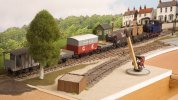
It’s not super clear.
AI Overview
Limewash (or lime wash) as a disinfectant for cattle wagons in the UK was formally banned in the
mid-1920s, with most sources citing 1926 or 1927. The practice was phased out because the lime was found to be harmful to the animals' hooves, replacing it with liquid phenol-based disinfectants.
- Timeline: While some evidence suggests the use of lime ceased around 1924, it was formally prohibited under the Animals (Transit and General) Order of 1926/1927.
- Purpose: The white, lime-based coating was applied as a disinfectant inside wagons rather than as a paint.
- Replacement: Following the ban, railway companies transitioned to using liquid cleaners.
RMW.
https://www.rmweb.co.uk/topic/70648-cattle-wagons-and-limewashwhitewash/
It was prohibited to use limewash under the Animals (transit and General) Order of either 1924, 1926 or 1927 - regret that I can't find the originals to trace which of these it was but I suspect judging by GWR amendments that it might be 1926.
Mike.
The Stationmaster (RIP)
Though this appears fairly conclusive
Posted April 15, 2013
In the
parliamentary debate of 27 Feb 1924 on the Diseases of Animals Bill, Mr Clayton asked
"...There is also the question of disinfecting railway trucks, docks, stations and markets. At present the principle in most cases is simply to whitewash, which is absolutely useless for the purpose. I would suggest that the Ministry look into the question of seriously disinfecting..."
and Major Steel asked
"...Has the Minister taken step to approach the railway companies with a view to getting them to disinfect and clean out the cattle trucks far more thoroughly than they are in the habit of doing in ordinary times?"
The speaker's responce to Major Steel was
"I have to remind the hon. and gallant Member and the House that, on the Third Reading of a Bill, the discussion is confined to the contents of the Bill, and is not of the same width as the discussion on the Second Reading of the Bill. I do not think the powers conferred by this Bill include the matters just referred to by the hon. and gallant Member, namely, the destruction of sacks and the cleaning of the railway trucks."
From which it seems reasonable to assume that limewashing was then still current. As Mike has written while I am typing, the Animals (Transit and General)(Amendment) orders or 1924, 1925 and 1926 are proving difficult to trace online, but the
Transit of Animals Order 1927 24 (i) says
"The floor, roof, sides, of the inside of the truck, and the sides, ends,, and fittings of the outside of the truck, and all other parts thereof with which any animal or its droppings or other excretions, have come in contact shall be scraped and swept, and the scrapings and sweepings, and all dung, sawdust, litter and other matter shall be effectively removed therefrom; then the same parts of the truck shall be thoroughly washed or scrubbed or scoured with water; and then be disinfected by being thoroughly coated or washed with an approved disinfectant."
Nick
edit, had to nip out for a few minutes so finished that too abruptly. "Approved Disinfectant" is defined as:
"...either a five per cent. solution of standard phenol, or a disinfectant approved by the Minister for the purposes of the Diseases of Animals (Disinfection) Order of 1926, if used at the dilution at which such disinfectant is so approved."
So, it looks like the 1926 order is probably the origin of the 5% phenol solution as a replacement for limewash. Unfortunately,
that order has not been digitised so is not available online
I guess between ‘26 & 27, so after Richard’s model and before mine.