Dave Holt
Western Thunderer
Having previously posted about the Class 27 I worked on for a friend, I thought it better to start a new thread for my own model.
I know the B1 isn't finished and there's another Black 5 ticking away in the background, but outside factors have caused me to start thinking about the Class 27 again and to make a start on the chassis.
The model utilises the Craftsman kit to provide the body and a Palatine Models P4 chassis kit. However, just to complicate matters, I'm going to try to fit working Joy valve gear and that requires some majir additiions to the chassis kit and a change from the intended CSB to beam compensation. These days, many might consider that a retrograde step but the massive curved guide reverser casting for the valve gear is right smack where one of the CSB supports needs to go - and, if I'm honest, I'm probably a bit more comfortable with beams.
Another deviation from the Palatine Models idea is to mount the motor in the firebox area, whereas the original model has a tender mounted motor driving the rear coupled axle via a cardan shaft. To aid traction, I'm intending to hang the front of the tender onto the rear of the loco to transfer some addional weight, another first for me, although not uncommon I believe.
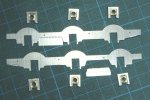
Anyway, a start has been made by preparing a set of slimline High Level horn blocks and guides and cleaning up the side frames. The Palatine frames have nicely etched ash pan sides included, but in my model these will be part of the inner frame overlays and so need to be removed. The photo shows one done and it does leave the frames looking rather shallow till the overlays are fitted.
Frames and horns.
Dave.
I know the B1 isn't finished and there's another Black 5 ticking away in the background, but outside factors have caused me to start thinking about the Class 27 again and to make a start on the chassis.
The model utilises the Craftsman kit to provide the body and a Palatine Models P4 chassis kit. However, just to complicate matters, I'm going to try to fit working Joy valve gear and that requires some majir additiions to the chassis kit and a change from the intended CSB to beam compensation. These days, many might consider that a retrograde step but the massive curved guide reverser casting for the valve gear is right smack where one of the CSB supports needs to go - and, if I'm honest, I'm probably a bit more comfortable with beams.
Another deviation from the Palatine Models idea is to mount the motor in the firebox area, whereas the original model has a tender mounted motor driving the rear coupled axle via a cardan shaft. To aid traction, I'm intending to hang the front of the tender onto the rear of the loco to transfer some addional weight, another first for me, although not uncommon I believe.
Anyway, a start has been made by preparing a set of slimline High Level horn blocks and guides and cleaning up the side frames. The Palatine frames have nicely etched ash pan sides included, but in my model these will be part of the inner frame overlays and so need to be removed. The photo shows one done and it does leave the frames looking rather shallow till the overlays are fitted.
Frames and horns.
Dave.