Mickoo's BR modelling

Jordan or Plymouth Mad

Mid-Western Thunderer
The 50 does look good Mick, but you’re right about niggles. From the photos, it looks as if there may be something wrong with the profile of the lower cab sides where they transition
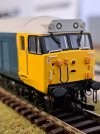
Interesting about 'niggles', and which might cause bother or not. For me it's always cab windscreens - they define the 'face' of a diesel or electric so much. The windscreens of the 50 have been notoriously hard to get correct in model form over the years, and I'm not convinced the HJ 50 gets them 100% right either - although the black windscreen surround helps mask it on the Large Logo livery.
One model 50 that does get it right - in my view anyway, and possibly quite surprisingly for some - is the Hornby TT:120 Class 50. I think the complex windscreen rake has been nailed, here.

OK, stop laughing everyone at the Front of the Class. :oops: ...for myself it's also a financial consideration, as well as an oppotunity to own some Nostalgia and also have space to actually give these 'big diesel' classes a good run.
Anyway in close up, much larger than life size, I think the Hornby TT:120 Class 50 stands up quite well. It still isn't perfect, but being smaller, the imperfections aren't so obvious either - especially without a microscope, or 'readers' :p ;)
20250411_103448.jpg

20250411_103536.jpg

20250411_103425.jpg
 

daifly

Western Thunderer
I took this at the NRM in July 2012 and shows that the basics aren't bad. One of the reasons I gravitated away from TT-3 some 60 years ago was the coarseness of the finer details such as windscreen wipers and handrails which, whilst a consequence of the need for robustness at the scale, are still jarring to my eye.
Dave
DSC02533 copy.JPG
 

mickoo

Western Thunderer
Interesting about 'niggles', and which might cause bother or not. For me it's always cab windscreens - they define the 'face' of a diesel or electric so much. The windscreens of the 50 have been notoriously hard to get correct in model form over the years, and I'm not convinced the HJ 50 gets them 100% right either - although the black windscreen surround helps mask it on the Large Logo livery.
One model 50 that does get it right - in my view anyway, and possibly quite surprisingly for some - is the Hornby TT:120 Class 50. I think the complex windscreen rake has been nailed, here.

OK, stop laughing everyone at the Front of the Class. :oops: ...for myself it's also a financial consideration, as well as an oppotunity to own some Nostalgia and also have space to actually give these 'big diesel' classes a good run.
Anyway in close up, much larger than life size, I think the Hornby TT:120 Class 50 stands up quite well. It still isn't perfect, but being smaller, the imperfections aren't so obvious either - especially without a microscope, or 'readers' :p ;)
View attachment 238002

View attachment 238003

View attachment 238001
That looks nice, likewise one of my hate anoraks is also glazing, not necessarily the shape but the thickness.

I think the thickness goes a long way toward distorting things and jarring the eye, correct that and maybe some of the other niggles go away?
 

mickoo

Western Thunderer
A little more me time today, in this case my BR Blue interest bubble, focused on my spotting years 1979-1982 but primarily 1981 as that was my last full year spotting and the last year for Deltics and 76's.

I'm slowly acquiring kits and stock here and there and now have a rash of Peaks in the collection, three JLTRT kits and one Heljan body. Most of this morning was spent researching engines to match all the different types of headcode I have here. I'd also got some bits and bobs from the JLTRT rummage box at Stafford few years back, enough to make a 46 body only.

One of the Kit's is almost completely built, quite well it has to be said but some joints need refixing and I'll strip the paint off to see what's underneath, the bogies are both powered so I'll recover one set and use it to power another in the stash. The bogies also look like resin ones so it'll be interesting to see what's under the paint.

Unfortunately two of the models are split headcodes and have doors on the front so very early built engines from the early 60's period. I also found out today that very few split code Peaks survived after 1980. The upshot is that I'll smooth the whole front end off and add marker lights, but that's a later project.

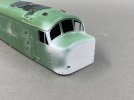
Today was all about the Heljan shell, it's going to be 45 038 'The Manchester Regiment' and by 1981 it had sealed beam lights, the shell came as a split bar in Green so was duly stripped down, details cleaned off and blanks stuffed in the holes, I also too the opportunity to remove the mould lines on the front pillars and by the lamp brackets, they're hardly visible but whilst I was poking around that area it seemed a good thing to do.

I'll let the paint harden on the first end and then add fine filler to get it nice and smooth and open up the holes for the 3D sealed beam lights. The next step is to blank off all the openings and steps in the body.

Img_4101.jpeg

Img_4135.jpeg

Img_4136.jpeg

Img_4137.jpeg

Img_4138.jpeg

Img_4139.jpeg
 

warren haywood

Western Thunderer
Check up on Manchester Regiment Mick, I remember seeing it in Swindon works late 79(?), don’t think it ever came out and was withdrawn in 1980 I belrive, one of the first few
 

richard carr

Western Thunderer
Hi Mick

I've just checked my Platform 5 Motive Power Pocket Book, Summer 1981 Edition (60p).

The Manchester Regiment is described as ZL(U), which translates to stored unserviceable at Swindon works. At least it hadn't been officially withdrawn.

Richard
 

mickoo

Western Thunderer
Well spotted chaps, I'm reasonably transient on actual loco's except #14 (later).

The latest photo I can find of #39 is Oct 1980 in service and the earliest when stored at Swindon is Mar 81

My broader dateline is 79-82 (spotting days) so that I don't run amok and amass stuff outside of that window if possible, but a tighter 'preferential' date is 1981 where possible.

I've also got to try and match all the nose ends I have here with engines that retained those details in 1981 and that's not so easy as a great many were plated over starting around 1977 I think.

The only must have is 45 014 'The Cheshire Regiment' which I had as haulage from Sheffield to Manchester Piccadilly; my first trip for my brother and I on the Boat train from Ipswich for a week long stay with my grandparents in Macclesfield. They never had a phone in the house so we drove out that evening to North Rode (Stoke cut off line) and rang our parents from a pay phone to say we'd arrived safely). Anyway, #14 is probably the first Peak I ever saw and it sticks in my mind over pretty much all others, so that has to be in the collection.

The problem is it was split bar (which I have and prefer) up until late 1980, possibly Aug - Oct for the refit and sealed beams. I have two choices, trade #39 sealed beam for #14 in 1981 and choose another split bar that survived into 1981 (45 036, 128, 141); or, keep both as originally planned and open the date line back to mid 1980 and apply rule #1.

I don't have a 45/1 in the alloted fleet right now so the switch around would solve the date issue at the loss of #39 and sealed beam #14.
 

mickoo

Western Thunderer
So Mick, you only had 1 peak for haulage, you lucky thing, for us dedicated 40 bashers, they were the bane of our lives always turning up when they shouldn't.
I've nothing against them now of course another great 60s era diesel these days.


Richard
No, I had many many more but only marked that aspect down in 1980 and probably not that accurate either missing many off the book, it's just #14 was the most memorable for me.

Don't recall ever getting a 40 for haulage or a 46 and only one Deltic (which I've forgotten) but then that wasn't my ambition and rarely went on routes where they were prevalent.
 

mickoo

Western Thunderer
Boxes on wheels..... :eek: The BR AL classes are actually quite complex shapes when you look up close.
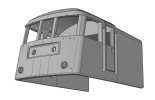
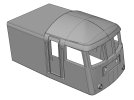
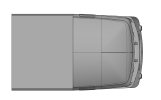
Something for myself over the weekend, working up a 3D AL3 test print, specifically for proportions and print settings/orientation so there's a few details not present yet.

The windscreen supports are place holders as I'm not sure yet how best to add them, either and etched overlay or thin 3D or even part of the main structure. The main problem is that the optimum orientation for the windscreen is not the same as the cab section.

There's a few niggles in the cab roof which could take hours to sort in CAD (Autocad isn't intuitive for complex compound curved shapes) but 30 seconds with fine abrasive paper after printing, the same goes for the base of the nose which is a different radius to the sides, much easier to post process than grind through CAD; though I do have an inkling of an idea that might get halfway there in CAD.

The AL3 drawings I have are pretty generic but the AKL4 and AL5 are better, luckily all the classes were reasonably generic, it's just the details that differ, handrails, headcode boxes, sheet work profiles etc.

AL3-01.jpg

AL3-02.jpg

AL3-04.jpg

AL3-05.jpg

AL3-06.jpg

AL3-07.jpg
 
Last edited:

Yorkshire Dave

Western Thunderer
The windscreen supports are place holders as I'm not sure yet how best to add them, either and etched overlay or thin 3D or even part of the main structure. The main problem is that the optimum orientation for the windscreen is not the same as the cab section.

Interesting - I think a small lip inside the 'mouth' opening may be the route. I've tried to sketch it on your picture.

The lip has only to be half the depth of the window frames and provides something onto which the frame can butt up to and the glazing can be added inside afterwards. I've tried to show this in the left hand sketch - lip = green, window frame = purple, glazing = blue.

The window frames I think should be an etch in five parts as they are all flat and it would be difficult to fold in three planes.

Once installed the corners can be formed from filling, filing and sanding. I've also tried to sketch the corner pillars on the picture. Lip = green, window frame = purple, body/pillar = brown. Once the frame is installed the pillar can be filed/sanded back to inside he red line to form the corner.

Mickoo.jpg
 

mickoo

Western Thunderer
Interesting - I think a small lip inside the 'mouth' opening may be the route. I've tried to sketch it on your picture.

The lip has only to be half the depth of the window frames and provides something onto which the frame can butt up to and the glazing can be added inside afterwards. I've tried to show this in the left hand sketch - lip = green, window frame = purple, glazing = blue.

The window frames I think should be an etch in five parts as they are all flat and it would be difficult to fold in three planes.

Once installed the corners can be formed from filling, filing and sanding. I've also tried to sketch the corner pillars on the picture. Lip = green, window frame = purple, body/pillar = brown. Once the frame is installed the pillar can be filed/sanded back to inside he red line to form the corner.

View attachment 245911
Pretty much along the lines I was thinking, the current pillars are just placeholders so not accurate and prone to tweaking in due course and the ledges you've drawn will be going in later to support either an etch or a 3D print.

I think the whole front can be done in one etch with two folds and blended in the corners as you note, you just have to compensate for the rake when you draw the net outline.

In the flat the top one won't work but the lower one will when bent, there's a calculation to work out X if you know the rake Z and angle Y, I did it in tech drawing but that was 45+ years ago. You could also do the side pieces as well but that's a massive barn door for Captain cock and his merry crew to gate crash the party.

Image1.jpg

AL3-03z.jpg

AL3-04x.jpg

A 3D print of the front screen to drop in is the other option and at 0.5-0.6 mm it's certainly viable and one in place plenty strong enough, trials with the EM1 and VL80 showed you can go down to 0.4 mm but run the risk of edge warping. If you break out the front screen you can then optimise it's orientation to get the best print, it's not the same as the bulky body though; which means adding the front and side screens into the main body is a tale of woe and crossed fingers/toes. Sometimes it works, most of the time it fails....not fun on a 30 Hr print.

The down side to an etch is minimum cost is £75 give or take a few shekels, you'd have to fill the sheet with several trial angles and wing it.

The corner posts are not curved, that's a common mistake many make, they're flat sections bent with the edges radiused, each class is slightly different. The side windows also lean in at the top and I think the corner post may well do so as well. The front main screens are not uniform either, the outside edges taper in at the top as well....but not the same as the side panels.

The side panels will almost certainly have to be an etch, the AL4 has a quarter light in a rubber grommet with radiused corners, the Al3 does not, it's a simple thin frame affair.

Img_3021.jpeg
 

Yorkshire Dave

Western Thunderer
The side windows also lean in at the top and I think the corner post may well do so as well. The front main screens are not uniform either, the outside edges taper in at the top as well....but not the same as the side panels.

Yeah, it's evident from the photo of the AL4 both fixed quarter light and the droplight windows lean in which is evident from the painted rear pillar, to accommodate the tapering of the roof towards the front.

I think the whole front can be done in one etch with two folds and blended in the corners as you note, you just have to compensate for the rake when you draw the net outline.

A three piece cab window etch would work - front and two sides. I would probably shy away from 3d prints as they will be fragile - unless you print spares or include the central pillars for a bit of additional support/strength. It would only take a wayward finger/object to dislodge or break them.
 

mickoo

Western Thunderer
A three piece cab window etch would work - front and two sides. I would probably shy away from 3d prints as they will be fragile - unless you print spares or include the central pillars for a bit of additional support/strength. It would only take a wayward finger/object to dislodge or break them.
The pillars and longitudinal ledges would stay to give it strength. You're talking a top and bottom edge of about 1.5 mm high and 0.5/6 mm deep, the corner posts are pretty meaty and the centre posts can be quite chunky as well, profiled correctly they'll have minimum impact. Once the 3D screen is in and secured it'll be quite robust I think.

The side panels/windows will almost certainly have to be an etch or scratch built from brass.

But hey, that's why I'm building a test pig, to learn all these pitfalls.
 

Matt Rogers

Member
Following this with interest!

There are subtle yet distinctive differences in the face of 82/83/84 in comparison to say the 81/85 (cab quarterlights are different on these two, along with the distinctive cab tumblehome on the 81), my working theory is the same jigs were used on the 81/85.

Class 82 - Note the main windscreen is a lot more square with the cab corner pillar and not very much lip between the bottom of the window frame and the cab front:

Class 83 - Note how the main windscreen has a distinct angle with the cab corner pillar:

Class 84 - Note the main windscreen is similar to the 83, but that the marker lights are in a significantly higher position than all the other early ALs:

Untitled-1.png

Regards
 
Top