7mm Mid-Century mineral

Suddaby

Western Thunderer
Hi,

Interested to see that you are modelling the Hull Corporation Electrickery wagon.
There is a photo and more details in PO Wagons V3 by Bill Hudson.
He gives livery details as follows:- Grey Body, partial black ironwork, white letters, black shading. The small lettering reads: "Empty to Hickleton Main Colliery Co. Ltd. Near Doncaster". Underneath that on the floor plank it says: "H&B Rly. Load 12 Tons". All this small lettering is in a lovely italic script.
A couple other refs - MRJ 12 and 15 though these are the usual photos seen elsewhere.

Although I am from Hull originally, I have lived in Derbyshire for over 45 years; the wagon was built at Derbyshire Carriage and Wagon Co, New Whittington Chesterfield, about 10 miles North of where I now live!

All the best,

Kevin
 

Overseer

Western Thunderer
Hi,

Interested to see that you are modelling the Hull Corporation Electrickery wagon.
There is a photo and more details in PO Wagons V3 by Bill Hudson.
He gives livery details as follows:- Grey Body, partial black ironwork, white letters, black shading. The small lettering reads: "Empty to Hickleton Main Colliery Co. Ltd. Near Doncaster". Underneath that on the floor plank it says: "H&B Rly. Load 12 Tons". All this small lettering is in a lovely italic script.
A couple other refs - MRJ 12 and 15 though these are the usual photos seen elsewhere.

Although I am from Hull originally, I have lived in Derbyshire for over 45 years; the wagon was built at Derbyshire Carriage and Wagon Co, New Whittington Chesterfield, about 10 miles North of where I now live!

All the best,

Kevin
Thank you, I thought it looked grey in the builders photo but making assumptions based on b/w photos is risky. It will end up with only remnants of the livery, so it won’t be pretty.
 

Suddaby

Western Thunderer
Hi,

One thing I didn't mention above is regarding the reference in MRJ12, is that it is part of Chris Crofts treatise on building PO wagons (all be it in 4mm scale). This spanned issues 12 to 15, with a catch up in 21. He did build a 7mm Slaters kit for Inkerman St in Iss 31.

Cheers,

Kevin
 

Overseer

Western Thunderer
Hi,

One thing I didn't mention above is regarding the reference in MRJ12, is that it is part of Chris Crofts treatise on building PO wagons (all be it in 4mm scale). This spanned issues 12 to 15, with a catch up in 21. He did build a 7mm Slaters kit for Inkerman St in Iss 31.

Cheers,

Kevin
Thanks Kevin. I hadn't pulled out my copies of MRJ 12 and 15, but have now. The same two photos are included in David Larkin's Acquired Wagons Vol 3. The lettering seems to have changed slightly at some stage, the 1957 photo shows traces of 'POWER' at the right hand end of the 4th plank down which presumably replaced the 'FOR POWER & LIGHTING' on the bottom plank of the early photo. Reminds me I need to add the commode handles on both ends.

Also on page 9 of MRJ 12 is a photo of a pre-1923 Stephenson Clarke 7 plank wagon in the black with unshaded white lettering as discussed in one of the tin plate threads. Similar to these ones taken circa 1920 -
SC wagons c1920.jpg
Not directly relevant to this thread as I don't think the early livery SC wagons survived into the 1950s. Maybe a few did last into the early 1950s as there is a photograph in one of the bookazines of one upside down after being bombed during WW2 - it looks in good condition apart from the blast damage.
 

Overseer

Western Thunderer
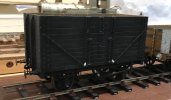
The two seven plank wagon kits are just about complete. Just trying to remember where the very fine chain is for the end door catches and the upper door catches on the 10 plank wagon. Painting some time soon. It will be interesting to see if anyone notices the 9'6" wheelbase on the coke wagon, it only really shows in the distance the ends of the springs are from the headstocks. Not much left over from the two kits, just two seven plank fixed ends, and nothing added apart from a few bits of styrene and some Ambis brake pushrods for the longer wheelbase. The Slaters kits are a very good base for modifying to produce a little variety in the 1923 standard wagons.

ch nc1.jpg
ch nc2.jpg

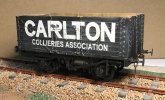
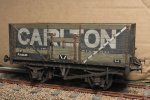
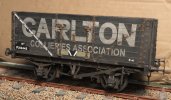
The Carlton wagon also has all its brake bits fitted. Now to make the new coke rails for the Dapol 'New Cransley' wagon, I was going to modify the ones provided but they aren't the same width planks as the prototype and the supports are in the wrong places for this wagon.
 

Overseer

Western Thunderer
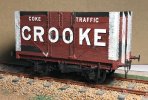
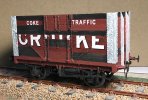
Painting has begun. Underframes were sprayed a dirty black, then I kept going and sprayed the bodies as well to provide a dark base for the following coats.

10pb.jpg
Not easy to photograph. I had forgotten to add the hockey stick ironwork before painting.

As usual, it looks a bit scary part way through. It will get worse.
crookep2.jpg
crookep1.jpg

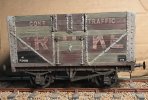
I haven't quite worked out how the Hull Corporation wagon is going to be done yet. I have made transfers but it might be more effective to hand paint the lettering to achieve the extremely deteriorated condition.
hce1.jpg

No change to the Carlton body yet.
carlb1.jpg
carlb2.jpg

The Midland D673 wagon is being painted to match one of the photos in Midland Wagons, remnant LMS bauxite, unpainted replacement planks and grey painted ironwork. Plenty still to do. The prototype photo shows the grey paint was daubed on roughly with plenty of grey paint on the planks, a bit challenging to copy without it looking like poor painting of the model.
mrp1.jpg
mrp2.jpg
 

AJC

Western Thunderer
Lovely work on all of these, Fraser. The Crooke coke wagon is especially appealing, only in part because it's so odd. For what it's worth, I think I would go with hand-lettering the Hull wagon, partly because of my masochistic tendencies, partly because I think representing the really significant wear would be more effective from that starting point - and that would make a suitable contrast with all of these which are at the next level up in terms of decrepitude if you know what I mean? I really am going to have to do my own, aren't I?

Adam
 

Overseer

Western Thunderer
Lovely work on all of these, Fraser. The Crooke coke wagon is especially appealing, only in part because it's so odd. For what it's worth, I think I would go with hand-lettering the Hull wagon, partly because of my masochistic tendencies, partly because I think representing the really significant wear would be more effective from that starting point - and that would make a suitable contrast with all of these which are at the next level up in terms of decrepitude if you know what I mean? I really am going to have to do my own, aren't I?

Adam
Thanks Adam. I am tending towards hand lettering on the Hull wagon but will leave it until the others have progressed a bit and see what happens. The Crooke coke wagon is odd, but not as odd as the Abbott coke wagon (on the cover) and Roberts Davy coke wagon also included in Acquired Wagons Vol 3 - they must be at least 17'6" long. They have standard width side doors and at least an extra 6" of planking between door and the ironwork (washer plates for the inside knees), looks like at least 10' wheelbase. But no mention in the text of them being non standard length.
 

AJC

Western Thunderer
Thanks Adam. I am tending towards hand lettering on the Hull wagon but will leave it until the others have progressed a bit and see what happens. The Crooke coke wagon is odd, but not as odd as the Abbott coke wagon (on the cover) and Roberts Davy coke wagon also included in Acquired Wagons Vol 3 - they must be at least 17'6" long. They have standard width side doors and at least an extra 6" of planking between door and the ironwork (washer plates for the inside knees), looks like at least 10' wheelbase. But no mention in the text of them being non standard length.

I hadn't looked too closely at the cover of that book before now, but I see what you mean: instinctively, it looks like a 10'/17' 6" to me (and since that's a Chas Roberts official shot, the accompanying order books survive, I think - the latter much underexplored by wagon historians, so proof may be available). Without wishing to do down Dave Larkins' enormous contribution to the field, caption writing never was his strongest suite, especially outside his core interests. I only hope that his notes have a secure home when the time eventually comes as they're beyond invaluable.

Adam
 

Overseer

Western Thunderer
img3222 Neg Strip 63 76027 on link line to Templecombe Upper from Bath 9 Sept 62 copyright crop.jpg
This is cropped from Tim Mill's photo in @oldravendale 's thread post 3976, here - #3,976

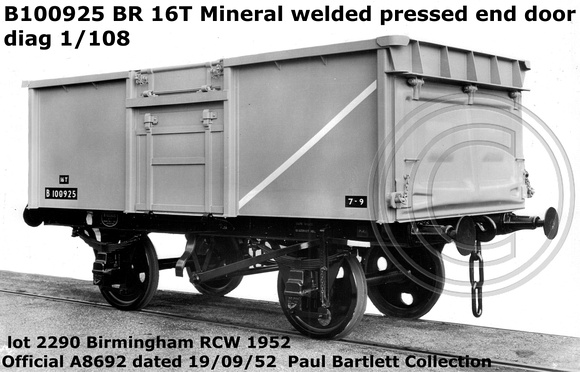
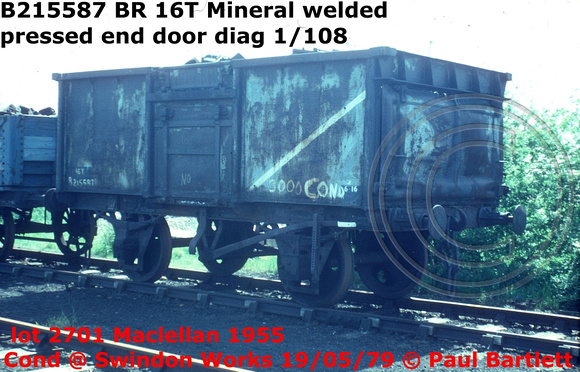
The discussion about the steel minerals identified this wagon as a diagram 1/108, which it must be as it has all the markers including Morton brakes and top corner reinforcing. It looks to me like it has a pressed steel end door. Not common I thought but when looking at an often published British Railways photo taken at Thoresby Colliery in 1955 (below), that I have looked at many times previously, I realised there are at least 3 diagram 1/108 wagons with pressed steel doors visible.

Thoresby Col 1955.jpg

Does anyone know how common pressed steel end doors were on diagram 1/108 wagons? Was it just one batch from one manufacturer? Any wagon numbers known, or does anyone have a print of this photo with the numbers readable?

I don't think I have seen a model of a Diagram 1/108 with a pressed steel end door, but now think I need one.

The other oddity in the Thoresby photo is a diagram 1/109 riveted wagon with a fabricated end door instead of the more common pressed steel end door on 1/109 wagons.
 
Last edited:

AJC

Western Thunderer
Hi Fraser,

The short answer is that I don't know how common they were, but they weren't insignificant in number, nor were they confined to a particular maker (see these from @hrmspaul's galleries, ok, so two are Birmingham RC&W, but one is not! All with legible numbers):


I think one of the reasons they tend to be overlooked, slightly, is that the doors were fairly easy to replace and the fabricated ones were easier to repair.

Adam
 
Last edited:

40057

Western Thunderer
Hi Fraser,

The short answer is that I don't know how common they were, but they weren't insignificant in number, nor were they confined to a particular maker (see these from @hrmspaul's galleries, ok, so two are Birmingham RC&W, but one is not! All with legible numbers):


I think one of the reasons they tend to be overlooked, slightly, is that the doors were fairly easy to replace and the fabricated ones were easier to repair.

Adam
I assuming the end doors got a great deal of rough treatment during normal use. Doors must have been replaced/exchanged to keep wagons in traffic, surely?

Bachmann’s range of 00 mineral wagons has included 1/108 wagons with pressed end doors. I’ve got two:


AJC

Western Thunderer
I assuming the end doors got a great deal of rough treatment during normal use. Doors must have been replaced/exchanged to keep wagons in traffic, surely?

Bachmann’s range of 00 mineral wagons has included 1/108 wagons with pressed end doors. I’ve got two:


I'm sure swaps were perfectly possible, and yes, Bachmann have done the pressed doors, I have several, too, but I wouldn't like to say whether swaps were normal or even routine, much easier to weld up/patch a wagon/fabricate a 'standard' door as required (you’d almost certainly need a crane to rehang the things). In any event, by the time replacement was needed, scrapping would probably have been the result as larger wagons and different types - and tighter budgetary constraints for repairs - became common.

Adam
 

Overseer

Western Thunderer
I obviously haven't paid any attention to Bachmann's 4mm wagon production. I knew the prototypes existed but don't recall reading anything about the number built with pressed end doors, and was surprised to see 3 out of 6 diagram 1/108 wagons with end doors visible in the 1955 photo having pressed doors. Paul Bartlett has 4 photos of pressed end doors in his collection of 318 photos. I have a feeling that the number of diagram 1/108 wagons built with pressed end doors was in the hundreds, out of 200,000 odd wagons built, but without evidence to support the number. The end doors on the 16 ton minerals were interchangeable so easy to change types. Surely a pressed door would be cheaper to make once the press tool exists, the US certainly proved that pressings were practical, as did BR with pressed steel van ends. Maybe the press being used wasn't large enough to press thick enough steel to make long lasting mineral wagon doors.
 

40057

Western Thunderer
I obviously haven't paid any attention to Bachmann's 4mm wagon production. I knew the prototypes existed but don't recall reading anything about the number built with pressed end doors, and was surprised to see 3 out of 6 diagram 1/108 wagons with end doors visible in the 1955 photo having pressed doors. Paul Bartlett has 4 photos of pressed end doors in his collection of 318 photos. I have a feeling that the number of diagram 1/108 wagons built with pressed end doors was in the hundreds, out of 200,000 odd wagons built, but without evidence to support the number. The end doors on the 16 ton minerals were interchangeable so easy to change types. Surely a pressed door would be cheaper to make once the press tool exists, the US certainly proved that pressings were practical, as did BR with pressed steel van ends. Maybe the press being used wasn't large enough to press thick enough steel to make long lasting mineral wagon doors.
I guess it would be possible to estimate the proportion with pressed end doors from photographic evidence.

I think it is safe to assume the type of end door had no operational significance. So wagons with pressed end doors were fully interchangeable and equivalent to the rest. So each photograph of a goods yard or train in service is a random sample (in respect of end door type) from the population of 16-ton mineral wagons. If you just had the 1955 photograph, the best estimate of the proportions of the two types would be 50:50 but with very wide uncertainty about the proportions in the population due to the tiny sample (6). Even with this one sample, however, if pressed doors were only fitted to a few hundred wagons, the probability of getting 3 in a sample of 6 is minuscule. The likelihood is the proportion was much higher — or you’ve picked out such a rare event you’re in with a good chance of winning the lottery too. I wouldn’t treat Paul Bartlett’s collection of photographs of individual wagons as a random sample from the population, so not read too much into that. But a few more yard photographs would get a better estimate.

I would also agree that once the press tooling is made, it would be used unless there was some problem with the process or the doors it made.
 
Last edited:

hrmspaul

Western Thunderer
I . I wouldn’t treat Paul Bartlett’s collection of photographs of individual wagons as a random sample from the population, so not read too much into that. But a few more yard photographs would get a better estimate.

I would also agree that once the press tooling is made, it would be used unless there was some problem with the process or the doors it made.
I admit that I was more likely to take a photo if it had a pressed end door, because they were more unusual. Certainly not random.

But do not overlook that 1955 is only part way into the build of diag 108 and 109 minerals. New fitting of pressed end doors seems to have stopped around 1956 or 7. Some of the later lots were huge, with Pressed steel building enormous numbers, and all recorded with fabricated end doors. In BR Wagons I did try to indicate when a pressed end door had been seen on at least one of lot number but more than 30 years ago there weren't the number of photographs available as there are now.

Paul
 
Last edited:
Top