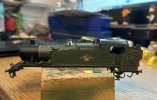
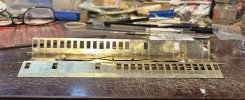
AJC
Western Thunderer
Adam
Brassmasters do an up grade kit for the modified Hall.
Might be worth looking at.
Mike
Already got that - but the want of decent crossheads isn't addressed in those etches. The body is the bit I'm looking forward to!
Adam

Adam
Brassmasters do an up grade kit for the modified Hall.
Might be worth looking at.
Mike


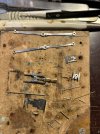

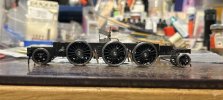
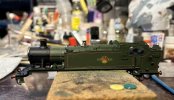
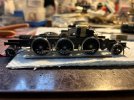
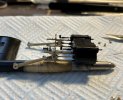
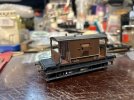
 . But now I have a dilemma, the front driver. The coupling rod is a single thickness of etch. This is going to sound daft, this is the first time I've done it like this - told you it would sound daft. So the problem being the crank pin bush fits the coupling rod but the locking nut boss is bigger than the bush. Bigger brains than mine have taken this problem on and a solution is at hand.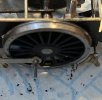

 .
.
True, you do need 2 printers. The new resin printers, a decent one can be had for £90. I’d go for a laser printer for ply sleepers, more cost I know. But a laser printer will also do your buildings for you and lots of other things once you open your mind to the possibilities.If I've understood the plug track system correctly, you need to have two 3D printers (a filament and a resin type), quite an outlay when your starting point is zero 3D printers.
It's an interesting approach to track building but it would be nice if someone were to market the 3D printed components.

@simondI suspect that for £500 you could be set up
@jonteSadly, I didn’t have time to watch the Bexhill vids on track construction using printed track in full, as kindly shared by Mike, however, I’m sure the narrator recommended laser cut sleeper bases to printed resin due to ‘shrinkage’?
jonte
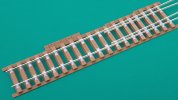
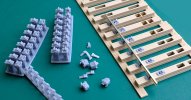
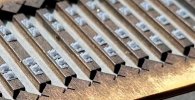

@jonte
Hi jonte,
3D resin printing is not generally suitable for the timbering bases, except perhaps in 2mm/ft scale. The shrinkage is unpredictable, making it difficult to set an accurate track gauge. They also tend to curl rather than stay flat.
For the timbering bases the three available options are:
1. 3D FDM printing -- slow, but user friendly and low-cost. Can clip together in small sections.
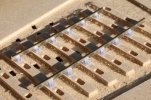
FDM machines are slow but run unattended while you build the rest of the layout. This is EM gauge:
View attachment 214766
This is FDM printed base in 7mm scale:
View attachment 214770
2. Laser-cutting -- fast and can use natural wood, but more expensive and needs proper workshop facilities. This is P4 in plywood:
View attachment 214769
3. CNC-milled panels -- also needs a workshop. This is EM gauge milled in 3mm MDF:
View attachment 214765
cheers,
Martin.
@jonteThank you for the prompt explanation, Martin.
It would appear that 3D is the easiest option after all, but depends on the TYPE of material used, FDM(?) being the most suitable in this case, rather than resin (I’m afraid I’m not au fait with these materials…) for reasons disclosed.
This is very interesting.
Jon
Many thanks once again, Martin, for your kind clarification.@jonte
Hi Jon,
Folks refer to "3D printing" as if it is a single thing. There are many different methods of 3D printing, some completely unrecognisable from others.
For home use the two common methods are:
1. UV-cured resin printing. You purchase a bottle of liquid resin. It is cured to a solid material by exposure to UV light in a suitable printer. This method is used to make the chairs for plug track. This method is capable of very fine detail, but it can be a bit messy and smelly.
2. FDM (filament) printing. You purchase a reel of plastic filament. In the printer it is fed through a heated nozzle which moves across the build area to build up the finished part in layers. This method can be used to make the timbering bases for plug track. This method is very user friendly -- there are toy FDM printers available for children.
cheers,
Martin.