
You are using an out of date browser. It may not display this or other websites correctly.
You should upgrade or use an alternative browser.
You should upgrade or use an alternative browser.
MOVING COAL - A Colliery Layout in 0 Gauge
- Thread starter PhilH
- Start date


......and fixed to the doors. The doors are stripwood approx 1mm thick with a backing of pieces cut from old drawing office radius curve templates, a very dense fine grained hardwood. The wood is primed but I just blackened the hangers, ready for a final coat of mid grey.
The doors are very easily knocked off the rail so I might decide to fix them in the open position, I'll see how it goes.
Your U-shaped hanging brackets are works of art. Actually, all your buildings look great.
I spent quite a bit of time last year looking for commercially made castings to represent similar brackets, or think of something else that would pass as a representation from a distance. Could not find anything suitable and I decided making eight was far too much work for a building at the back of the layout.
Your brackets look just like those in the photograph I had of an industrial building in Huddersfield.

PhilH
Western Thunderer
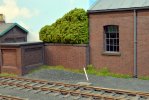
I've used static grass for the first time, but not applied directly on to the layout.

PVA was applied in strips and patches to pieces of plastic cut from empty margarine containers and static grass applied - I used 6mm then 2mm.
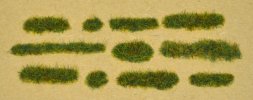
When dry the grass was peeled off the plastic and the edges trimmed.
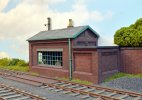
The grass was then applied in thin strips along the edges of the buildings and walls. The rest of the ground surface was applied later to cover any visible edges of the PVA holding the grass. The shrubbery on top of the wall really needs extending to fill the gap and hide the fact that the weighhouse roof has been foreshortened at the rear.
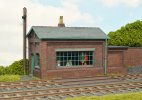
All the buildings in this area of the layout are now firmly bedded in.
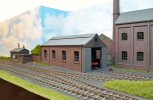
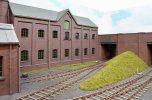
More grass in odd tufts and patches will be added in due course.

michael mott
Western Thunderer
Phil, I like the way that making narrow strips can enhance the use of static grass in tight places and corners.
Michael
Michael
PhilH
Western Thunderer

The first time I visited the NCB's Walkden Yard Loco Shed was on a Saturday afternoon in May 1964. It was a fairly dull miserable day on which I took the above rather dull miserable photo from the footbridge over the main colliery line passing the shed. Work had finished for the day and eight Austerities were on shed, four inside and four outside plus an ex North Stafford Railway 0-6-2T. The locos outside were left to right:- WARRIOR, still fitted with extended bunker and standard chimney (later removed and fitted with a Giesl Ejector); the ex North Stafford KING GEORGE VI; WIZARD and CHARLES both fitted with Giesls; and WASP fitted with the Hunslet system. Other withdrawn locos were alongside the shed.

I might get something near(ish) thanks to Messrs Dapol, just need to adapt them to Walkden prototypes and finish the two I've been scratch building !

Andrew Young
Western Thunderer
The static grass strips finish those buildings off very nicely. I bought some ready made versions for my layout, intended for military modellers I think, that worked very well. But suspect that your homemade versions were more cost effective and enabled you to get a greater variety.
Andrew
Andrew
PhilH
Western Thunderer
I decided to fit at least one of the Dapol Austerity 0-6-0STs with a Giesl Ejector chimney.
The NCB fitted Giesl Ejectors to 40 of its steam locomotives, 28 Austerity 0-6-0STs and 12 various other locos. Of these just under half were in the Lancashire Coalfield Area - 13 Austerities and 6 other locos ranging from a large 0-6-0T to small 0-4-0STs. On the Austerities removing the standard chimney and fitting the Giesl version exposes the existing 21½" dia chimney hole in the tank which is extended to the front of the tank as a 16" wide slot, producing a keyhole shaped hole in plan.
The Dapol saddle tank is a die casting and held in place with just two screws, one under the dome and one under the tank filler, both just a push fit into their respective sockets. Care needs to be taken when removing the tank to bend the front handrail round the lamp iron on the top of the smokebox front. On the prototype the lamp iron would be removed before the tank was lifted off the boiler. The first job on the tank was removing all the handrails. These are very delicate and probably wouldn't stand the handling of the tank, and will be replaced with metal knobs and wire. The plastic chimney is a tight push fit in a stepped recess, the top diameter of which is larger than the required hole in the tank and so it needed a turned brass collar to provide the prototype 21½" hole - 12.5mm dia. The bottom of the recess was filed away.

Luckily I had some ½" internal diameter thick walled brass tubing in stock which was near enough, so just the outside needed turning to fit the hole in the Dapol tank. The front part was cut away for the slot and the collar shaped as much as possible to leave just a small amount to be removed after it was fixed in position.
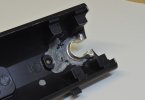
It was then fixed in the tank with solder, an operation that involved a soldering iron, blowlamp, various different Carr's fluxes that I had in stock - red, black and brown label, 70 degree and 145 degree solder. After all that it seems to be fairly well fixed. A small piece of brass was fixed to fill the gap between the collar and the front of the tank.
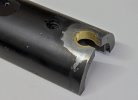
Most of the 'slot' was removed with a cutting disc and the edges trimmed in the milling machine. The top of the brass collar and solder round it was filed to shape, but there are a few minor imperfections that need to be filled at the painting stage. On the prototype locos the rear of the chimney hole has a small semi circular section taken out for its full depth to allow the tank to be lifted off without removing the Giesl chimney. I've provided this at the top but tapered it off down the hole, otherwise it would have cut the brass collar in two and risked loosening it. This shouldn't be too obvious when the chimney is in place.
tbc
The NCB fitted Giesl Ejectors to 40 of its steam locomotives, 28 Austerity 0-6-0STs and 12 various other locos. Of these just under half were in the Lancashire Coalfield Area - 13 Austerities and 6 other locos ranging from a large 0-6-0T to small 0-4-0STs. On the Austerities removing the standard chimney and fitting the Giesl version exposes the existing 21½" dia chimney hole in the tank which is extended to the front of the tank as a 16" wide slot, producing a keyhole shaped hole in plan.
The Dapol saddle tank is a die casting and held in place with just two screws, one under the dome and one under the tank filler, both just a push fit into their respective sockets. Care needs to be taken when removing the tank to bend the front handrail round the lamp iron on the top of the smokebox front. On the prototype the lamp iron would be removed before the tank was lifted off the boiler. The first job on the tank was removing all the handrails. These are very delicate and probably wouldn't stand the handling of the tank, and will be replaced with metal knobs and wire. The plastic chimney is a tight push fit in a stepped recess, the top diameter of which is larger than the required hole in the tank and so it needed a turned brass collar to provide the prototype 21½" hole - 12.5mm dia. The bottom of the recess was filed away.
Luckily I had some ½" internal diameter thick walled brass tubing in stock which was near enough, so just the outside needed turning to fit the hole in the Dapol tank. The front part was cut away for the slot and the collar shaped as much as possible to leave just a small amount to be removed after it was fixed in position.
It was then fixed in the tank with solder, an operation that involved a soldering iron, blowlamp, various different Carr's fluxes that I had in stock - red, black and brown label, 70 degree and 145 degree solder. After all that it seems to be fairly well fixed. A small piece of brass was fixed to fill the gap between the collar and the front of the tank.
Most of the 'slot' was removed with a cutting disc and the edges trimmed in the milling machine. The top of the brass collar and solder round it was filed to shape, but there are a few minor imperfections that need to be filled at the painting stage. On the prototype locos the rear of the chimney hole has a small semi circular section taken out for its full depth to allow the tank to be lifted off without removing the Giesl chimney. I've provided this at the top but tapered it off down the hole, otherwise it would have cut the brass collar in two and risked loosening it. This shouldn't be too obvious when the chimney is in place.
tbc
PhilH
Western Thunderer

The brass Giesl chimney is from Shapeways, presumably cast from a 3D pattern, 3D design by Alexander Clark. It has 2mm dia spigots at each end and a central hole which I tapped 10BA.
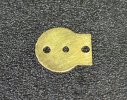
The chimney sits on a brass plate soldered to the bottom of the hole in the tank. In the prototype this would be the top of the smokebox, but I've kept it flat to form a better seating for the chimney and it will be hardly visible when the cover plate on the front of the tank slot is in place. The location of the chimney support plate is fairly crucial so it was soldered in place using a jig to fit the chimney in the correct position on the tank.
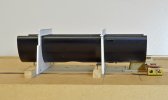
The centreline of the tank was marked on a piece of MDF and the chimney fixed to it with a length of 10BA studding. Two parallel strips of wood each side of the top of the chimney ensured that it was correctly positioned in line with the centreline. A brass strip mounted on two brass blocks was fixed at the front of the chimney with a slight gap measured with a feeler gauge, so that the front of the tank would be correctly positioned when it was butted against it. The tank was mounted upside down on two plastikard frames to give the correct measurement from the top of the chimney to the top of the tank.
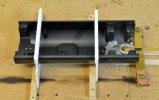
With the tank and chimney firmly fixed in position and any slight adjustments made to get the chimney exactly in the middle of the tank hole/slot, the chimney mounting plate could be finally shaped to fit and bolted to the base of the chimney. It was then just a simple matter of soldering the mounting plate in place. A strip of 15 thou brass was provided under the chimney, this will allow for a support for the cover plate over the front of the tank slot.
tbc
PhilH
Western Thunderer
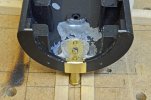
The soldered joint on the mounting plate has been tidied up and the chimney fixed in position. Some of the paint under the tank has been removed by rather liberal (or put another way - sloppy) use of Carr's liquid solder flux (possibly a good paint stripper ?). The cover plate on the front of the tank slot is fixed in place, these were provided on all the NCB Lancashire Austerities although some other NCB areas didn't seem to bother and just left the front of the slot open.
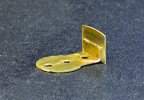
The cover plate is fixed to a bracket sandwiched between the bottom of the chimney and its mounting plate.

On the prototype locos the Giesl chimney just pushes the cover plate slightly away from the top of the tank front. The plate had a tab below its bottom edge which was fixed behind the lamp iron, with the bolts spaced horizontally rather than vertically as on the Dapol model.
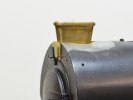
Removing the Dapol lamp iron and providing the tab on the plate with a correct lamp iron fixed to it would have done away with the problem of the tank front handrail passing under the lamp iron, but unfortunately the Dapol smokebox front extends just a little bit beyond the tank front instead of being flush with it. The new metal handrail will have to be fitted after the tank is finally in place.
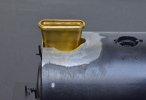
To fit the Giesl chimney on the prototype it had to be moved forward of the existing chimney to clear the main steam pipe in the smokebox, which required a slight 'S' bend in the new blastpipe. Note the semi‑circular cut out at the rear of the tank hole to clear the chimney when the tank was removed.
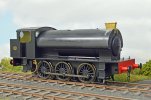
I'll rub the tank down and give it a coat of primer before fitting the handrails. Also the tank steps need replacing as the plastic ones haven't survived the handling. I think this will be a Red loco, or maybe Black, haven't decided yet.


PhilH
Western Thunderer
I imagine the fact that Phil is prepared to countenance one on his layout - given the quality of his own scratch builds - says something reasonably positive about the RTR offering?
I suspect that message with question mark at the end may have been intended to elicit some comment from me about the quality of the Dapol models. Well I've got 5 so far (not all intended for the layout I might add), and two friends have got two each and talk about getting more, so that possibly might give some hint of approval. Most of these are probably destined for modification into various prototype locomotives.
Overall I think Dapol have done an excellent job with this model. Its obviously made to a budget price, and there are some signs such as the printed works plates and the not very well defined cab roof hatch for example, but I think the easy removal of the circuit board and conversion to DCC sound via the opening smokebox door and the representation of working valve gear are great features. The very few dimensions I've checked for various reasons have been correct within ½ mm or so, but I haven't checked the major dimensions, if it looks OK and you can't alter it why worry about it ? I could possibly nit pick over certain items, such as the small opening door in the cab back sheet which is in the centre rather than offset to the left, and they haven't quite got the chimney correct.
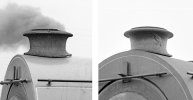
There's only a short straight section between the curves of the cap and the base but it should have a noticeable taper inwards and the base is set into the top of the tank rather than on it, so you can't lift it slightly to get the gap under it as on the prototype. However these are minor gripes and probably wouldn't worry most people. The running is superb, on DCC and with a stay alive (recommended) my examples will crawl along with barely any apparent movement, then wound up to speed the drive is virtually silent. Contrast that with the Slaters motor/gearbox on my scratchbuild, which has an annoying whine when it's at anything above a moderate speed. For just over 100 quid more than the cost of that, Dapol have provided a complete locomotive !
I could gripe about some of the colours used on the industrial examples, which are no doubt based on the locos as preserved. The Green on WHISTON is a bit too garish, which is a pity as it doesn't show off the yellow lining to best effect. However colours can be very subjective and others might have a different view. If you're going to modify and repaint it doesn't really matter anyway.
Last edited:
PhilH
Western Thunderer
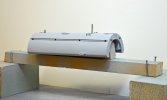
I did try painting a primer on the Austerity tank leaving most of the original black intact, with just a rub over with wet & dry paper to give a key. However I wasn't satisfied with the result so decided to strip the tank down to bare metal. The existing paint seemed to be just the black with no primer underneath and it came off quite easily with a few hours soak in neat Dettol. The tank was then given a light grit blasting and primed with U-pol Acid 8 etch primer. The new metal handrails have been added and it will be painted with red oxide primer and the final red top coat - exact shade of red to be determined ! Its mounted on a jig so it can be turned during the spraying process.
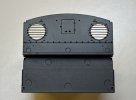
The cab back slides out, quite a neat arrangement although it does leave a visible join at the top where it meets the cab side. I've removed the moulded coal rails in front of the windows and replaced them with 0.4mm dia. wire. The existing 'glass' is 1mm thickness and pushes out quite easily, but its fairly soft and easily marked. I'll replace it with 0.5mm thick perspex after painting.
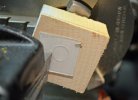
I cut the new 0.5mm thick windows on the lathe. A block of wood was fixed in the 3 jaw chuck and faced off. Squares of perspex were fixed to the face of the block with two pins and the circles cut with a pointed lathe tool. The cut can be adjusted with the cross slide to give the correct diameter for a perfect fit in the window opening. There's a bit of swarf produced at the corners of the cut edge but that can be easily removed with a knife.
PhilH
Western Thunderer
So, where was I last July - how time flies ! Well there's a fair amount been done, but not a great deal to show for it.

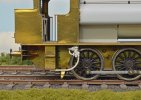
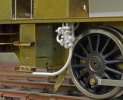
The injectors have been prepared for the scratchbuild Austerity in the form of 3D prints. My 2D CAD drawing was converted to 3D and printed by Alexander Clark. These may be done eventually as lost wax brass castings, trials are currently being carried out.
A few other items have been done as 3D prints including the firebox backhead.
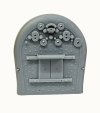
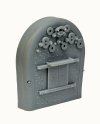
This is the first trial print, there's a few minor changes required. I now need to draw some of the fittings to go on it.
Another version of the injectors has been done to fit the Dapol Austerities, as the Dapol version is a little on the small side.

tbc
The injectors have been prepared for the scratchbuild Austerity in the form of 3D prints. My 2D CAD drawing was converted to 3D and printed by Alexander Clark. These may be done eventually as lost wax brass castings, trials are currently being carried out.
A few other items have been done as 3D prints including the firebox backhead.
This is the first trial print, there's a few minor changes required. I now need to draw some of the fittings to go on it.
Another version of the injectors has been done to fit the Dapol Austerities, as the Dapol version is a little on the small side.
tbc

PhilH
Western Thunderer
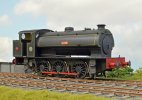
Back to the Dapol Austerity locos. Two were going through the "paint shop", the Giesl one with the modifications previously described, which will be red, and a standard chimney one in black. I haven't determined a suitable red colour yet so decided to press ahead with the black one. This is based on the Hudswell Clarke built loco ALLEN as I saw it on my first visit to Astley Green Colliery in 1964.
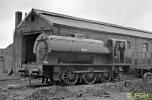
Hudswell Clarke & Co. built 50 of the Hunslet designed Austerity 0-6-0STs for the War Department between 1943 and 1946. Works No.1777 was ex works from Leeds on 16/12/1944 as WD 71500. Many of the Austerity 0-6-0STs were loaned from new by the Ministry of Fuel & Power to existing collieries or new opencast sites as part of the war effort, and HC 1777 was sent initially to a colliery near Wigan where it spent four months. In April 1945 it was sent to Walkden where it was received on 19/4/1945 and put to work four days later, still in WD livery.
It was purchased by Manchester Collieries in July 1946, and subsequently named ALLEN after a colliery official. Apart from occasional visits to Walkden Yard for repairs, ALLEN spent the rest of its working life at Astley Green Colliery, where it shared the work with three other 0-6-0s - a Hawthorn Leslie 0-6-0ST, a Kerr Stuart 0-6-0T and a Hunslet 0-6-0T. The closure of Mosley Common Colliery in February 1968 resulted in several newer Austerity 0-6-0STs becoming available and all four locos at Astley Green including ALLEN were sent to Walkden Yard for storage where they were scrapped in September and October 1968.
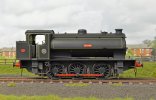
The main modifications to the Dapol model were as follows:
1. Coupling hooks replaced and fitted with shackle and two link couplings.
2. Front centre lamp iron removed from footplate.
3. New 3D printed chimney, this is ex Shapeways at present, but it's temporary and not fixed in position as it doesn't quite cover the Dapol chimney hole. A new 3D printed version with a slightly larger base is being prepared.
4. Two lifting brackets fixed to top of tank - as fitted to Hudswell Clarke built Austerities.
5. Handrails replaced by 0.7mm dia wire with 'WD' plain supports instead of handrail knobs, fitted to at least some of the HC built locos.
6. Drain cock lever fitted alongside firebox on RH side.
7. Two 0.3mm dia. wires fitted alongside the boiler and firebox on each side to represent the 3/8" dia. pipes on the prototype - on the right hand side is the steam supply to the front sanders which goes to a 'T' piece at the top centre of the motion plate where it splits to the sanding pipes on each side; on the left hand side is the oil supply pipe from the displacement lubricator in the cab (not fitted to the Dapol model) to the cylinders which enters the rear of the cylinders on the right side via a 'S' bend under the boiler. On the prototype these are fixed to the boiler and firebox cladding with clips. I've reproduced these with loops of fine wire passed through two holes drilled each side of the 'pipe' and bent over on the inside of the boiler and firebox.
8. Wooden floor fitted to cab.
9. Bars on rear cab windows replaced with 0.4mm dia. wire and new thinner spectacle glasses fitted.
10. Top edge of bunker bevelled on the inside to give a thinner top edge.
11. New 3D printed injectors fitted.
It's had a complete repaint and lining with a Bob Moores lining pen, using the finest 0.2mm nib. It's the first time I've tried lining, and it's probably reasonably acceptable from the normal operating viewing distance - like the other side of the room ! The next one may go a bit better, if I can face doing it !
Some light weathering has been applied, which doesn't show up very well in the photos, but the prototype was reasonably clean when I saw it on that first visit to Astley Green.
It may surprise, or even shock, some to learn that among the list of surface workers employed at Astley Green was a Mr.McMullen described as "locomotive cleaner nights". I suspect that apart from giving the locos an occasional wipe over another of his duties would be to keep the working locos in "light steam" overnight so they would be nearly ready for work on the morning shift.
The etched name and works plates were supplied by Light Railway Stores. The works plates fitted to the Hudswell Clarke built Austerities were not the usual HC plates, which have lettering inset into a plain oval brass plate, but similar to the equivalent Hunslet plates with raised lettering and borders. Also they were in cast iron rather than brass, presumably a wartime measure which was possibly applied to works plates fitted to these locos by other manufacturers. Light Railway Stores very obligingly amended their existing Hunslet plates with the required lettering in addition to the works number and date. I've taken some of the 'brass look' off the works plates by using a light coating of chemical brass black, but in retrospect it may have been better to get the plates done in nickel silver although the real plates do have a slightly 'brassy look'.
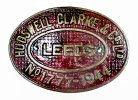
Photo of the works plate from HC 1777, kindly provided by the current owner.
Last edited:


Podartist79
Western Thunderer
Superb work on the Giesel chimney and the upgrade to the Dapol RTR Model(s) that you’ve undertaken Phil.
Truly inspiring stuff!
Love your scratch built Austerities also.
Your layout is looking great too.
Neil.
Truly inspiring stuff!
Love your scratch built Austerities also.
Your layout is looking great too.
Neil.