Rivermead Central

John R Smith

Western Thunderer
Martin

Just as an update and a postscript to the discussion about the B-L B17 "Arsenal" in the Vectis auction last week.

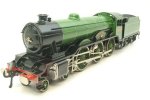
The engine went for a hammer price of £2,100, which plus the buyer's premium of 27% totalled £2,667. The model was undeniably very attractive -
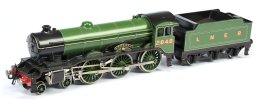
B-L LNER B17 01 Web.jpg

However, in my view it was not really collectible. By the end of my research, I had come to the following conclusions : obviously the engine was refinished (but of course very well done); the driving wheels were 18 spoke with the later slotted centre nuts, when they should be 16 spoke with the boss plate centres (so the clockwork motor has probably also been changed); the tender wheels were wrong (they should be cast-iron but were not - Vectis checked them for me with a magnet); and the buffers were round when they should be oval. Oh, and there is evidence of damage to the cab roof and tender front on this LH side. So the engine should have looked like this -
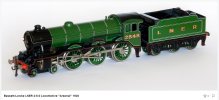
B-L Arsenal Flickr.jpg

Which is different enough to be noticeable, I think.

John
 

40057

Western Thunderer
Martin

Just as an update and a postscript to the discussion about the B-L B17 "Arsenal" in the Vectis auction last week.

The engine went for a hammer price of £2,100, which plus the buyer's premium of 27% totalled £2,667. The model was undeniably very attractive -

View attachment 260750

However, in my view it was not really collectible. By the end of my research, I had come to the following conclusions : obviously the engine was refinished (but of course very well done); the driving wheels were 18 spoke with the later slotted centre nuts, when they should be 16 spoke with the boss plate centres (so the clockwork motor has probably also been changed); the tender wheels were wrong (they should be cast-iron but were not - Vectis checked them for me with a magnet); and the buffers were round when they should be oval. Oh, and there is evidence of damage to the cab roof and tender front on this LH side. So the engine should have looked like this -

View attachment 260751

Which is different enough to be noticeable, I think.

John
Hi John

Thanks for sharing your findings on the B17. I didn’t go into the same detail, but I did notice it in the auction catalogue and could immediately see it was ‘wrong’ in multiple respects.

Clearly, at some point the model suffered serious damage/mistreatment. That does seem surprising when you consider what an expensive purchase it was when new. But we can’t know the circumstances. It could even have been damaged in an air raid during WW2. When I was an undergraduate student in Newcastle in the 1970s, there was a very distressed B-L, live steam, BR-livery, Stanier mogul without its tender for sale in a small shop near Central station. The loco would have been somewhere between ten and twenty-five years old. It too would have been an expensive purchase and no doubt originally someone’s pride and joy. How did it end up, after only a few years, dented and tender-less in a back-streets junk shop? The loco was still unsold in the shop when I graduated.

I have often wondered about that loco’s story what had happened to reduce a fine hand-built, hand-painted, model to being unwanted junk in a junk shop.

Perhaps someone took pity on the Stanier mogul, bought it, restored it, and it is running today. If so, and I saw it in auction catalogue, I guess I would be commenting ‘restored’, ‘not the original tender’, ‘evidence of damage to the cab’.

Given the obvious non-original elements of the Vectis B17, I agree it’s no longer ‘a collector’s piece’.

On the other hand, it still exists. Which I suspect is not the case for the mogul in the junk shop.

Martin
 

John R Smith

Western Thunderer
Given the obvious non-original elements of the Vectis B17, I agree it’s no longer ‘a collector’s piece’.

On the other hand, it still exists. Which I suspect is not the case for the mogul in the junk shop.

A very good point, Martin. I must have been sounding a bit judgemental about the B17, which was inevitable but not really intended. It was just a bit of fun for me, as I can never resist doing a bit of historical research (it's a bit like using pottery types to date an archaeological dig). I sincerely hope the purchaser of "Arsenal" is delighted with it!

John
 

40057

Western Thunderer
as someone who has no interest whatsoever in collecting these models, I find the thread, and the sleuthing most enjoyable!
Hi Simon

I much appreciate your comment. This is the third anniversary of me starting this thread. It’s obviously not the kind of modelling pursued by most on WT, so I really didn’t know what the reaction would be. However, three years on, with 864 posts and 110K views, there clearly is interest. Which is great.

Thank you to everyone who has contributed comment or viewed the posts.

Martin
 

40057

Western Thunderer
I sincerely hope the purchaser of "Arsenal" is delighted with it!
Me too!

It’s a fine looking loco and still a Bassett-Lowke B17. The new owner might want to reinstate the correct type tender and bogie wheels, buffers etc. and change the motor and driving wheels to the original type. The appearance could be returned very close to ‘as made’. It would still be restored, but look as Bassett-Lowke intended. Or the new owner might view the alterations as part of the loco’s history, especially if the story behind the changes can be established, so the reason why is understood. Or the new owner may just love his/her fine new engine and not care about the alterations, or perhaps even realise they have been made.

Martin
 
Last edited:

40057

Western Thunderer
Martin

Just as an update and a postscript to the discussion about the B-L B17 "Arsenal" in the Vectis auction last week.

The engine went for a hammer price of £2,100, which plus the buyer's premium of 27% totalled £2,667. The model was undeniably very attractive -

View attachment 260750

However, in my view it was not really collectible. By the end of my research, I had come to the following conclusions : obviously the engine was refinished (but of course very well done); the driving wheels were 18 spoke with the later slotted centre nuts, when they should be 16 spoke with the boss plate centres (so the clockwork motor has probably also been changed); the tender wheels were wrong (they should be cast-iron but were not - Vectis checked them for me with a magnet); and the buffers were round when they should be oval. Oh, and there is evidence of damage to the cab roof and tender front on this LH side. So the engine should have looked like this -

View attachment 260751

Which is different enough to be noticeable, I think.

John
Hi John

I have been looking again at your post above and comparing the two photos.

I don’t know where you got the second image but it looks to be a fine example of a Bassett-Lowke B17.

Much earlier in the discussion of the Vectis B17, I observed that the D-shaped hook on the rear of the loco wasn’t the right shape. Of course, it also lacked the expected serial number.

By comparing your two photographs, I now notice other discrepancies in the Vectis loco:
Wrong font on the nameplate.
Hinge straps too widely spaced on the smoke-box door.
Snifting valve the wrong shape
Chimney not quite right
Curvature of the front framing in front of the smoke box too flat

And of course, wrong type of mech and wheels.

I am not sure the Vectis B17 is actually Bassett-Lowke. A close copy, using some genuine parts? I would want to examine the loco in person to be sure, either way.

If — and it is an ‘if’ — the loco is a copy, being sold as the genuine article, that makes it a fake.

Martin
 

John R Smith

Western Thunderer
Hello Martin

A can of worms here, isn't it? Very astute observations Martin - and I would add one more. The spacing between the boiler handrail and the pipe above it is very different in the two examples, too. I thought from the outset that the nameplates looked very new, and of course they are not the originals, which the font confirms, well spotted.

The reason that I started this investigation in the first place was that it annoyed me that Vectis were setting the bidding so high on a refinished engine like this, without any proper provenance. So I shot them a few pertinent questions, which they brushed off with the following reply -

"I suspect the locomotive has a full strip down and rebuild as part of the restoration by Chris Littledale, but everything has been done correctly and in sympathy with the original." (from Mike Fishwick at Vectis)

I know that their obligation is to the seller (to obtain the best price) and of course if you read their conditions you find that they disclaim any liability to the buyer. However, the implication of their high starting bid (£1,000) and high estimate was surely to imply that this was a fine example of a very rare and collectible Basset-Lowke model.

We know that Chris Littledale has two fine examples of the B17 at the Brighton Museum (both of them have the boss-plate wheel centres), so he does know what he is doing. But of course he is now well into his 80s and it would be unfair to trouble him for information on this particular refinish, and it is not really for us to do so.

All you can say, really, is Caveat Emptor!

John
 

40057

Western Thunderer
Hello Martin

A can of worms here, isn't it? Very astute observations Martin - and I would add one more. The spacing between the boiler handrail and the pipe above it is very different in the two examples, too. I thought from the outset that the nameplates looked very new, and of course they are not the originals, which the font confirms, well spotted.

The reason that I started this investigation in the first place was that it annoyed me that Vectis were setting the bidding so high on a refinished engine like this, without any proper provenance. So I shot them a few pertinent questions, which they brushed off with the following reply -

"I suspect the locomotive has a full strip down and rebuild as part of the restoration by Chris Littledale, but everything has been done correctly and in sympathy with the original." (from Mike Fishwick at Vectis)

I know that their obligation is to the seller (to obtain the best price) and of course if you read their conditions you find that they disclaim any liability to the buyer. However, the implication of their high starting bid (£1,000) and high estimate was surely to imply that this was a fine example of a very rare and collectible Basset-Lowke model.

We know that Chris Littledale has two fine examples of the B17 at the Brighton Museum (both of them have the boss-plate wheel centres), so he does know what he is doing. But of course he is now well into his 80s and it would be unfair to trouble him for information on this particular refinish, and it is not really for us to do so.

All you can say, really, is Caveat Emptor!

John
Hi John

Let’s assume for a moment the B17 is NOT Bassett-Lowke, but a copy. Based on the photos, I think it isn’t a Northampton product. It may well have been made perfectly innocently, with no intention to deceive. Someone thought they had little or no chance of finding an original and opted to make, or get made, a copy as the next best thing. Maybe that person has died, and the knowledge of the model’s origin was not passed on. At the point someone tries to sell the model as a Bassett-Lowke, it has become a fake. The vendor may well not realise this.

Legally, I suspect Vectis are completely covered. But the catalogue description was unambiguous: ‘Bassett-Lowke’. Not ‘Bassett-Lowke or similar’ or some other additional wording as an escape clause. And whatever the legal position, Vectis have a reputation to protect. Being seen as a reputable and trustworthy business is surely essential for an auction house.

As mooted above, there is no need to invoke suggestions of deliberate wrong doing. The vendor didn’t know and the auction house didn’t notice. Nor presumably did the bidders though these will have no doubt been largely relying on the catalogue description. Which, if I am right, was wrong.

I am not aware of ever having met Mr Fishwick. I know nothing about his experience or knowledge of vintage model railways and I don’t want to criticise him unfairly. But, as a general comment, should an auction house spot when something they are being asked to sell is a fake? Yes, of course. The day after the B17 was sold, Vectis sold two tank wagons catalogued as ‘Hornby’ (lots 1057 and 1058) which I am certain were not made by Meccano Ltd. Both wagons contain Hornby parts, but they are not Hornby tank wagons. The prices realised suggest the Hornby enthusiasts in general had noticed these wagons weren’t authentic.

What’s to be done? Neither you nor I have agency in that we are not parties to the sale — not the vendor, not the buyer, not the auction house. So it’s really none of our business. However, I do feel Vectis should be alerted. What they do about it, if anything, is then up to them. They, ought, I would suggest, at the very least examine the B17 to form a more considered view on whether it is a genuine Bassett-Lowke model.

Martin
 

John R Smith

Western Thunderer
Hello Martin

The more I think around this, the more it puzzles me. Like you, I don't think that anybody has deliberately set out to deceive. The previous owner is dead, and his relatives or executors are selling off his estate. The history of this engine is unknown, except possibly to Chris Littledale. He numbered this particular refinish as 640 -

B-L LNER B17 05 Web.jpg

So somewhere he might have a ledger entry for it.

For a while I thought that this B17 might be a replica from Ludlows of Bolton. But looking at examples of their work, they seem to be rather better than the Vectis engine in certain respects -

Ludlows Arsenal 3-Rail 03.jpg

(photo from the Binns Road website)

The nameplates and the buffers are certainly spot-on, and the snifting valve has the little pip on top of it. The only real give-aways are once again the 18-spoke drivers, and also the painted handrails, which should be bright. So the Vectis B17 is not a Ludlows, beause it is not good enough (!).

I am not really sure that there is anything to be done about this. As you say, neither you nor I have a dog in this race. I did my best before the sale to alert Vectis to my own concerns as I outlined them here, and I have copies of my email exchange with Mr Fishwick to substantiate this. To confirm our suspicions it would be necessary to examine the engine in hand rather than by photos.

However, ownership of the B17 has now passed to the successful bidder and if they made their bids in person they will now have it in their possession (and it will no longer be under Vectis' roof). Without knowing who the new owner is we have no means of passing on our doubts, and it would be for them to raise a claim with the auctioneers, not us, as I understand it.

John
 

40057

Western Thunderer
Changing the subject …

Starting around post #701, there was an extensive discussion about clockwork motors and their haulage capacity.

It appears, the answers to most of the questions can be found in here:

CDF47540-0CF2-454F-9B15-B4E06B7FA5BD.jpeg

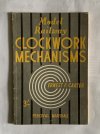
Published in 1950. The author acknowledges assistance from Bassett-Lowke and A.&J. van Riemsdyk.

The book, for example, explains why a clockwork locomotive should never be left for an extended period with the motor wound up.

On the issue of haulage capacity, there is this very useful Appendix:

C15BFEA4-F47B-4547-AA02-C6358EAEA770.jpeg

The loads described do correspond to my own experience, allowing for the variation between similar motors, as previously discussed. The figures for the Bassett-Lowke mechs’ haulage capacities were supplied by the company (stated in the text).

The stand-out statistic to me is just how much stronger the large Bing mech is compared with anything else.

Martin
 

John R Smith

Western Thunderer
The stand-out statistic to me is just how much stronger the large Bing mech is compared with anything else.

Is that the same mechanism that is in the first series of the Bassett-Lowke 2-6-0 Mogul?

That looks like a very interesting book from Ernest F Carter (the Editor of the MRC). It makes you wonder why it was written and published just then in 1950, when clockwork was neglected and in decline amongst the majority of model railway practitioners. By 1957 Jack Ray was having trouble finding springs or any other spares for his own engines.

John
 

40057

Western Thunderer
Is that the same mechanism that is in the first series of the Bassett-Lowke 2-6-0 Mogul?

No. The mechanism referred to was used in three types made by Bing for the British market: a 4-6-0, an 0-6-0 and an 0-6-0T. Also in similar locos for Bing’s domestic market, as per the video in my post #299. Nothing was made for Bassett-Lowke using this mechanism.

That looks like a very interesting book from Ernest F Carter (the Editor of the MRC). It makes you wonder why it was written and published just then in 1950, when clockwork was neglected and in decline amongst the majority of model railway practitioners. By 1957 Jack Ray was having trouble finding springs or any other spares for his own engines.

John

Clockwork was certainly in decline, though still widely used. To quote from the book’s preface:

‘The literature on this very important branch of model railway engineering is conspicuous by its absence, and this observation is particularly true when it is realised that over 50 per cent of the “0” gauge model railways in existence are run by clockwork-driven locomotives’.

Whether the 50% figure was accurate no-one can say, but it was the author’s perception, so justification for him.

The other point that comes across is the discussion of further development of clockwork, especially in relation to 00 and controlled speed mechanisms. The author definitely did not see clockwork as ‘finished’.

Come to that, neither do I.

Martin
 

John R Smith

Western Thunderer
The other point that comes across is the discussion of further development of clockwork, especially in relation to 00 and controlled speed mechanisms. The author definitely did not see clockwork as ‘finished’.

Yes. But the point about this is that further development did not happen. Jack Ray (again) tried to float the idea for a new clockwork powered O Gauge engine in the late 1950s I believe, wrote it up in the MRN and asked for expressions of interest with a view to gathering subscribers, and had to abandon the attempt for lack of support. In fact, O Gauge itself was in steep decline. Despite the inspiration provided by W S Norris' articles from 1960 onwards (and the formation of the Gauge O Guild), there was very little available indeed for 7mm by the late 1960s. I built my first O Gauge layout in 1973-4, and had a terrible time finding anything in the way of kits for rolling stock or motive power, let alone ready-to-run. Whereas if you run fine scale 7mm today, you are spoilt for choice and in hog heaven. There is actually plenty of choice in coarse scale O Gauge too, as long as you run 3-Rail electric, of course.

We old 'Clockers' must truly be stubborn masochists!

John
 

40057

Western Thunderer
Yes. But the point about this is that further development did not happen. Jack Ray (again) tried to float the idea for a new clockwork powered O Gauge engine in the late 1950s I believe, wrote it up in the MRN and asked for expressions of interest with a view to gathering subscribers, and had to abandon the attempt for lack of support. In fact, O Gauge itself was in steep decline. Despite the inspiration provided by W S Norris' articles from 1960 onwards (and the formation of the Gauge O Guild), there was very little available indeed for 7mm by the late 1960s. I built my first O Gauge layout in 1973-4, and had a terrible time finding anything in the way of kits for rolling stock or motive power, let alone ready-to-run. Whereas if you run fine scale 7mm today, you are spoilt for choice and in hog heaven. There is actually plenty of choice in coarse scale O Gauge too, as long as you run 3-Rail electric, of course.

We old 'Clockers' must truly be stubborn masochists!

John
Hi John

It’s impossible I guess to separate the decline in clockwork and in 0 gauge. Both largely disappeared as model railways were reinvented using plastics etc.

The Carter book was written in 1949 (date of the preface), or perhaps slightly earlier, and published in 1950.

From the description given, the ‘controlled clockwork mechanisms’ said to be ‘currently on the market’ were evidently the ‘Walker-Fenn’ modification of the Marklin 6-coupled mech. I don’t think these mechanisms were actually made post-WW2. There are several references to van Riemsdyk 00 mechanisms but not to the later 0 gauge vR mechs.

So there was a little more development of clockwork still to come: the van Riemsdyk 6-coupled 0 gauge motor, a genuinely new design for 0 gauge. Also, of course, the Teleguv — but that was never adopted commercially.

Martin
 

John R Smith

Western Thunderer
So there was a little more development of clockwork still to come: the van Riemsdyk 6-coupled 0 gauge motor, a genuinely new design for 0 gauge. Also, of course, the Teleguv — but that was never adopted commercially.

Hello Martin

Yes, once again you are correct - I had forgotten about the v-R mech. Hornby, of course, were still selling their basic 0-4-0 clockwork tinplate toy trains to a shrinking marketplace, until 1965 I suppose. Those little engines, cheap and cheerful though they were, are the great survivors on eBay today.

So now we are faced with the inevitable but sad situation where there is currently no clockwork motor made for O Gauge model railway engines (and there has not been for some 60 years). I would suppose that the skills and tooling to make such a thing have long since vanished, even if the demand was there. There are so many obvious snags and limitations involved with the use of clockwork motive power that it is very hard to explain to others why anybody should wish to use it. In fact, I've given up on trying.

This leaves us with an interesting dilemma - interesting to me, at any rate, after a professional career in conservation management. Should we continue to run and use these increasingly precious hand-made historical artefacts (like a Bassett-Lowke B17 "Arsenal" for example), in the sure and certain knowledge that we are wearing out the clockwork mechanism which cannot be replaced or (probably) be repaired either? Or should we regretfully store them away in a display cabinet for preservation into the future?

John
 
Last edited:

40057

Western Thunderer
Hello Martin

Yes, once again you are correct - I had forgotten about the v-R mech. Hornby, of course, were still selling their basic 0-4-0 clockwork tinplate toy trains to a shrinking marketplace, until 1965 I suppose. Those little engines, cheap and cheerful though they were, are the great survivors on eBay today.

So now we are faced with the inevitable but sad situation where there is currently no clockwork motor made for O Gauge model railway engines (and there has not been for some 60 years). I would suppose that the skills and tooling to make such a thing have long since vanished, even if the demand was there. There are so many obvious snags and limitations involved with the use of clockwork motive power that it is very hard to explain to others why anybody should wish to use it. In fact, I've given up on trying.

This leaves us with an interesting dilemma - interesting to me, at any rate, after a professional career in conservation management. Should we continue to run and use these increasingly precious hand-made historical artefacts (like a Bassett-Lowke B17 "Arsenal" for example), in the sure and certain knowledge that we are wearing out the clockwork mechanism which cannot be replaced or (probably) be repaired either? Or should we regretfully store them away in a display cabinet for preservation into the future?

John
Hi John

An interesting set of observations/comments there.

First, on the ‘repairability’ of clockwork mechs. I’m more positive than you, because the skills are there in a related field — clock making and repair. There are clocks still running after hundreds of years. Sure, parts wear out as with any other mechanical device, but they were made once and can be made again. Not cheap to get bespoke repairs, but there are plenty of clock repair businesses, that all seem to be busy. It should be possible to keep a clockwork mechanism in working condition pretty much for ever.

The wider question of whether an historic loco should be run is exactly the same as for full size preservation. Use it, and originality will be lost. So the NRM (and others) have some locos strictly on static display with the aim of keeping everything as it was. Others are run and, like Flying Scotsman, have almost no original parts. I have locos I am happy to use, others I would want to run only very occasionally. I have previously mentioned for example my Fowler LMS dock tank, ex-Sherwood. There is clear photographic evidence of it getting replacement wheels and repainted during its service on Sherwood. The bodywork suggests it may well originally have had a different mechanism. The dock tank’s chassis is currently with Tom Mallard for repair (it needs a new stub axle as the thread for the wheel retaining nut has worn). The dock tank is my ‘Flying Scotsman’ in terms of my attitude to looking after it: repair as necessary to keep it running. I do have a few early models that have survived in extraordinarily good condition. I would be very upset if I damaged them by use resulting in, say, a derailment. So only very occasional runs for these.

But occasional runs, not static display. I would argue that a vintage clockwork loco is only truly the object it was designed to be when running. It wasn’t made for static display. It only has the clockwork mechanism so it can pull trains along a track. To appreciate the object properly it must be run as intended.

Martin
 

40057

Western Thunderer
Hi again John,

Your question above (post #877) has really got me thinking about operating (or not) historic artefacts.

Unlike you, I don’t have a professional background in the museum/heritage sector. I wonder if there are accepted principles or best practice guidelines used by practitioners to inform choices?

If something is very rare, or a unique survivor, and very fragile, it can’t be used/operated. Too much risk, the loss if damaged too great. This is not going to apply to many antique model trains, but it does to this one:

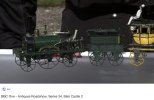
B8027465-7B3E-4ACB-A312-D534F38DB751.jpeg
I have seen this amazing early train and the one other very similar known survivor that is in a private collection. These cannot have been made as toys for children; they wouldn’t last five minutes. I would see them as analogous to a 19th century automaton. An amusement for adults.

Automata are relevant to this discussion. Because in its resting state an automaton could be a plain box or a rather simple looking doll or other model. Only when operating does it really become an automaton. Appreciating how clever and wonderful it is — actually seeing what it is — depends entirely on it being wound up and operated. This is a bit more extreme than our 20th century clockwork trains. But the principle stands, I feel.

That said, it cannot always be the case that an historic artefact must be used as intended to be fully appreciated and understood. I can see such an approach would present insuperable legal and moral difficulties for a museum of arms and armour, for example.

So, do you know if there are best practice guidelines or similar on how to approach the conservation of mechanical objects?

Martin
 
Top