That is a really interesting project, Martin. You now have a tender and a mechanism for your original purchase - so, the obvious question is, how does the cosmetic condition of the tender (on its way) match up with the very good condition of your original engine? I have read that while it is relatively easy to replace a mainspring on our clockwork motors, having a ratchet die is very bad news. So the new motor will be a (relatively) easy solution to this problem, providing that all the mounting points match up - which they should, of course. It would be great to see some before/after photos of this rebuild as you progress.
John
Hi John
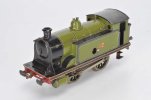
Yes, a project many years in the making — essentially starting with the speculative purchase of a Marklin Precursor with a broken motor and no tender. Quite a gamble in that it isn’t a common model, so no guarantee I would ever find the motor or tender needed. It wasn’t cheap, either. I have probably had the broken Precursor for close to twenty years, with no sign of a replacement motor or tender at any point. Then both turn up in the same auction lot in combination with a rough loco that I wouldn’t want because of its condition. Perfect! But a long wait.
The tender I have just bought, on the basis of the auctioneer’s photos, appears to be in much better cosmetic condition than the loco that is coming with it. Comparable with the loco I already have, I think. I can see the coal rail has been re-soldered on one side, but apparently with little paint damage. The rear coupling is not the original. The buffers are Marklin but I don’t think they are original either — much later, I would say. Nothing that can’t be sorted.
I am pretty confident the tender I have just bought is the correct type for a Precursor — but not 100% certain. The tender is clearly Marklin, LNWR and early — and it is paired with a Precursor, so most likely the original tender for the loco. But I have never seen another 0 gauge Marklin Precursor that would confirm the tender type. Also, the type of tender supplied when new might have changed over the production period. This is a very early model. Marklin’s Gauge 1 version (much more common than the 0 gauge model) has a tender with a break in the frames; front axle in a fixed position, but the sections of the frames holding the middle and rear axles are actually a bogie without looking like one. There were examples of this in 0 gauge too reflecting the then current standard curves. So I have slight doubts as to whether the 0 gauge Precursors should have a similar arrangement, at least for the earliest production. I would very much like to see another example of the 0 gauge Precursor to confirm the tender fitted and, if the same as my purchase, what buffers and coupling my tender should have.
The Marklin 0 gauge Precursor was included in the Bassett-Lowke catalogue from c. 1907. The B-L catalogue listing was for the Gauge 1 Precursor made by Bing exclusively for Bassett-Lowke. But there is a small inserted picture (engraving, I think, not photo) showing the (much less accurate) 0 gauge model that was also available. B-L did not sell the Marklin Gauge 1 Precursor which was much inferior to Bing’s model. Something else I must try to establish is when the 0 gauge Precursor ceased to be offered. I’m guessing once the George the Fifth model came out (so 1910 or ‘11).
Martin