You are using an out of date browser. It may not display this or other websites correctly.
You should upgrade or use an alternative browser.
You should upgrade or use an alternative browser.
Scratch build - LNWR Precursor Tank - Scale7
- Thread starter adrian
- Start date


Ian@StEnochs
Western Thunderer
I do that too. I profile the frame on my panto mill in thin brass and then solder to the cab front. It is then quite easy to scribe a cutting line with dividers using the outside of the frame as a guide.I learnt from "blank" to do it as an overlay with no cut out. You then cut the opening in both sheets in one go.
Simon


adrian
Flying Squad
I've been flitting between a few projects and trying to remember post updates isn't always top of the list! Progress on the tank was delayed whilst I tried to decide which bits were going to be fixed and which to bolt down. There are a few considerations and the cab area and roof being the tricky one to resolve, more of which later. The final decision has been to solder the tanks and cab to the footplate but the boiler will be bolted in and removable. To start with I simply tack soldered the tanks in place, just in case they need adjusting later on when I have the rear tank built for reference.
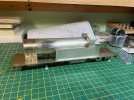
The rear tank is then cut out, nothing complicated for the tank just a few rectangular plates to be cut out. The rear cab plate a little more complicated.

There is quite a bit more detail to add to the rear spectacle plate so I've not soldered it in yet, figuring it'll be easier to add detail in the flat prior to soldering it in place.


The rear tank is then cut out, nothing complicated for the tank just a few rectangular plates to be cut out. The rear cab plate a little more complicated.
There is quite a bit more detail to add to the rear spectacle plate so I've not soldered it in yet, figuring it'll be easier to add detail in the flat prior to soldering it in place.

freelance7
Western Thunderer
Lovely work Adrian,
Paul
Paul
adrian
Flying Squad
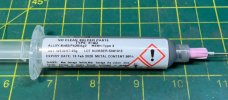
One thing I forgot to mention - there was a slight pause in build after I had run out of solder paste. I've used Carrs 179 solder cream for a number of years for the excellent results however the syringe I had was near it's end and had dried up too much to be useful and needed replacing.
However the only supplier with stock appeared to be C&L, I'm all for supporting the specialist modelling retailers but at the best part of £54 including postage it made me start to consider alternatives. CPC is just round the corner for me so I tried a variety of alternatives but nothing was as good, they just didn't flow nicely, wet the metal or seep into the joint in the same way as Carrs 179.
Hobby Holidays equivalent is Qualitek cream but have zero stock at the minute. A quick search found a supplier, Somerset Solders, which comes in at £30 including postage.

 www.somersetsolders.com
So far I have been very pleased with the results, it seems to flow as well as the Carrs solder, it penetrates into the joint very nicely, it "wicks" into the joint, follows the heat so just what I want as it minimises the amount I need to apply and consequently much less cleaning up to do. Now it might be that my Carrs cream was drying up so I kept applying additional flux. This as a fresh tube the flux with the solder works very well such that so far I haven't felt the need to apply any additional flux. Just a dab of the solder cream is all that is needed, the flux carrier works very effectively - the added bonus being that there's no flux based splatter from the added water based flux, again a bonus with reduced cleaning up required. The flux it does use seems to wash away nicely.
So if you are looking for solder paste give this a try - I don't think you'll be disappointed.

Even better for me would have been to collect it from CPC at £20 - but when there is zero stock the price doesn't mean much.
However the only supplier with stock appeared to be C&L, I'm all for supporting the specialist modelling retailers but at the best part of £54 including postage it made me start to consider alternatives. CPC is just round the corner for me so I tried a variety of alternatives but nothing was as good, they just didn't flow nicely, wet the metal or seep into the joint in the same way as Carrs 179.
Hobby Holidays equivalent is Qualitek cream but have zero stock at the minute. A quick search found a supplier, Somerset Solders, which comes in at £30 including postage.
619D Tin Lead syringe solder pastes
A tin, lead and silver alloy solder paste in a syringe for easy dispensing. Ideal for SMT component soldering of prototype circuit boards, the Qualitek 619D comes in 10cc and 30cc syringes.
www.somersetsolders.com
So far I have been very pleased with the results, it seems to flow as well as the Carrs solder, it penetrates into the joint very nicely, it "wicks" into the joint, follows the heat so just what I want as it minimises the amount I need to apply and consequently much less cleaning up to do. Now it might be that my Carrs cream was drying up so I kept applying additional flux. This as a fresh tube the flux with the solder works very well such that so far I haven't felt the need to apply any additional flux. Just a dab of the solder cream is all that is needed, the flux carrier works very effectively - the added bonus being that there's no flux based splatter from the added water based flux, again a bonus with reduced cleaning up required. The flux it does use seems to wash away nicely.
So if you are looking for solder paste give this a try - I don't think you'll be disappointed.
Even better for me would have been to collect it from CPC at £20 - but when there is zero stock the price doesn't mean much.

RichardG
Western Thunderer
The idea of a paste which doesn't need a special clean-up is very appealing.
I keep a veneer pin inside the tip of the syringe to stop the paste drying out. This is with GPT183 paste, which claims to be 63% tin and 37% lead.
The ingredients don't include a percentage for the flux, so I guess they are telling us what we have left after a joint is made.
I keep a veneer pin inside the tip of the syringe to stop the paste drying out. This is with GPT183 paste, which claims to be 63% tin and 37% lead.
The ingredients don't include a percentage for the flux, so I guess they are telling us what we have left after a joint is made.
adrian
Flying Squad
The data sheets on the CPC website - who after posting last that they had no stock no suddenly have 3 in stock!The idea of a paste which doesn't need a special clean-up is very appealing.
I keep a veneer pin inside the tip of the syringe to stop the paste drying out. This is with GPT183 paste, which claims to be 63% tin and 37% lead.
The ingredients don't include a percentage for the flux, so I guess they are telling us what we have left after a joint is made.

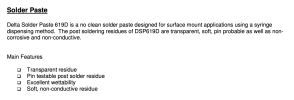
Personally, I would be very cautious about 'no clean' - there is an implied assumption about the circumstances in which the solder is being used and here it clearly says "for surface mount applications". We are using these materials in circumstances light years from those intended - and a residue which is completely harmless when left on a printed circuit board might well play havoc when coated in several layers of very beautiful paintwork, lining and weathering.
adrian
Flying Squad
I don't think anyone is taking this as an absolute "no clean" solution - it quite clearly does leave a residue, it even mentions "post soldering residue", "soft residue" and models will need cleaning. However some residues are easier to remove than others and this is I suspect is what Richard was saying that no "special cleaning" (my bold) was required. The data sheets suggest hot soapy water will ease cleaning.Personally, I would be very cautious about 'no clean' - there is an implied assumption about the circumstances in which the solder is being used and here it clearly says "for surface mount applications". We are using these materials in circumstances light years from those intended - and a residue which is completely harmless when left on a printed circuit board might well play havoc when coated in several layers of very beautiful paintwork, lining and weathering.
adrian
Flying Squad
A quick update - flitting between numerous projects at the moment but have progressed a little on the loco.
I forgot to take photos for a bit but nothing really complicated at all, just rectangles of nickel-silver sheet cut out, filed square and assembled. So I fitted the interior coal space, the side sheets have been extended in height to form part of the tool boxes.

They only needed an L-shaped strip for the other side and rear and finally capped off. Access appears to be via doors in the rear spectacle plate rather than lids. I've also decided to make the rear tank a removable component to be able to paint the inside of the cab when finished so some brass strip has been soldered in the bottom of the tank to be drilled and tapped when the position is determined. In this photo the rear tank is just loosly placed on the rear footplate. Having the rear tank in this state allowed me to confirm the main tank positions. The were nearly correct but did need a little tweaking, they are now fully soldered in place so a little more detailing can now take place.

The rear spectacle plate needs a bit more detailing before soldering in, now that positioning has been sorted attention has turned to building up some of the detailing on the chassis. Starting with the balance pipe between front and rear tanks, for which I have been teaching myself 3D modelling (using FreeCAD)
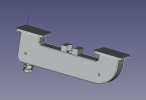
The intention being to mount the loco steps on the chassis rather than the body/footplate. The little pedestal in the middle is intended to hold a 12BA nut so that the balance pipe can be screwed to a cross member that will be supporting the step and it will be hidden by the cab step.

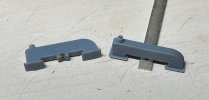
That's all for now - just going back to some detailing to finish off the rear spectacle plate and rear tank.
I forgot to take photos for a bit but nothing really complicated at all, just rectangles of nickel-silver sheet cut out, filed square and assembled. So I fitted the interior coal space, the side sheets have been extended in height to form part of the tool boxes.
They only needed an L-shaped strip for the other side and rear and finally capped off. Access appears to be via doors in the rear spectacle plate rather than lids. I've also decided to make the rear tank a removable component to be able to paint the inside of the cab when finished so some brass strip has been soldered in the bottom of the tank to be drilled and tapped when the position is determined. In this photo the rear tank is just loosly placed on the rear footplate. Having the rear tank in this state allowed me to confirm the main tank positions. The were nearly correct but did need a little tweaking, they are now fully soldered in place so a little more detailing can now take place.
The rear spectacle plate needs a bit more detailing before soldering in, now that positioning has been sorted attention has turned to building up some of the detailing on the chassis. Starting with the balance pipe between front and rear tanks, for which I have been teaching myself 3D modelling (using FreeCAD)
The intention being to mount the loco steps on the chassis rather than the body/footplate. The little pedestal in the middle is intended to hold a 12BA nut so that the balance pipe can be screwed to a cross member that will be supporting the step and it will be hidden by the cab step.
That's all for now - just going back to some detailing to finish off the rear spectacle plate and rear tank.

adrian
Flying Squad
The rear spectacle plate will be soldered to the removable rear tank. The issue is the roof, it has a reverse curve at the edge and there is no side sheet all the way back to the rear spec plate. So not convinced I can make a removable roof to fit snugly. So the roof will be soldered to the rear spec plate and clip in at the front. Making it all removable makes it easier to detail and paint the cab later on.

adrian
Flying Squad
Trying to remember to take photos and post progress of physical progress - alternating between this and some more 3D modelling practice for some more components.
So the rear spectacle plate now has bezels around the rear windows and I've softened some brass angle to go around the central door - a rather prominent feature on these locos. It needed a little bit of working to keep it flat around the various bends - I tend to get these thing more or less to the approximate shape, the final fitting is easily adjusted when soldering it in place.
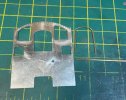
So now fitted and a horizontal length across the bottom between the toolboxes.

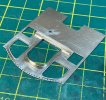
Dry assembled with the rear tank to ensure it all fits, which it did.

Now that is sorted I have tack soldered the rear tank in place on the footplate to make sure I have got all the dimensions correct. Everything seems to be square and the correct spacing for the cab doors. I'll leave it for a day or so to make sure I'm happy with the position, the sharpie pen marks are indicating where the internal brass plate are situated so when okay I know where to drill through from underneath for the attachment bolts.


So the rear spectacle plate now has bezels around the rear windows and I've softened some brass angle to go around the central door - a rather prominent feature on these locos. It needed a little bit of working to keep it flat around the various bends - I tend to get these thing more or less to the approximate shape, the final fitting is easily adjusted when soldering it in place.
So now fitted and a horizontal length across the bottom between the toolboxes.
Dry assembled with the rear tank to ensure it all fits, which it did.
Now that is sorted I have tack soldered the rear tank in place on the footplate to make sure I have got all the dimensions correct. Everything seems to be square and the correct spacing for the cab doors. I'll leave it for a day or so to make sure I'm happy with the position, the sharpie pen marks are indicating where the internal brass plate are situated so when okay I know where to drill through from underneath for the attachment bolts.

adrian
Flying Squad
Thanks for that - oh it did twist more than a little, however a little light pressure from some steel rectangular bar soon persuaded it flat again.Very neatly done, Adrian.
Bending angle like that without getting twist in the section is quite tricky - even in full size.
Dave.