
You are using an out of date browser. It may not display this or other websites correctly.
You should upgrade or use an alternative browser.
You should upgrade or use an alternative browser.
Two plank dumb buffered wagon
- Thread starter Jon Nazareth
- Start date

Ian_T
Western Thunderer
Just received my copy of the G3S Spring Newsletter Nick - Great Issue - Well done!
Looking at the two photos of your 'Precedent' I'd say there are many here who would also like to see them (and more please!)
Staggeringly good work. You and Mike seem determined to give me an inferiority complex!
Regards,
IanT
Looking at the two photos of your 'Precedent' I'd say there are many here who would also like to see them (and more please!)
Staggeringly good work. You and Mike seem determined to give me an inferiority complex!
Regards,
IanT
Last edited:

michael mott
Western Thunderer
Just finished reading through this thread Jon. Enjoying your work and feeling that hopefully one of these days to get back in the workshop and doing some modelwork. Interesting discussion about the wheel making. I am getting used to new glasses now as it is three months since my cataract surgery. I'm looking forward to seeing how you get on with the wheels, Lovely work on the styrene as usual. will you be rounding the tops of the inside slot in the W irons? I had to ask since I have not seen any mention of work on them yet.
cheers Michael
cheers Michael

Jon Nazareth
Western Thunderer
Michael
It would have been nice to have had some spare material to round off the tops but, sadly, there isn’t. I asked Mike Williams to make these up for me for, I think, a LBSCR covered van. Ever since then, I’ve used them for any wagon that has straight legged axle box guides.
Jon
It would have been nice to have had some spare material to round off the tops but, sadly, there isn’t. I asked Mike Williams to make these up for me for, I think, a LBSCR covered van. Ever since then, I’ve used them for any wagon that has straight legged axle box guides.
Jon
michael mott
Western Thunderer
Ah I see, would it not be possible to solder in a rectangle of brass and then cut or file it to shape for this wagon? assuming that they will be painted.
Michael
Michael
Jon Nazareth
Western Thunderer
That’s a possibility, I suppose. This is a bit like Mike Williams suggesting that I need to make or have made nine spoke open spoked wagon wheels .
Jon
Jon
Jon Nazareth
Western Thunderer
Nick Baines very kindly drew up and organised the printing of these two items for me. The wheel is the nine spoke one for this wagon and the axle box is a generic one that I can use on different wagons. The little brass piece is one the bearing inserts for the box. The wheels being black don’t photograph very well and the finish is much better than it appears in the pictures.
Thanks again, Nick.
Jon
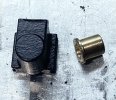
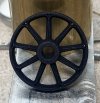
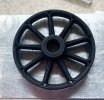
Thanks again, Nick.
Jon
Last edited:

NickB
Western Thunderer
Thanks due to Jon for being game to participate in my ongoing 3D print experiments
Just a few comments. The material is PA12, a type of nylon, which has better strength and toughness properties than the commonly used thermoplastics such as PLA. The printing is done by a sintering process which avoids the layering finish that one often sees. They were, of course, made by a professional 3D print company, not on a hobby machine. The axleboxes were treated to a post-printing "vapour smoothing" process. You can judge for yourself whether the results are actually better, Jon and I are still undecided.
What is definitely true is that the results are difficult to photograph well and can look quite different "in the flesh". The surface is granular and the grains are reflective so light gets scattered in different ways depending on how you are looking at it. The parts I have had done for previous projects certainly came up well under a coat of paint.
Speaking of paint, concerns have been expressed in some quarters about the life of plastic parts, and particularly the possibility of embrittlement from exposure to sunlight. Come back in ten years are we might know! Seriously, embrittlement occurs with most (all?) plastics, and the cause is UV light, a component of sunlight. Does painting form a barrier to extend the life? A little research turned up the interesting information that oil-based paints are largely transparent to UV, whereas acrylic paints are more opaque. So if you are concerned about life, a coat of acrylic might be the answer.
Nick
Just a few comments. The material is PA12, a type of nylon, which has better strength and toughness properties than the commonly used thermoplastics such as PLA. The printing is done by a sintering process which avoids the layering finish that one often sees. They were, of course, made by a professional 3D print company, not on a hobby machine. The axleboxes were treated to a post-printing "vapour smoothing" process. You can judge for yourself whether the results are actually better, Jon and I are still undecided.
What is definitely true is that the results are difficult to photograph well and can look quite different "in the flesh". The surface is granular and the grains are reflective so light gets scattered in different ways depending on how you are looking at it. The parts I have had done for previous projects certainly came up well under a coat of paint.
Speaking of paint, concerns have been expressed in some quarters about the life of plastic parts, and particularly the possibility of embrittlement from exposure to sunlight. Come back in ten years are we might know! Seriously, embrittlement occurs with most (all?) plastics, and the cause is UV light, a component of sunlight. Does painting form a barrier to extend the life? A little research turned up the interesting information that oil-based paints are largely transparent to UV, whereas acrylic paints are more opaque. So if you are concerned about life, a coat of acrylic might be the answer.
Nick
Jon Nazareth
Western Thunderer
I’ve run out of storage space on my display shelf. So, with all of these new wagons waiting in the wings, I have had to add another length of track!
Jon
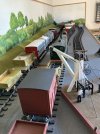
Jon
Jon Nazareth
Western Thunderer
I need to machine up the wheel rims in order to carry on with the body. I have other work to carry out on the underframe before I can do this and so, I’ve been working on other parts.
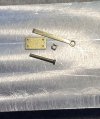
Some parts for the drop side retainers. I machined a little from the head of a 3/64” brass rivet in order to make it look less like a rivet.

One of them silver soldered up. I discovered these dummy brass bolts and there are enough to use on all four catches.
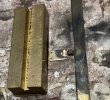
I sandwiched the pieces this way to stop them moving when heated.
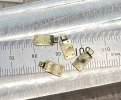
All four soldered up and with a first clean up.

I managed to drill a 1/16” styrene rod with a .74 drill in order to make these barrels for the hinges and the pin retainers. I tried to part them off in the lathe but the rod simply bent. In the end, I cut them to engine on the Chopper. The rod that I’m using is a little tight and so I’m going to have to open out these little pieces. A bit of a pain but it has to be done.
Jon
Some parts for the drop side retainers. I machined a little from the head of a 3/64” brass rivet in order to make it look less like a rivet.
One of them silver soldered up. I discovered these dummy brass bolts and there are enough to use on all four catches.
I sandwiched the pieces this way to stop them moving when heated.
All four soldered up and with a first clean up.
I managed to drill a 1/16” styrene rod with a .74 drill in order to make these barrels for the hinges and the pin retainers. I tried to part them off in the lathe but the rod simply bent. In the end, I cut them to engine on the Chopper. The rod that I’m using is a little tight and so I’m going to have to open out these little pieces. A bit of a pain but it has to be done.
Jon
Jon Nazareth
Western Thunderer
Ian
Thank you. The retaining plates look big at 8mm long but very fiddly to hold. The styrene tube that I made even worse. I expect that it’s simply par for the course for the 4mm folk.
Jon
Thank you. The retaining plates look big at 8mm long but very fiddly to hold. The styrene tube that I made even worse. I expect that it’s simply par for the course for the 4mm folk.
Jon