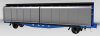
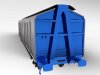
The cross-section of the model looks deeper than the prototype.... and more rounded whereas some of the Paul Bartlett photos seem to have a flatter profile.
Some of the ones in Paul's gallery are the later type, which are both higher and wider, and also have a different roof arrangement. Both of the later diagrams seem pretty similar, but the first 100 were different.
Just why do these wagons have a central higher section to the roof?
As Jordan mentions, various gubbins related to the operation of the doors lives up there. The operating gear on the ends is the unlocking mechanism - AFAIK the doors are moved by hand (or mostly by fork, by those too lazy to get off their forklifts, probably).
Jordan - I've manged to orient the model closer to one of Paul's photos - I think the overhang of the ends and doors is about right comparing the two. Have a look and see what you think.
I'm also forming the opinion that the roof sheet is in the right place, but what's wrong is the angle of the door tops - it should be flatter than it is. This would increase the gap between the roof sheet and the doors, and improve the appearance.
Again, any observations welcomed:
http://paulbartlett.zenfolio.com/twinvan/h2a7ebaa2#h2a7ebaa2

Looking at all of these pictures has also made me think that I need to revisit the buffers, there' not quite the same type as on these wagons. Still, better to notice something now than after everything's been cast!


 I certainly wouldn't mind a few.

 starting to sound like a wishlist....