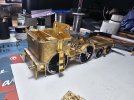
Nick Dunhill's Workshop - GWR Broad Gauge (ex- Bristol and Exeter) Pearson 4-4-0ST.

Nick Dunhill

Western Thunderer
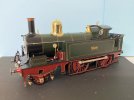
This time we delve back into the neolithic period of history with this Broad Gauge loco. The etches have just been completed by Jeff Ennis for the Broad Gauge Society, and they were supplied with a few castings, a list of the individual panels and a short section of instructions. I suppose this is a test build of sorts. The brief is to build a model of the loco below, dated 1885.
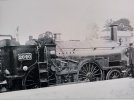
54564900722_4561a06723_b.jpg

I had a longish chat with Jeff on the phone and got going.

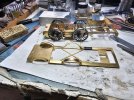
I cut out all the chassis frames and stays, together with the cylinder and motion bracket parts.

54566071520_51a9c9fe12_b.jpg

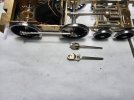
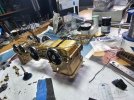
I assembled the cylinder, ashpan and crank axle support sections. I decided not to use the rocking beam suspension system Jeff had designed into the kit. I am sure it would have worked well, as I had built a similar system designed into Scorpio's Queen class kit. The need to be able to remove a crank axle necessitated the use of hornblocks, and the frames were modified appropriately. The ashpan side is part of the rocking beams and I cut away the latter.

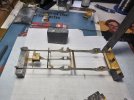
There is quite a complicated structure to the rear of the cylinders. It supports the bogie and centre section of chassis. Luckily the instructions covered this, but soon ran out!
54565750946_e862c76b5a_b.jpg

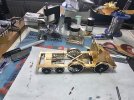
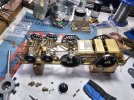
I was able to make the basic chassis, and all the etchings went together without any issues. I thought I would build the water tank and ashpan to add strength to the structure before adding the hornblocks and wheels.

54565955759_49c89eb4e7_b.jpg

The water tank went together in a very satisfying way with MOK/F7-style sub millimetre perfection. The firebox/ashpan sides were also soldered to the chassis, and I completed the bottom, front and rear as they were not moving independently of each other any more. It makes the motor and gearbox almost invisible.

54566103120_0df401df24_b.jpg

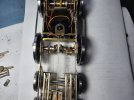
The kit has been designed around one of Jeff's foldy-up gearboxes and a nice set of Ultrascale gears. I had a NOS Mashima 1833 which is now part of the drive train. As I have to build inside motion the drive has to be on the rear axle which is inaccessible to all the usual spur gearbox combos. I got the motor to fit with a minimum amount of slitting disc activity, and then realised I had to turn the motor through 90 degrees!

54566102810_494f2ceae3_b.jpg

Chop, chop....

54566008078_c11ae27d8e_b.jpg

You can see I have made a motor mount to locate it all. It runs very well and surprisingly quietly for a worm and gear, and is easily powerful enough for a shortish BG train.

Wheels and inside motion next.
 

Dave Holt

Western Thunderer
Wow! Those frames look slinky compared with later locos. Great care needed not to bend them in either plane, I imagine.
Dave.
 

Nick Dunhill

Western Thunderer
And so, I have fitted up the Broad Gauge wheels. These were specially made by Slater's for the BGS, and are available from the latter. I did have an issue with the 12BA screws supplied with the driving wheels. They were under the correct diameter, and consequently the top hat crankpin bearings were a very sloppy fit. The chassis would run freely until you tightened up the crankpins, when it would bind. Swapping out the 12 BA crankpin screws for ones with the correct (1.35mm) diameter over the threads cured the issue completely.

Next up was the bogie. I had another chat with Jeff Ennis about how it went together, and it did go together exactly as he had envisaged.

54571348365_84164dff75_b.jpg

The bogie is mounted with no side-play to the loco chassis, and 1.0 mm of end float on each axle. It happily goes round a 5' 6'' curve, which is a big ask for a BG loco in 7 mm as they comply to S7 standards.


You can see that I have installed pick ups and a Loksound V5 decoder with an ESU stay-alive and YouChoos Lurve9 speaker.

I have spent all day fettling Laurie Griffin castings for the Allen valve gear. He didn't have crank castings that were identical to the drawing, but I modified what he sent. I have fettled the slide bars, crossheads and connecting rods. They are all now very close to what is shown in my drawing of the loco.

54571249928_563f31a71f_b.jpg

54571347940_1504181257_b.jpg

Next week I will start on the valve gear. I think it will be a mash-up of LGM castings and Jeff's etched parts. We will see!
 

Dave Holt

Western Thunderer
Are you going to fit the centre axlebox or is that too much of an alignment issue? It probably was on the full sized loco. Also unusual is the slide-bar support arrangement not being a full width motion plate. Early locos certainly appear to have some odd features compared with later 20th century designs.
The bogie is incredibly short wheelbase compared with the track gauge. It wouldn't take too much gauge clearance to allow it to crab relative to the track.
Beautiful work, as usual.
Dave.
 

Nick Dunhill

Western Thunderer
The LNWR Precursor tanks had a similar middle bearing arrangement supporting the crank axle. I have a left over 3D print of an axlebox that I'll look to use.

The crank axles of BG locos must have been prone to breakages as they predate the Bessemer process that allowed larger quantities of steel to be produced. The locos must have largely been made of wrought iron?
 

Nick Dunhill

Western Thunderer
The next job tackled was the eccentric rods and shieves (round bits.) I had a batch of eccentric shieves made a couple of years ago and these were to suit the split strap eccentric rods supplied in current Laurie Griffin Miniatures Stephenson sets. The cast eccentric sheives that Laurie supplies are too big for the split eccentric straps. However the eccentric rods supplied in this Allan set are his old type solid straps, and they do fit the shieves, but it is difficult/awkward/rubbish to fit them as solids before you solder up the crank axle. I drilled and cut the straps so they would come apart and fit round the shieves when required later. This was an awful lot more work, but the finished (solid, modified) eccentric straps were much better than the cast halves in his Stephenson set. Sorry if my language skills didn't articulate this well.

54582974321_19ea31c578_b.jpg

Next I thought it would be better to build the crank axle and test everything out. There's an old maxim about measuring twice and cutting once. Luckily I didn't cut! I measured all the positions for the shieves, spacers and crank web castings on the axle after a grueling day of fettling eccentric bits. Instead of checking measurements the following day I just soldered the crank axle up. The eccentric shieves and crank castings were all in the wrong place. Bad arithmetic after a long day. As I hadn't cut the axle I was able to unsolder it all, clean it all up and have another go. It was bang on second time, and easier to do as the parts were well washed with solder.

54582103712_26533ca289_b.jpg

The con rods fitted very nicely, as did the crossheads in the slidebars. The slidebars, crossheads, con rods and crank castings were all cast LGM parts, and fitted up well after a bit of fettling. There are etched parts for all of the above, but I thought it would be quicker to fettle castings than laminate etches, and, as there isn't a parallel universe that I can access, I'll never know. I'm sure Jeff's etches would have been fine too.

54583153329_dd78e76efb_b.jpg

You can see in the above photo that I have made the (very boxy) expansion links from Jeff's etches. In the end I grafted Jeff's eccentric rods on to Laurie Griffin's eccentric straps, and they came out very well. I've also made the valve rods and glands and partly finished the radius rods.

Next I have to make the lifting shaft and links. These will also be another mash up of LGM castings and Jeff Ennis etches. Should be fun. I should add that the kit parts I recieved are very much in the test phase. Jeff has done all the CAD for the castings required to complete the kit, but they don't exist yet, so I am having to improvise with castings available elsewhere.
 

Dave Holt

Western Thunderer
An interesting exercise in mixing and matching to good effect, Nick.
The cranks look like castings for the webs and pins but how do you solder them (and the eccentric sheaves) to the steel axle? This is something that has defeated me and I've ended up gluing and pinning the two crank axles I've made in 4 mm scale.
Dave.
 

Nick Dunhill

Western Thunderer
Hi Dave
They're soldered with normal electrical solder. I use a big 80W soldering iron, the sort used by stained glass window makers.


It has a big chisel tip to get lots of heat into the parts.

I clean the axle and all the holes in the castings with wet-or-dry first and use Baker's fluid as the flux. Baker's fluid is good for whetting both steel and brass so you should be able to get good penetration with your solder.

I never bother pinning, as I don't like the idea of breaking a drill in the middle of a crank web.

 
Last edited:

Dave Holt

Western Thunderer
Thanks for posting the video, Nick. Very interesting and informative.
I tried silver soldering a crank axle, couldn't get the solder to flow and ended up with a carbonised and distorted mess and had to start all over again. Your soft solder method, with a large soldering iron, looks far easier.
Dave.
 

Nick Dunhill

Western Thunderer
A quick update to complete the Allan valve gear.

I noticed on the GA that the reversing shaft has two boxes cast on to it that carry shafts supporting the lifting links for the expansion link and radius rod. The etches include the lifting links, but Jeff's drawings show that he planned a casting for this item.

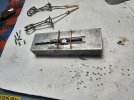
I made a jig out of some waste brass strip to support some thin walled tube to act as shaft bearings held in place with some drills.

54586002461_23409af943_b.jpg

I then flooded the whole thing with 145 deg solder to make a blob. This was fettled carefully to make the required shape.

The valve gear was then finally soldered together and assembled thus.


It ran without any binding first time. Very satisfying!

Brake gear next.
 

45609

Western Thunderer
A very interesting build. Something a bit different. I was asked to build a BG kit of a 3501 2-4-0T in 4mm scale over 10 years ago now. Overall it was a pretty easy kit to put together but I didn't bother with the inside valve gear. I also chickened out on the painting and sent it to Warren. He made a tremendous job of it...


Looking forward to seeing this one progress. Also, I must say the footsteps into the cab on the prototype photo look like they could have found an alternative life at the local swimming baths.

Cheers...Morgan
 

Nick Dunhill

Western Thunderer
I have built the basic footplate and cab this week. The loco is very odd, and therefore lots of care and attention needs to be taken when forming parts. The kit is excellent, well up there with MOK and F7, but, like kits from those manufacturers, does need a LOT of care when assembling. If you don't the mistakes/misalignment will be amplified as you progress. I made two of the Scorpio Armstrong Convertables as BG locos and two Queen class locos a couple of years ago, and the Ennis design principles are broadly the same. Jeff has moved the process on by designing in CAD.

54602470953_546b8b5059_b.jpg

The footplate has an 'underlay,' onto which the valences are soldered, and an overlay from which you form the splasher tops. It is tricky to get this part to fit, but it will. You can see here where I have taped the structures together to check the fit on one side. The two layers have alignment tabs to guide you.

54602561110_80f425c42d_b.jpg

This is the result, with the cab front in place. I had to jiggle and adjust the footplate so that the valences are straight and the footplate lands nicely on all of the chassis top. I fitted up the buffer beams too as they are an integral part of how the two structures fit together. Also part of the rear buffer beam structure supports the cab floor.

Care must also be taken when forming the cab/bunker side panel. The flare needs accurate constant curves, and the corners must be bent to fit round the cab floor accurately. I had to take a little off the rear of the cab floor to make the cab land properly, but it did so very nicely. Sitting perfectly between the valences.

54601378037_1841c44e8e_b.jpg

I made the dreaded GWR bunker/tender corners (add beading, flood fingers with solder, file, file, dress, dress) and planted the top extension on.

The kit didn't include parts to make the thin strip of footplate at the side of the cab, above the valences. Jeff says that the majority of the locos didn't have that feature, but 2040 did. I carefully soldered a bit of profiled boiler band strip round the valence top and reduced the width with a rotary sander. This threw up another issue as the panel for the rear footplate overlay was too narrow for my version. I made a wider one. I'd avoid making no 2040 next time.

54602448539_c0a3264c0b_b.jpg

There was enough working-week left to fabricate the water filler on the rear wall of the bunker. That went together with little effort.

Next week I will continue with the cab interior. The loco has an interesting back plate arrangement.
 

Nick Dunhill

Western Thunderer
This week Jeff has been away on hols, and I didn't want to bother him with constant questions about the build. I had planned to build a resin kit of 10000 (diesel one,) and machine the parts out of doors to prevent my workshop from acquiring a layer of resin dust. However the sunshine in South Yorks has been sometimes of the aqueous type so I took the bold move to add details to the model without Jeff's guidance. What could possibly go wrong.

54617713464_5d7e27079f_b.jpg

I added the lamp irons to the rear and front of the loco and built the bunker front. I also added the front steps to the loco.

54617732603_0e593e8022_b.jpg

54617732588_ebe3c57327_b.jpg

In the GWR era the locos were fitted with a vacuum brake pipe for the train (the loco only had a handbrake.) The loco had a very conspicuous vac pipe nailed to it, and I made that.

54616630037_641e599093_b.jpg

On Wednesday I took my Rickman Metisse to a Govt testing centre for a MSVA Certificate, and it passed so I spent the rest of the day celebrating.

On Thursday I added all the loco controls. This loco is very unusual in that the firebox backplate is in front of the cab front, and all the controls poke through holes in it, thus:

54617732708_f6c9bfed4d_b.jpg

Today I took a deep breath and made the cab steps. There were many daunting looking etched parts, but they went together surprisingly easily. It sort of aligns itself when you fit the handrails.

54617733008_f616d051c3_b.jpg

54616630372_66074f8931_b.jpg

A very weird loco indeed.

Next week the sun will shine, and I'll be machining resin parts out of doors.
 
Top