The Heybridge Railway, 1889 to 1913

40057

Western Thunderer
If I painted my models when I built them then this Workbench thread would be a lot less fragmented . . .

View attachment 254645
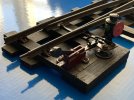
I had the presence of mind to solder a brass tube onto the bottom of the point position indicator. So I have something to hold the model when I glue it into the layout.

View attachment 254646
Yellow paint is a strange product. This took four coats, the white took one.

View attachment 254648
This is a somewhat contrived scene, but I want a point position indicator to help to show the period of the scene.

I am not a student of signalling and if the indicator should be somewhere else do say! The two sets of points are worked independently. I want to make the indicator move with the blades of the Setrack point and I expect a servo is the easiest way to do this. I doubt I will want to try for a mechanical linkage.

View attachment 254644
Here is a similar-looking signal, photographed at Mangapps on 23 August 2023.
I’m not knowledgeable about signalling either, but I would expect the circular disc to be red.

Martin
 

RichardG

Western Thunderer
I’m not knowledgeable about signalling either, but I would expect the circular disc to be red.

I painted it yellow because it can be passed at danger as part of a shunt.

Approaching Levisham Station Stock Photo - Alamy

In comparison, this one at Levisham is red because proceeding beyond it will bring a derailment.

Nevertheless, it will always be easier to change some painting from yellow to red than the other way round!
 

40057

Western Thunderer
I painted it yellow because it can be passed at danger as part of a shunt.

Approaching Levisham Station Stock Photo - Alamy

In comparison, this one at Levisham is red because proceeding beyond it will bring a derailment.

Nevertheless, it will always be easier to change some painting from yellow to red than the other way round!
Richard

This is the stage where my ignorance has me very unsure about what is correct. I think the crucial fact is a point indicator lamp is not a signal. The similar looking rotating signals at Levisham are actually signals (I asked the signalman last time I was there). They are moved using their own levers in the ‘box. A point indicator lamp is not independently controlled. It changes its aspect depending on the position of the switch blades. So it shows a driver/shunter which road the points are set for, but is not as such a stop/go control. I am aware of yellow ground signals, but can’t see an analogy that would require yellow point indicators. But I may be wrong.

Point indicator lamps were generally fitted to good quality early model railway points. These were invariably red. That doesn’t prove there weren’t also yellow ones, but it is probably a reliable indication of what was usual. Here’s one of mine dating from around WWI:

BC105ABB-E33E-4A23-9175-FA36A697BD65.jpeg

Martin
 

RichardG

Western Thunderer
The similar looking rotating signals at Levisham are actually signals

Thanks for this Martin. I will speak with my mate who assured me they are indicators!

On the bright side, it will be months before I fix this indicator onto the layout . . . I have plenty of time to find a definitive answer, and I can change the colour if need be.

I cannot help thinking, your model shows a beautifully simple approach. Much easier than a power supply, a position detector, a microcontroller and a servo. And associated software.
 

40057

Western Thunderer
I cannot help thinking, your model shows a beautifully simple approach. Much easier than a power supply, a position detector, a microcontroller and a servo. And associated software.
100% reliable too. Works every time.

Also, I would contend, far more realistic. Certainly component parts such as the bell-crank are much over-scale. But the mechanism is similar in operation to the principles used on real railways. Not many rural lines using servos in the early 20th century.

Martin
 

RichardG

Western Thunderer
Point indicator lamps were generally fitted to good quality early model railway points. These were invariably red. That doesn’t prove there weren’t also yellow ones, but it is probably a reliable indication of what was usual.

This website seems very thorough:
Indicators and Signs associated with Points

Points indicators were later provided only for shunting movements and took the form of revolving discs mounted at ground level [11.18 - 11.22]. Generally, this form of points indicator displayed a red disc and light [11.18] when the relevant points were set for the main line, or in the case of trap points, set to derail. When the points were set the other way, the disc was rotated out of view and a white light was shown at night [11.19].

The site gives examples of discs on point indicators being red, blue and green; not yellow.

So I think I have a choice:
(a) If the Hull and Barnsley Railway used blue, there is no reason why the Heybridge and Langford Light Railway could not use yellow;​
(b) Use red like almost everyone else.​

:thumbs:
 

Stephen Freeman

Western Thunderer
Strictly speaking, probably no. Point Indicators were done away with, I think in the 1900s, due to Safety issues.

Yellow or permissive shunting signals, were not adopted by all companies (GWR ones looked the same as other GWR ones just had a white light yellow ones only came in on the WR but that is another story) Other companies that did have yellow ones probably brought them in at some point after grouping.
 
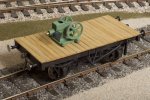
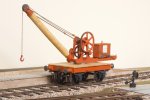
RCH flat wagon (1887 on) and mobile crane . . completion

RichardG

Western Thunderer
This is an implement wagon (unfitted) so it cannot form a part of Bentall’s exhibition train (a future project). This carried passengers and needs to be fitted throughout. The wagon might find itself pressed into use for other purposes on the railway (e.g. as a match truck), but these uses will be of a secondary nature.

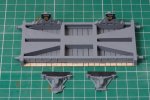
Finishing off the RCH flat wagon . . .
DSC_1547.jpeg
The primer is the new version of Halford’s grey primer. If I hadn’t read some quite critical reviews of this I doubt I would be able to tell the difference. The fumes from the new formula are less pungent and disperse sooner.
DSC_1638.jpeg
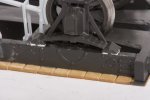
I thought the chassis was flat but one W iron has needed shims to keep all four wheels in line. I have my doubts about the long-term stability of a styrene chassis with a wooden floor and no bracing from a body . . . I can only wait and see.
DSC_1642.jpeg
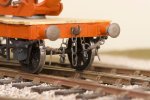
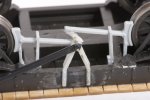
The Slater’s brake parts are moulded in black plastic. I couldn’t really see what I was doing fixing black onto black so I used some spares moulded in grey, these were left over from a rectangular tank wagon. This was the second model I posted on WT!

The moulding for the brake hangers is rather short and sets the brake shoes about 1.5 mm away from the wheel treads, so I did a cut and shut with the various parts and closed up the gaps. I think this looks better, but really I think brass is better for such intricate assemblies.

DSC_1632.jpeg
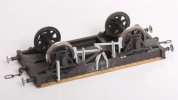
The Slater’s coupling hooks are too thick to fit into the slots in the headstocks so I used some etched brass hooks instead.
DSC_1627.jpeg
For the avoidance of doubt, I don’t get on at all well with springs, especially the tiny Slater’s ones. Such springs never seem to have much effect in my short trains so I won’t miss them. The buffer stems and the coupling hooks are set solid in Araldite.
DSC_1606.jpeg
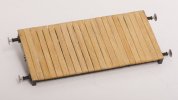
The colouring on the coffee stirrers is Colron wood dye (“English Light Oak”) applied by brush in a really thin coat. I rubbed the side of a soft pencil over this, the graphite leaves a silvery sheen to suggest bare wood starting to weather down.
DSC_1635.jpeg
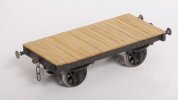
I have plenty of unfinished models behind me so this time I will leave this as a model of an unfinished wagon. With no superstructure I can try it with some out of gauge loads.

This wagon was supposed to be a filler to keep me busy for a few days between Christmas and New Year. It has taken me another week to get through it. I would have never written this four years ago, but I now find brass so much easier and more satisfying to work with. I am rather glad this model is done.

 

RichardG

Western Thunderer
How about some sort of agricultural threshing machine to go with the engine?

I rather fancy a threshing machine as a future wagon load, but I think it would need more power than the small oil engine could provide. Like, a stationary steam engine.

DSC_1661.jpeg
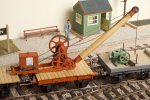
I've been painting the mobile crane today, and by total luck not any kind of planning, the RCH flat is the only wagon I possess which can clear the adjuster on the weight box. So I suspect I will not fix anything down onto this wagon for a while.

The plate giving lifting data was in a Word document from @Rob Pulham, thanks Rob.

Rob has suggested having an air compressor to pair with the oil engine. I think this would be better, though it might need a fresh wagon all of its own . . .
 

simond

Western Thunderer
Richard,

might I suggest that your crane, and your flat wagon are, just a bit, too clean, too uniform?

The track (and brickwork beyond) are more natural, IMO.

ATB
Simon
 

RichardG

Western Thunderer
might I suggest that your crane, and your flat wagon are, just a bit, too clean, too uniform?

Very much so - most of my models are too clean. I am still learning to paint; my attempts at “red oxide” paint produced something more orange than I expected, and in two different shades. I used a dark grey primer on the crane and a pale grey primer on the truck, and the difference still shows. There’s a lesson for me to learn here. I will have to claim the paint was mixed locally.

DSC_1673.jpeg
I am making up a lot of things in these models. I have no colour photos from the period, so I am imagining for example what the steel turnbuckles and forgings would look like.

Clearly there are two possible approaches - either aim for a pristine finish and then weather it; or go for the weathered finish straight way. For the weathered look, I put a few different shades of grey and brown on and around the rail clamps, and there are a few different shades on the underframe too. Eventually, when I have learnt the fundamentals of weathering as well as painting, I ought to be able to unify these finishes using powders or an airbrush or whatever. But I'm not quite ready yet.

Incidentally this photo shows a coupling hook retained by a spring and a split pin, and shows exactly why I prefer to fix these hooks in place with glue :rolleyes:
 

simond

Western Thunderer
Maybe a wash of very thin dark paint (on the red chassis) or very thin pale grey wash (on the dark one) might be a starting point.

though there are many folks on WT and in print with a far better idea than me!
 

RichardG

Western Thunderer
I have a row of shops built by Allan Downes, and these have bird droppings on the roofs. If the crane is going to be sitting on blocks, the attention of some sea gulls would be good.

I want to call the model finished for now so here are two more photos . . .

DSC_1667.jpeg

DSC_1683.jpeg
:drool:

I used almost all of the parts in the Meteor kit. I made a new weight box and added the rail clamps. The chain is from Slater's and of course I grew my own jib!
 
( Diversion : Bentall Marine )

Osgood

Western Thunderer
...
Rob has suggested having an air compressor to pair with the oil engine. I think this would be better, though it might need a fresh wagon all of its own . . .

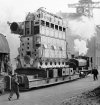
You need to develop the business - I give you BENTALL MARINE.

This will of course entail dredging the basin (an excuse for a steam-powered dredger at the quay), but it would provide the necessary justification for heavier loads for that wagon which will ensure it either keeps flat or develops a bow in the right direction (down in the middle).

So, how about a new-fangled marine diesel engine?

Shipyard copy.jpeg

You're gonna need a bigger crane though......... Whistle.gif
 

RichardG

Western Thunderer
Yes, upscale the business. And I do like the way the new name rolls off the tongue.

Sadly I fear such an operation would place burdens on the 1896 Act and indeed the English language which, when applied in the context of a “light” railway, would be too hard for them to bear. Rather like my little wagon underneath this engine really.

Thank you Tony :thumbs:
 
Top