Tom Mallard’s Workbench - P4 K1 - Clockwork LNER Q1 and Van Riemsdijk motor

Tom Mallard

Western Thunderer
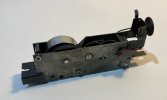
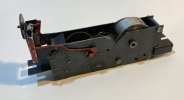
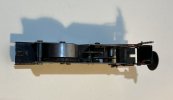
For those who are curious, please find attached images of the Van Riemsdijk motor for the Q1. This is in it's recently liberated condition so a bit grubby but it's a marvellous thing I think we can all agree, with the unique variable speed operated by a gear wheel attached to a screw thread.

The Q1 design will require some new holes drilling for the correct coupled wheel centres, with some additional frame extensions to carry the leading coupled axle.

Tom

IMG_E7389.JPGIMG_E7388.JPGIMG_E7391.JPG
 

40057

Western Thunderer
Hmm. Big spring. Very chunky main gear, I like that. And a female arbour, like Bassett-Lowke? And I can't work out the reversing gears, at all.

John
John

The reversing mechanism (and the way the winder works, and the governor) is unconventional. Reversing is effected by the usual odd versus even number of gears in the drive train. But, instead of the normal pivoted plate, the alternative drives are achieved by moving one or other of two spring-loaded gears transversely across the motor. The way the system works is partly visible in Tom’s second photo. Move the lever and one or other of the gears is pushed across the motor.

Martin
 

40057

Western Thunderer
For those who are curious, please find attached images of the Van Riemsdijk motor for the Q1. This is in it's recently liberated condition so a bit grubby but it's a marvellous thing I think we can all agree, with the unique variable speed operated by a gear wheel attached to a screw thread.

The Q1 design will require some new holes drilling for the correct coupled wheel centres, with some additional frame extensions to carry the leading coupled axle.

Tom

View attachment 259195View attachment 259196View attachment 259194
A bit of context for the motor.

Whilst Tom is designing and building the Q1, the motor around which the loco is being constructed was designed and built by John van Riemsdijk. ‘JvR’ was certainly a notable person as his Guardian obituary makes clear:


The motor for the Q1 was made in the early 1950s and used in a r-t-r 0-6-0T sold by W&H, but was also sold as a mechanism for use by scratch builders. As advertised here in The Model Railway News:

69B38C48-BFB6-4684-9585-5DC3741AFDCE.jpeg

So, after a delay of c.75 years, the Q1’s mechanism is being used as the maker intended. The 0-6-0T and its motor got good reviews when first introduced. I recall one reviewer suggesting that whilst clockwork power for model railways had seemed doomed to extinction, with a track performance this good, clockwork surely had a future …

Martin
 

James

Western Thunderer
Shame we aren't interested in that anymore in the UK, these days it's all about if that rivet is in the right place and nothing about what the point of a railway is, what it does and why.
Tony
To be brutally honest very few enthusiasts actually understand operations enough to effectively reproduce or mimic the real thing.
 

76043

Western Thunderer
To be brutally honest very few enthusiasts actually understand operations enough to effectively reproduce or mimic the real thing.
Unlike the Americans? Do you know if their system is prototypical?
 
Last edited:

Ian Rathbone

Western Thunderer
Here are a couple more of Martin’s engines, that I repainted many years ago. First a NLR tank as repainted by the LNWR -

IMG_1167.jpeg


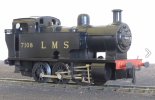
And a Fowler dock tank. This one had the cylinders attached to the body, which made it very difficult to dismantle, so I refitted them on the chassis before repainting. A nice little model. It has its winder on the right hand side, does that make it rare?

IMG_1168.jpeg

Ian R
 

Tim Watson

Western Thunderer
A bit of context for the motor.

Whilst Tom is designing and building the Q1, the motor around which the loco is being constructed was designed and built by John van Riemsdijk. ‘JvR’ was certainly a notable person as his Guardian obituary makes clear:


The motor for the Q1 was made in the early 1950s and used in a r-t-r 0-6-0T sold by W&H, but was also sold as a mechanism for use by scratch builders. As advertised here in The Model Railway News:

View attachment 259216

So, after a delay of c.75 years, the Q1’s mechanism is being used as the maker intended. The 0-6-0T and its motor got good reviews when first introduced. I recall one reviewer suggesting that whilst clockwork power for model railways had seemed doomed to extinction, with a track performance this good, clockwork surely had a future …

Martin
I only met JvR once. He seemed an Olympian character, as confirmed by his obit.

Tim
 

40057

Western Thunderer
Here are a couple more of Martin’s engines, that I repainted many years ago. First a NLR tank as repainted by the LNWR -

View attachment 259239


And a Fowler dock tank. This one had the cylinders attached to the body, which made it very difficult to dismantle, so I refitted them on the chassis before repainting. A nice little model. It has its winder on the right hand side, does that make it rare?

View attachment 259240

Ian R
Hi Ian!

A bit of background on the two locos shown above.

Both are the work of Leslie Forrest aka Windsor Models.

No mystery about the Fowler dock tank no.7108. This loco was commissioned by Norman Eagles for his famous layout ‘The Sherwood Section of the LMS’. From memory, I think it was built in 1934. Anyway, its history is well documented in various articles about the Sherwood railway which appeared in the model railway press over five decades. Its usual duty on the Sherwood railway was to shunt the sidings at Port Trent. Photographs published over the years show the loco originally had Leeds Model Co. cast alloy wheels. No doubt these disintegrated, hence the cast iron replacements now fitted. Photographs also show the loco was repainted whilst working on the Sherwood railway as the lettering at some dates was shaded and apparently transfers. There is some evidence the mechanism might have been changed too, as there are a couple of redundant holes in the body.

When I bought the loco it had been poorly spray painted black and very amateurishly and unevenly lettered by hand. Since there was no ‘original paint’ to conserve, I got it properly repainted by Ian. The motor in no.7108 is a similar or identical type to the motor in CR 828 (see above). Both motors have been modified to make them suitable for their respective prototypes. The key hole is on the right in both locos because the motor has been turned round so the spring is at the front and the rear axle is powered. For both 7108 and 828, turning the motor has allowed ‘daylight’ under the front part of the boiler. Leslie Forrest was not the world’s greatest in respect of his metal working skills. His locos were quickly built and sold for prices not much above contemporary mass produced models. Windsor Models locos are often not quite square, straight edges aren’t quite straight and there tends to be an awful lot of spare solder inside and underneath. Nevertheless, the overall look of Windsor Models productions is generally pretty good, as Ian’s photos show. The aspect of model making in which Leslie Forrest absolutely excelled was fitting clockwork motors into prototypes with small-diameter low-pitched boilers. Types which were clearly impossible to make in clockwork — yet he did it by trimming and tilting the motor, using stub axles, mounting the motor back-to-front — whatever it took to squeeze the motor into the space available. Leslie Forrest’s other great skill was in his painting. For the more obscure prototypes, all lettering and numbering was done by hand, and brilliantly executed. Number-plates and company crests too, all entirely hand painted. In post #406 above the LNWR initials and company crest on the Bowen-Cooke tank are hand-painted and Leslie Forrest’s work.

By coincidence, the chassis of no.7108 is currently with Tom for repair. The middle wheels are on stub axles and the thread for the retaining slotted-nut on one axle has worn to the extent that the nut is loose and not keeping the wheel securely in position. But for a loco that has been intensively used over a working life of decades, such repairs are inevitable. To my mind, ‘preservation’ for no.7108 is not primarily about retaining all of what is currently there — much of which isn’t ‘original’. What I want to do with 7108 is keep it operational, in the way that has always been done since it was first put into traffic.

The North London Tank is a different story. It turned up in a local auction. No attribution in the catalogue, not that kind of auction. ‘0 gauge clockwork tank locomotive’ was the best they could do. It was filthy dirty and had been repainted and lined, it appeared, using a toothbrush. However, in these circumstances, the trick is to see through the superficial ghastliness. Which no-one else did, so I was able to buy it very cheaply. I have no doubt Leslie Forrest built this loco. There is no maker’s plate or signature, but it’s his work I’m sure.

Martin
 
Last edited:

40057

Western Thunderer
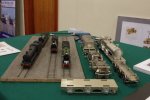
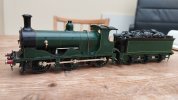
Tom: Great to speak to you at York, and to see your P4 Drummond locos. I mentioned that I also had a 700 class, and here she is. Still awaiting number and worksplates, and lettering. Also, for some reason I forgot the whistle.
View attachment 261090
Hello

Until I looked at your photo, I had not realised that these LSW locos looked almost exactly the same as a Caledonian Railway 294 class 0-6-0. Just green instead of black or blue.

Martin
 
Top