Yorkshire Dave

Western Thunderer
And then there's the question of what do I match it too... Books, photos on the web? All have variances in reproduction etc.

I tend to look at all available colour photos, books, t'interweb, real life, etc and mix a shade to something in between the variances and then adjust for scale i.e. lightening. If a 1:1 and a 1:insert model scale here Bullied pacific were painted the same shade of green the model version would appear darker as we are seeing the green on a smaller surface area.

Personally, I cannot see how anyone can criticise, argue or question whether a colour is accurate as there are so many variables. If someone questioned the colour of anything I painted I would be politely asking them if they can provide evidence :). I would go with what looks right to you as colour is very subjective. Although the original 1:1 railway colour specifications are available, do we know if the paint suppliers scale the colour for models?

From my own observations regarding colour/shade variances:
Paint batches of supposedly the same shade vary due to mixing processes (less so today with synthetic pigments and more accurate measuring techniques).
Dependent upon the lighting conditions seen/photographed under.
Film emulsion and exposure time.
Time period the photos were taken in (1950s, 60s, etc) as it will show the effects of pollution and subsequent clean air acts.
Printing/reproduction processes.
The fact the true original colour will only remained so immediately after painting as it starts to deteriorate by the action of weather - rain washing and abrasion (waterborne particles), sun (UV) and wind abrasion by airborne particles.
As individuals we all see colour slightly differently.

I would also add that building materials are a different kettle of fish. Although stone may come from the same quarry and geological strata there will be subtle variances in colour due to geological and atmospheric conditions during the formation of the strata and subsequent actions over millennia e.g. heat, pressure, chemical and gas composition. Followed by the later action of weather once exposed by quarrying. With bricks I would surmise the colour/shade variances will come down to the clay source, manufacturing methods and firing. Both building materials then become subject to the effects of weather and pollution.

The topic of the question of colour comes around as regular as the moon's phases.
 

Peter Insole

Western Thunderer
Indeed Dave, I fully agree... which is why I always preferred to work from verifiably genuine paint samples wherever practically possible. Even then, any available sample might not be fully representative of general practice - but at the very least is as good a starting point as any other?!

By the way Dave, you forgot to mention the type of surface... and the direction viewed from in relation to any light source! ;)

The issue I have, and the warnings given from long experience, is relying on any descriptive, or written account of colour schemes - indeed, the very material that AI draws all it's information from! As an example: I had a close look at that Southern e-group link. As a result of earlier research I am already familiar with the original SR/BR(S) document... and immediately picked up three notable errors in the more recent transcription.

I know the errors are not in any way deliberate, but I do get frustrated if they become relied upon or compounded into something that can become seriously misleading to anyone attempting to "get it right"!

Pete.
 

Yorkshire Dave

Western Thunderer
By the way Dave, you forgot to mention the type of surface... and the direction viewed from in relation to any light source!

Just to add another thought - the primary and/or undercoat and number of top and finishing/varnish coats and how these can weather will also alter the colour/shade. I would assume primary, undercoat and varnish batches varied.

Although the SEMG 'guide' listed the topcoats it did not specify the primary and undercoat colours other than 'as specified by the manufacturer' which leads to the question as to whether these are known. I would assume red oxide can vary by batch.

There's so much scope in the NOTES section giving discretion to each of the Divisional Engineers. Therefore as an example the station timberwork painted green in the Western Division could be a lighter or darker shade of green than the timberwork of the stations in the Central or Eastern Divisions. No wonder there's so much inconclusive discussion around colour.

As we appear to have agreed - you have to go with what looks right to you.


I know the errors are not in any way deliberate, but I do get frustrated if they become relied upon or compounded into something that can become seriously misleading to anyone attempting to "get it right"!

This is the problem with AI - Quite often I've seen a number of individuals go straight to an AI summary rather than dive deeper to corroborate and verify original sources.
 

Pencarrow

Western Thunderer
Indeed Dave, I fully agree... which is why I always preferred to work from verifiably genuine paint samples wherever practically possible. Even then, any available sample might not be fully representative of general practice - but at the very least is as good a starting point as any other?!

By the way Dave, you forgot to mention the type of surface... and the direction viewed from in relation to any light source! ;)

The issue I have, and the warnings given from long experience, is relying on any descriptive, or written account of colour schemes - indeed, the very material that AI draws all it's information from! As an example: I had a close look at that Southern e-group link. As a result of earlier research I am already familiar with the original SR/BR(S) document... and immediately picked up three notable errors in the more recent transcription.

I know the errors are not in any way deliberate, but I do get frustrated if they become relied upon or compounded into something that can become seriously misleading to anyone attempting to "get it right"!

Pete.

Morning Pete,

I would be interested to know what the errors were in the SEMG info so that I can correct my own version. It may also be worth you dropping a line to SEMG. I've noted inconsistences and errors in the past and they have corrected them. I'm all for making source info more reliable for people in the future.
 

Pencarrow

Western Thunderer
Just to add another thought - the primary and/or undercoat and number of top and finishing/varnish coats and how these can weather will also alter the colour/shade. I would assume primary, undercoat and varnish batches varied.

Although the SEMG 'guide' listed the topcoats it did not specify the primary and undercoat colours other than 'as specified by the manufacturer' which leads to the question as to whether these are known. I would assume red oxide can vary by batch.

There's so much scope in the NOTES section giving discretion to each of the Divisional Engineers. Therefore as an example the station timberwork painted green in the Western Division could be a lighter or darker shade of green than the timberwork of the stations in the Central or Eastern Divisions. No wonder there's so much inconclusive discussion around colour.

As we appear to have agreed - you have to go with what looks right to you.


This is the problem with AI - Quite often I've seen a number of individuals go straight to an AI summary rather than dive deeper to corroborate and verify original sources.

Morning Dave,

For a very peculiar reason, my work has included a project to test and trial AI agents over the last year and that sideline has been quite interesting and has shaped how I use the tool. AI is a tool and, just like any tool, success using it depends on knowing how to use it and what its strengths and weaknesses are. AI results can be anywhere between incredibly useful and insightful through to completely misleading and incorrect.

The prompt (question) you write is very important. It's not so much what you ask, but the controls and limitations you place on the question. It's also incredibly important to validate the results, look at any source data and make up your own mind. This last point is often missed by those that treat the tool as an all seeing god.

For the paint questions (and there were multiple refined questions and corrections), I'd already got myself a shortlist of what I felt could be suitable paint shades and also a collection of colour photos. In truth the range of greens 3, 3A or 4 could have been based on those photos was huge. That's for the reasons you set out in your earlier post.

To get the "correct" shade, ideally you would have a set of physical historical samples and also actual model paint samples and do a comparison. I, and most people, have neither. I was therefore into "best guess" territory.

I found asking the AI tool a big help in not only finding source info (like the SEMG page) but also discussions on the same topic. I said previously it was a rabbit hole! The results generally pointed towards similar paint shades as being widely agreed as being suitable. I found it funny that the discussions railway modellers have about colour are insignificant compared to those military modellers have!

Good enough for me is having a repeatable starting point, particularly for the SR greens. I've not managed to get that repeatability with mixing my own shades, hence the search for a premixed colour. I don't build pristine museum grade models and, as always, that starting point colour will be weathered, faded and distressed to give me a result that feels right to me.

The AI assisted colours will be arriving in the next couple of days - I'll then take a view of how helpful the tool has been at that point.

As a closing point, after finding that all my usual sources for paint had items on the list out of stock, I asked the AI to recommend UK based suppliers that had all in stock and find my the cheapest option including postage. This pulled up a number of better value suppliers than I'd found manually (£5 better) and all had full stock. This saved a lot of time and effort - which is a good outcome for any tool.
 

Osgood

Western Thunderer

simond

Western Thunderer
I would add to the thoughts above. Whilst I’m happy to play with washes and weathering, I’m utterly useless at mixing paints, everything I try to mix ends up mud-coloured. Bit like a trainee carpenter and his four-inch high, four-legged stool, that still wobbles.

I therefore always want to start with a reasonable colour out of the bottle,
 

Pencarrow

Western Thunderer
I would add to the thoughts above. Whilst I’m happy to play with washes and weathering, I’m utterly useless at mixing paints, everything I try to mix ends up mud-coloured. Bit like a trainee carpenter and his four-inch high, four-legged stool, that still wobbles.

I therefore always want to start with a reasonable colour out of the bottle,

Yes, same here. I'm fine with stone, brick, wood and concrete etc as these are all shades of yuck, but I find getting repeatable mixes of blues, reds and greens quite problematic.
 

76043

Western Thunderer
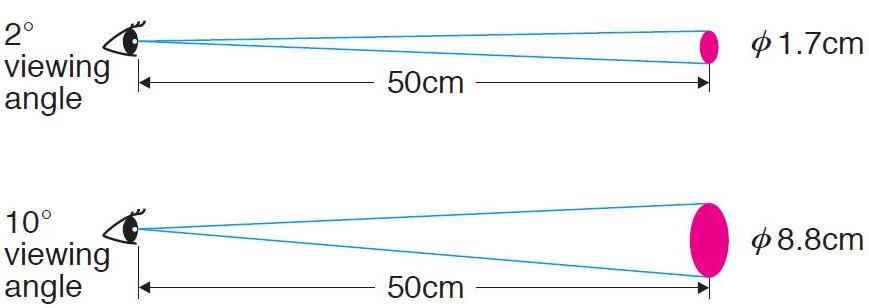
Field Size Metamerism is the science behind this idea of scale colour. Came from the problem that small colour sample chips don't look the same when painted on a large wall. There's mention of it in this ISO document, but it also deals with pigment and lighting metamerism, which is not really relevant to modelmaking.


Field-size metamerism occurs if both of the object colours of a pair of samples are perceived as being the same on the retina for a size of an observation field (e.g. defined by the 2° standard observer), while they differ for a different observation field on the retina (e.g. 10°).


NOTE 2 The reason for field-size metamerism is based on the existent colour matching functions of an observer during an observation situation. The colour matching functions change with the size of the observation field on the retina. Such change of the observation field can also occur if, for example, the pair of samples is examined from different distances.
© ISO 2020 – All rights reserved


But the colour science doesn't have an equation that properly deals with modelmakers' weathering so maybe just be happy with your colour... :)
Tony
 
Last edited:

Pencarrow

Western Thunderer
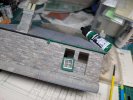
Whilst I was at work today the postie delivered the paints I ordered at the weekend. The one I was most interested in getting my hands on was the 3a Green used for windows, doors and gutters etc.

So here we have 70.970 and initial results are very positive for a starter (pre weathering) colour. It's got just that right shade of pea that was eluding my manual mixing.
PXL_20260325_222749581.jpg

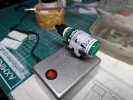
Yesterday another little tool arrived. This is, I think, intended for nail varnish but apparently lots of military modelling folk use them for shaking paint pots.

PXL_20260325_222826520.jpg

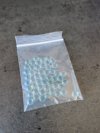
Very basic but seems to work. I've got a delivery of small glass beads arriving at the weekend and several will be placed in the new paint bottles. They act as paint agitators and will work well with the shaky machine.

@Mark F think you need one for your nail bar...
 
Last edited:

simond

Western Thunderer
I got an orbital shaker, you just press the paint bottle on the top and it runs, it’s good, but I can see that strapping the bottle on and being able to leave it whilst you make a cuppa might be handy.

+1 for the balls. I bought a bag of stainless steel ones. Glass sounds good too.
 

Flaxfield

Western Thunderer
Whilst I was at work today the postie delivered the paints I ordered at the weekend. The one I was most interested in getting my hands on was the 3a Green used for windows, doors and gutters etc.

So here we have 70.970 and initial results are very positive for a starter (pre weathering) colour. It's got just that right shade of pea that was eluding my manual mixing.
View attachment 260434

"It's got just that right shade of pee"

Noted.

SB
 

Pencarrow

Western Thunderer
I got an orbital shaker, you just press the paint bottle on the top and it runs, it’s good, but I can see that strapping the bottle on and being able to leave it whilst you make a cuppa might be handy.

+1 for the balls. I bought a bag of stainless steel ones. Glass sounds good too.

I've previously gone for glass balls (no tittering at the back) because I heard that some of the metal ones can end up rusting in the paint and discolouring it. Decided not to take the risk. Wasn't a quick task putting two in each of 100 bottles!
 
Top