RichardG
Western Thunderer
@simond The phrase we want is "live springing". From the Guild Knowledge Base (which I really must look at more often):
"For spring suspension to work properly the vehicle must ride on the springs (‘live’ springing) such that when pressed down the body will compress the springs further and when lifted slightly the wheels will still remain in contact with the rail. A total movement of about 1 mm is more than sufficient to cope with the most irregular track faults. Experiments have determined that about 65 g (2.5 oz) per axle is a good figure to aim for but some whitemetal wagons weigh considerably more than this so stronger springs need to be fitted".
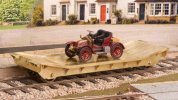
What this advice does not address is, of course, the case of an open wagon with and without a load. For the machinery wagon, the load could be quite substantial e.g. a traction engine made from white metal. I reckon, if a wagon is made fairly heavy and the springs are chosen to suit, then the effect of adding such a load will be minimised.
The GER machinery wagon is 180 mm long over headstocks. If I follow the usual guideline of 1 gram per millimetre (or 1 oz per inch) of length, I expect the springs will compress too much. I will add some lead evenly along the model so the springs at the one end are at their mid-point, and take it from there.

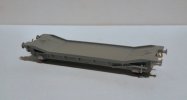
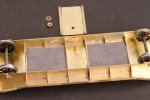
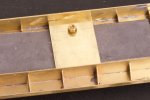
For the record, here is the model without any ballast weights.
"For spring suspension to work properly the vehicle must ride on the springs (‘live’ springing) such that when pressed down the body will compress the springs further and when lifted slightly the wheels will still remain in contact with the rail. A total movement of about 1 mm is more than sufficient to cope with the most irregular track faults. Experiments have determined that about 65 g (2.5 oz) per axle is a good figure to aim for but some whitemetal wagons weigh considerably more than this so stronger springs need to be fitted".
What this advice does not address is, of course, the case of an open wagon with and without a load. For the machinery wagon, the load could be quite substantial e.g. a traction engine made from white metal. I reckon, if a wagon is made fairly heavy and the springs are chosen to suit, then the effect of adding such a load will be minimised.
The GER machinery wagon is 180 mm long over headstocks. If I follow the usual guideline of 1 gram per millimetre (or 1 oz per inch) of length, I expect the springs will compress too much. I will add some lead evenly along the model so the springs at the one end are at their mid-point, and take it from there.
For the record, here is the model without any ballast weights.






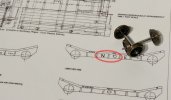

 . In my defence, the castings get no mention in the instructions.