Back in April last year, starting at post #342, there was an extended discussion in this thread about the post-1906 blue colour of Caledonian Railway locomotives. The discussion was prompted by having to choose the blue colour for the model of C.R. 828 built by Tom Mallard (see his workshop thread).
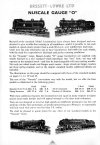
Amongst all the uncertainty and debate about ‘Caledonian blue’, a good case can be made for copying the colour used on the contemporary models made by Bing and others and sold by Bassett-Lowke. These were not toys for children, but ‘scale models’, expensive items aimed at well-to-do, educated, adults. Within the limitations of the manufacturing processes, these were accurate representations of real locomotives. It seems inconceivable to me that the manufacturers would not strive to get the colour of the livery correct. Their customers, by definition interested in railways, would soon have complained if the model was the wrong colour. And Bassett-Lowke, with a retail outlet in Edinburgh, had plenty of customers who saw real Caledonian locomotives on a daily basis. Bassett-Lowke was also supplying promotional models (made by Carette) to the Caledonian Railway for sale at the company’s stations. Bassett-Lowke definitely knew what colour ‘Caledonian blue’ was. Bassett-Lowke was also, of course, selling models of Midland, GNR, LNWR and many other companies’ locomotives. No-one suggests these models are the ‘wrong colour’; indeed, it is quite clear they carry generally accurate renditions of the respective liveries. So why should anyone assume Bassett-Lowke, uniquely, got the Caledonian colour wrong?
So my assumption is that I can trust the contemporary quantity produced models sold by Bassett-Lowke as a reliable source for Caledonian Railway locomotive livery.
There are, however, some caveats that must be applied to reliance on the contemporary Bassett-Lowke models. The paintwork will be over a hundred years old. It may have faded if left in bright light. The varnish covering the paint may have darkened or yellowed with age. The paint is likely to be dirty. All these things may have changed the colour over time. Over and above that, having looked at a range of contemporary models, I don’t think they were all exactly the same colour to begin with. And the blue can appear very different depending on the lighting conditions and even what angle the surface is at relative to the incident light.
It also has to be remembered that manufacturers, then as now, do make mistakes. Also, manufacturers might not pick up immediately on changes on the real railway, so models could reproduce out-of-date livery styles. Generally, in the pre-WW1 period, models copied the latest practice, but for Caledonian Railway livery there is the question of which blue is being represented — pre-1906 (darker) or post-1906 (lighter).
Shown previously, but worth including here, Bing’s model of C.R. no.142 in Gauge 1, sold by Bassett-Lowke c. 1910.

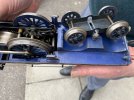
I looked at several contemporary models when deciding on the colour for 828. I had previously been able to examine contemporary models at the Brighton Toy & Model Museum. My conclusions were:
1. The blue colour was very similar (but not identical) on all the models examined.
2. It was a noticeably bright blue but much darker than some current paints sold as being the C.R. lighter blue.
3. The blue tended towards a purple-blue, not a green-blue or turquoise.
Several of the contemporary post-cards reproduced in the Caledonian Liveries book also have a purple cast to the blue colour.
The colour I chose for 828 was based on my judgement of the ‘consensus’ amongst the shades exhibited by the contemporary models. The paint used was a mixture of RAL 5002 and purple. I will never know if this is an accurate, or even a good, representation of C.R. post-1906 blue. But it seems very unlikely to be badly wrong, based as it is on multiple contemporary sources.
Just to show how important lighting is, three pictures of 828 at different times of day with or without supplementary artificial light:
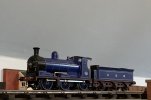
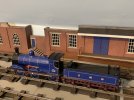

Same paint in all three photos.
Since 828 was painted, I have come across two other contemporary sources for C.R. lighter blue. These sources are independent in that they played no part in my settling on the colour for 828. Both are also post-WW1 products from manufacturers who weren’t making trains until long after 1906.
First, Meccano Ltd, whose range of Hornby toy trains was introduced in 1920. Between 1921 and 1923, Caledonian livery was offered along with Midland, LNWR and GNR. None of these locos had lining; essentially the locomotives were available in blue, red, black or green. Here’s the blue:

Picture from the Binns Road website, used with permission.
Despite all the variation due to lighting and any effects of ageing on the paint, the blue used by Meccano Ltd is clearly very similar to the blue used by Bing pre-WW1 and the the blue on 828. The bright colour, on the purple rather than green side of blue, is present again. It’s a nice confirmation.
However, I have also come across a very different rendition of Caledonian lighter blue. I must emphasise I haven’t seen this model, only a photograph. I have no idea of the lighting conditions used for photography. This model was offered on eBay. It’s a first series Leeds Model Company (LMC) 4-4-0 tank loco dating from the early 1920s. Very unusually for the LMC, it clearly has its original paint:

This is a markedly different colour to all the other models I have seen in what was supposed to be the same livery. Even from the photograph online, it’s clear the varnish on the LMC model has significantly yellowed. The paint may also have faded but there is no sign that the lower part of the boiler, for instance, is a different colour. The wheels, however, do appear to be a different shade. It’s impossible to know without examining the model in person, but my best guess is the wheels are not varnished. The wheels appear darker and more in line with the blue used on other models.
With only a photograph to go on it’s impossible to be sure, but it seems likely the LMC tank engine was always a paler and greener blue than the other models produced when the Caledonian Railway was still in existence.
Martin