
You are using an out of date browser. It may not display this or other websites correctly.
You should upgrade or use an alternative browser.
You should upgrade or use an alternative browser.
Giles' misc. Work bench.
- Thread starter Giles
- Start date

Giles
Western Thunderer
Giles
Western Thunderer
The Landrover is done, but awaiting a battery. The tilt is not a great success, but will have to do unless/until I can think/can do better. It's 0.2mm plastic formed over the cage.
The wing mirrors are polished N/S silver soldered onto wire, the windscreen wiper is lasercut N/S, which is a lot more resilient than plastic would be!
The wiper blow is not the one used - this one was slightly too large.
The wing mirrors are polished N/S silver soldered onto wire, the windscreen wiper is lasercut N/S, which is a lot more resilient than plastic would be!
The wiper blow is not the one used - this one was slightly too large.
Giles
Western Thunderer
I think my brother is now going to get this Landrover for his birthday (battery has arrived, and all is well). He will thoroughly enjoy and appreciate it, and it was as much part of his childhood as it was mine..... and frankly, I have quite a few vehicles....
I spent a week or so on a little 009 toy - actually a Dutch diesel electric tram (gauge narrowed a little to 009). An extremely good quality print from Inoxion on a Japanese chassis.
I also had a whim to see how small I could legibly engrave. The answe was really quite small. I need to measure it though
This is a 2p piece
I spent a week or so on a little 009 toy - actually a Dutch diesel electric tram (gauge narrowed a little to 009). An extremely good quality print from Inoxion on a Japanese chassis.
I also had a whim to see how small I could legibly engrave. The answe was really quite small. I need to measure it though
This is a 2p piece
Last edited:

simond
Western Thunderer
Presumably angels on the head of a pin, next?I think my brother is now going to get this Landrover for his birthday (battery has arrived, and all is well). He will thoroughly enjoy and appreciate it, and it was as much part of his childhood as it was mine..... and frankly, I have quite a few vehicles....
I spent a week or so on a little 009 toy - actually a Dutch diesel electric tram (gauge narrowed a little to 009). An extremely good quality print from Inoxion on a Japanese chassis.
I also had a whim to see how small I could legibly engrave. The answe was really quite small. I need to measure it though
This is a 2p piece
Giles
Western Thunderer
The choppers do work well (and reliably) and - if you like a gift of the printing technology. These are in ABS-like Resin, which seems to be quite up for the job, and transforms the appearance. I use basically the same thing in 4mm, 7mm and 16mm.
The little 009 Quarry Hunslet's appearance is vastly improved by scale couplings and replacing the cab grab rails with wire
The little 009 Quarry Hunslet's appearance is vastly improved by scale couplings and replacing the cab grab rails with wire
Giles
Western Thunderer
Having despatched the Series II to my brother (who is also seriously ill) I've been on the one hand lacking mojo, and on the other hand looking round for something to do that wasn't going to give me too much grief. I eventually pulled out a Locos-n-stuff Peckett 0-6-0ST that I had bought a number of years ago and stashed away in my 'later' cupboard.
Opening it for the first time, I found a note about some parts that were faulty and would be replaced - never mind, I'll make them when I get that far.
The next was a check over of etches, which visually look clean and nice, and then a look at the supplied gearmotor with gearbox. This was an N20 with a special gearbox with skew gears for the final drive. This was not so happy, as it had an unusually loud noise to it, plus an intermittent catch and slowing. I separated the elements, finding that the culprit was the N20 gearmotor - fortunately I had a similar one in a drawer which I could substitute. The axle also had loctite or whatever it was on the bearing surface which didn't help, but that cleaned up easily. When it was all rebuild with a new gearmotor, it ran nice and smoothly.
Frames next. The etches are nice, and needed minimal cleaning up. The first few components I silver-soldered on to save trouble with further soft soldering (easy with nickel silver, more risky with thin brass). One stretcher was etched with the tabs slightly too high, which would have put it in the wrong position, so I filed the upper portion of the tabs down to correct that.
You can either build the chassis rigid or with compensation. I'm going for compensation..... for which nice little Highlevel hornblocks and bearings are supplied. Once folded up, these need soldering to the frames, and you need the supplied rigid frame to use as a jig to hold the axles (and therefore the bearings and horns) true and in place. In testing however, I found that the rear axle hole of this rigid frame jig plate was over-size and therefore wouldn't hold things in the right place.... Rather like 'The Gas Man Commeth', I needed to carefully ream out the offending oversized hole in this plate, and bush it down to the correct 2mm ID (checking it against the coupling rod etches) before I could use said plates to solder the horn guides in position.
Winning slowly. It is a lovely little prototype though
Opening it for the first time, I found a note about some parts that were faulty and would be replaced - never mind, I'll make them when I get that far.
The next was a check over of etches, which visually look clean and nice, and then a look at the supplied gearmotor with gearbox. This was an N20 with a special gearbox with skew gears for the final drive. This was not so happy, as it had an unusually loud noise to it, plus an intermittent catch and slowing. I separated the elements, finding that the culprit was the N20 gearmotor - fortunately I had a similar one in a drawer which I could substitute. The axle also had loctite or whatever it was on the bearing surface which didn't help, but that cleaned up easily. When it was all rebuild with a new gearmotor, it ran nice and smoothly.
Frames next. The etches are nice, and needed minimal cleaning up. The first few components I silver-soldered on to save trouble with further soft soldering (easy with nickel silver, more risky with thin brass). One stretcher was etched with the tabs slightly too high, which would have put it in the wrong position, so I filed the upper portion of the tabs down to correct that.
You can either build the chassis rigid or with compensation. I'm going for compensation..... for which nice little Highlevel hornblocks and bearings are supplied. Once folded up, these need soldering to the frames, and you need the supplied rigid frame to use as a jig to hold the axles (and therefore the bearings and horns) true and in place. In testing however, I found that the rear axle hole of this rigid frame jig plate was over-size and therefore wouldn't hold things in the right place.... Rather like 'The Gas Man Commeth', I needed to carefully ream out the offending oversized hole in this plate, and bush it down to the correct 2mm ID (checking it against the coupling rod etches) before I could use said plates to solder the horn guides in position.
Winning slowly. It is a lovely little prototype though
Giles
Western Thunderer
Little progress for various reasons, but the next stage is cranks, for which are provided etches to fold up to three layers and solder together, followed by dressing down. My preferred methothod is to CNC them on my Stepcraft. The drawback is that I haven't used the Stepcraft for over a year, and I couldn't remember how to use it (long Covid having left me with amongst other things, memory issues - I need to use these techniques frequently and regularly if I don't want to relearn them from scratch, which is more difficult than it was....). I had Peckett cranks already drawn and programmed because I had made a pair of 0-4-0 chassis a few years ago, but I could not get it to run at all.... it turns out I was trying to run the wrong type of file. After a couple of hours I worked it out and got some made, but I obviously need to brush up on this machine.
Giles
Western Thunderer
Wheels.... I dug out the supplied wheels, and popped them in the lathe to fettled down the flanges a fraction (0.5mm over the diameter) to my taste, and then found they didn't fit the supplied axles.... The wheels have small insulated bushes in a nylon stuff which were them selves quite thin walled, and all in all, it wasn't at all practical to open out these bushes to the 2mm axle diameter. I bought this kit 7 years or more ago, so it's not reasonable to go back and try to swap them out, particularly after having put them in the lathe. Nothing for it but to replace them. I bought some Gibson wheels from Wizard models, which arrived 2 days later, and after filing down the boss, work perfectly.....
Giles
Western Thunderer
I've made new (front) cylinder end covers to replace the very simple etched ones (shown next to a 20p piece). It took me ages to wind the nuts on.....
Giles
Western Thunderer

Giles
Western Thunderer
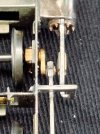
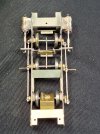
I'm afraid I don't know.... Bernard Snoodyk in Australia built a number of these gearboxes for sale ten years ago, and one of these was included in the kit. As you know, my own preference is for bevel gears, as they are a bit more efficient - though with an N20 on the front, it's rather academic!