Nothing here at allClick on the signal and read what it says....!

You are using an out of date browser. It may not display this or other websites correctly.
You should upgrade or use an alternative browser.
You should upgrade or use an alternative browser.
Giles' misc. Work bench.
- Thread starter Giles
- Start date
But there seems no way to add anything to the shopping cart.Servo-O-Link’s website is still live, complete with shopping cart (and God Bless America graphic).

daifly
Western Thunderer

Maybe best to tell them their web site doesn't work for everyone.
You might also note they don't say they have any stock. People who have called them say they don't have any and don't know when or if they'll ever have any more stock.
Last edited:
I put in a query when I saw this and to my great surprise got a call from the local agent on Friday, to talk about quoting. So I'll share what I hear when I get a quote. They explained the price is by the link rather than selling lengths, you specify the number of links and they supply it joined to the correct length as trying to have a breakable link is too difficult. They also quote for sprockets/gears but I wasn't too interested as most would be very custom and easy to make by laser cutting. So I'll spill the beans when I hear. The pitch is pretty good for model bikes and motorbikes in the 1/6 to 1/10 scale range. Would look great on a museum model!I always try to keep an eye out for useful things, and in my previous life I used to use roller chain in some of my stage Engineering exploits. One of our (model railway/model engineering) wish-list things has always been extremely small roller chain, and we're getting there......
Made by a Japanese company called Tsubaki, I rather dread how much it costs....

David Halfpenny
Western Thunderer
I placed an order this morning and, yes, it can be a struggle to find the Links embedded in the pages.But there seems no way to add anything to the shopping cart.
The trick is to click the Online Order System button in the left margin, then the Shop More button at the foot of the page that comes up.
That takes you to the Order Form for the Delrin gears and sprockets and chain:
Looks like cheery Gregg is still at the helm, but I'm stocking up on chain against the day he retires.
- If you think you might do likewise, 14 feet is one of the sweet spots: enough to get a modest discount but not enough to attract higher-rate shipping - and probably enough to last a whole bunch of us a lifetime


Giles
Western Thunderer
Thanks for the reminder - I had completely forgotten about the stuff! It's years since I used it. I'll buy a can and give it a try!Hi Giles, they look great. Regarding dross, if you are not already, try using welder's non-flammable anti spatter spray on the sheet before lasering. My laser suppliers use it if I remind them, and it makes the dross much easier to remove.
Cheers
Piet
David Halfpenny
Western Thunderer
What follows won't affect Giles but may help folk with weedier lasers or none
Discarded packaging is a good 'free' source of tinplate, though it's fair to say that biscuit tins and oil cans are generally more useful than bean tins or cat-food cans
Containers are generally lacquered internally and often painted externally. It's not ideal, yet when I had access to a school laser (before Covid), I took full advantage of those coatings as Resist layers.
ex Metal Box Company
Discarded packaging is a good 'free' source of tinplate, though it's fair to say that biscuit tins and oil cans are generally more useful than bean tins or cat-food cans
Containers are generally lacquered internally and often painted externally. It's not ideal, yet when I had access to a school laser (before Covid), I took full advantage of those coatings as Resist layers.
[In a nutshell, I lasered part outlines into the painted side, then etched through the metal until I could see light through the lines. At that point the varnish conveniently held the whole sheet together, avoiding small parts escaping. Parts needing paint could simply be pinged from the sheet, degreased, and glued to the model. But wherever I needed bare metal, I struggled to remove food-grade paint, which the usual chemical strippers won't touch.
This method doesn't even depend on access to a laser: simply scribing around a template with a sharp steel point has the same effect.]
Maybe worth mentioning that some metallic food packaging is aluminium alloy. The base of a traditional 'roll-top' sardine tine is slightly dished, which means that, for suitably small components, the upturned tin forms its own tiny etchant bath, This saves on the quantity of nasty liquid for disposal, and makes it easier to put in landfill rather than waste-water.
David 1/2d ex Metal Box Company
Hi Giles, it's great to see tinplate cutting well on your machine. I'm definitely going to have to buy one at some stage. Once I've amortised the 3d printer.
Tinplate is a fantastic material- I still use it for loco building. It is slowly getting harder to get from retail/commercial vendors in decent quantity/size sheets. If you can get larger sheets like around 3' x 3' (try your local cannery) it becomes insanely cheap, but you will need a guillotine or a friend with one.
You should not have any problems with tin coming off. In fact, quite the opposite.
Re cutting, not that it relates to your machine, but with a non-oxidising assist gas like nitrogen, not only can you get no dross, but the tin flashes over the cut edges and stops them from rusting. And even without that, soldering is a dream.
Cheers
Piet
Tinplate is a fantastic material- I still use it for loco building. It is slowly getting harder to get from retail/commercial vendors in decent quantity/size sheets. If you can get larger sheets like around 3' x 3' (try your local cannery) it becomes insanely cheap, but you will need a guillotine or a friend with one.
You should not have any problems with tin coming off. In fact, quite the opposite.
Re cutting, not that it relates to your machine, but with a non-oxidising assist gas like nitrogen, not only can you get no dross, but the tin flashes over the cut edges and stops them from rusting. And even without that, soldering is a dream.
Cheers
Piet
Giles
Western Thunderer
Following on, I've been limited with some of the things I can do since Trotec changed their formula and I've not been able to cut it with my little diode laser. Having bought some sheets on tin plate (0.008" and 0.013") and having a play, it cuts nicely and quickly. I thought I would have a go at the metal treads that I used for fire escapes (on Denton Brook - and I did some for other people). These were complicated to cut anyway in order to get the little squares out, so they are a good test. I had a go at the 4mm ones, and eventually produced this little set. I struggled with assembling them - only afterwards realising I can make it very much simpler for myself!
These are silver-soldered (tin plate....) with no issue and very robust of course. They are black with heat, and I just wire-brushed the treads.
These are silver-soldered (tin plate....) with no issue and very robust of course. They are black with heat, and I just wire-brushed the treads.

Brian McKenzie
Western Thunderer
Giles - that's a stunning use of materials and technologies 
-Brian McK.
-Brian McK.
David Halfpenny
Western Thunderer
BRAVO!the metal treads that I used for fire escapes

John57sharp
Western Thunderer
Hello Giles - is the 4mm tool still available at all?The Sett Embossing Tools are now on my website.
TIA
John
Giles
Western Thunderer
Hi John, I'll have a look, although it's a long while since I made any (and I'm not up to commission work any more).
I recently got a small sheet of 0.9mm mild steel to see how that goes with the fibre laser, and put a test piece in this afternoon. The point is to learn about it, and also to add viable (and cheaper) materials to the armoury.
0.9mm cuts very nicely and cleanly, apart from the surface dross on the edge of the actual cut. I have tried anti-spatter, but to no effect. Once the surface is cleaned off (with a teeny linisher), the cut is nice and clean. I find I get a little less distortion than with nickel silver, and possibly a cleaner cut, maybe with fewer passes. I put all this down to being a poorer conductor of heat.
I think I would have little problem cutting 1.2mm steel, which on a little bench top machine is extraordinary!
At any rate, I can make parts for myself to a much higher level of detail than would be otherwise possible in a variety of metals and thicknesses. I tend to cut one component and a time, which is fine for scratchbuilding, but no good at all for commercial practise. One could absolutely cluster a small bunch together, but it wouldn't decrease the actual cutting time, only the handling time.
0.9mm thick gear
I recently got a small sheet of 0.9mm mild steel to see how that goes with the fibre laser, and put a test piece in this afternoon. The point is to learn about it, and also to add viable (and cheaper) materials to the armoury.
0.9mm cuts very nicely and cleanly, apart from the surface dross on the edge of the actual cut. I have tried anti-spatter, but to no effect. Once the surface is cleaned off (with a teeny linisher), the cut is nice and clean. I find I get a little less distortion than with nickel silver, and possibly a cleaner cut, maybe with fewer passes. I put all this down to being a poorer conductor of heat.
I think I would have little problem cutting 1.2mm steel, which on a little bench top machine is extraordinary!
At any rate, I can make parts for myself to a much higher level of detail than would be otherwise possible in a variety of metals and thicknesses. I tend to cut one component and a time, which is fine for scratchbuilding, but no good at all for commercial practise. One could absolutely cluster a small bunch together, but it wouldn't decrease the actual cutting time, only the handling time.
0.9mm thick gear
David Halfpenny
Western Thunderer
I placed an order this morning and, yes, it can be a struggle to find the Links embedded in the pages.
The trick is to click the Online Order System button in the left margin, then the Shop More button at the foot of the page that comes up.
That takes you to the Order Form for the Delrin gears and sprockets and chain:
Looks like cheery Gregg is still at the helm, but I'm stocking up on chain against the day he retires.
David 1/2d
- If you think you might do likewise, 14 feet is one of the sweet spots: enough to get a modest discount but not enough to attract higher-rate shipping - and probably enough to last a whole bunch of us a lifetime
Yay, my order's arrived today! 14 feet of Delrin chain on a neat industrial spool in one of those nylon-laced paper envelopes you can cut with scissors but can't tear with your hands.
So I rang Gregg Carson to thank him.
He's bright and cheerful as ever, planning to work for another ten years or so - though he did mention that the unique chain-making machine needs constant maintenance.
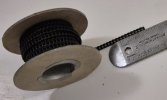
For those who quite reasonably dread how much things might cost, 14 feet of 1/8" pitch Delrin chain is $99.68 plus $18 postage plus £15 UK VAT plus £8 Post Office handling fee, which totals £8 a foot.
And worth every penny, given you can't get it anywhere else - except seemingly-struggling stockists.
(I used to be a small-time non-profit Serv-O-Link stockist, maybe 20 years ago, until model shops took it up.
Could be a business opportunity here for somebody new.)
Giles
Western Thunderer
Hi John - sorry for the delay - yes, I have one.......Hello Giles - is the 4mm tool still available at all?
TIA
John