
You are using an out of date browser. It may not display this or other websites correctly.
You should upgrade or use an alternative browser.
You should upgrade or use an alternative browser.
Breaking Ground - Finescale - of a sort
- Thread starter Richard Insole
- Start date
-
- Tags
- peter insole

Tom Insole
Western Thunderer
Agreed! I didn’t make the box and would have factored this. Slowly we’ll get it up to standard order and I’ll rectify a few missed bits.The coach bolt ends could do with capping!
Dave
Call it a “rolling resto/Restomod”
Tom

Peter Insole
Western Thunderer
Oh, where has the last month gone?! The weather has been mostly good, but I'm afraid I have been much less so!
The days are notably shortening, and there is a shed/booking office that must be reassembled and made waterproof before the winter winds and rain ruin it! Before that can happen, the stack of concrete slabs will have to be shifted.
When Mr. O came home from work this afternoon he wandered nonchalantly down the garden to see what I was up to - and the poor boy suddenly found himself volunteered for hard labour!!

The last two slabs have now been heaved around, with the furthest one (in the above view) aligned and ready to be slid forward, raised at the outer end and then dropped into a hole. This will be the final one at the left, abutting the booking office, and will at last leave the space clear for me to make a start on building a low foundation wall with some of our collection of reclaimed bricks.
It wasn't all gruelling work though, so while I took a necessary breather, Mr. O decided that it was probably an opportune moment - before the wall got any longer - to plant a rambling rose in the freshly piled and tamped earth behind.
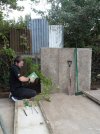
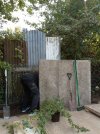
There is nothing I can do about the horrid wriggly tin erection in my neighbour's dumping ground plot next door, except an attempt to hide it from view! To that end, we will be using the unused bolt holes in the upper edges of each slab to fix a diamond pattern trellis along the top - in a nice traditional style - with the rose bush hopefully thriving, growing upwards and eventually spreading its dense and semi evergreen foliage to eventually obscure the monstrosity?! It should also spill over the wall as well and end up surrounding the "running in board" with a cascade of delightful, creamy white flowers in the season.

Peek-a-boo! Tied to a temporary twig, one stem of the rose had already grown long enough in its pot to just reach - while the others are still hiding out of sight not far below!

I was surprised how far we got with the job before throwing in the towel this evening! The trench was almost done at this end and will only require another inch or so scraping out to level off the bottom - before another "big lift" and a nudge (or two) to finish it off!!
Mind you, the previous slab cost me almost half a box of not so sticky sticking plasters for wounds received and at least three yards of bandage for another slightly more severe injury, so "only" seems a bit inappropriate...?!!
Pete.
The days are notably shortening, and there is a shed/booking office that must be reassembled and made waterproof before the winter winds and rain ruin it! Before that can happen, the stack of concrete slabs will have to be shifted.
When Mr. O came home from work this afternoon he wandered nonchalantly down the garden to see what I was up to - and the poor boy suddenly found himself volunteered for hard labour!!
The last two slabs have now been heaved around, with the furthest one (in the above view) aligned and ready to be slid forward, raised at the outer end and then dropped into a hole. This will be the final one at the left, abutting the booking office, and will at last leave the space clear for me to make a start on building a low foundation wall with some of our collection of reclaimed bricks.
It wasn't all gruelling work though, so while I took a necessary breather, Mr. O decided that it was probably an opportune moment - before the wall got any longer - to plant a rambling rose in the freshly piled and tamped earth behind.
There is nothing I can do about the horrid wriggly tin erection in my neighbour's dumping ground plot next door, except an attempt to hide it from view! To that end, we will be using the unused bolt holes in the upper edges of each slab to fix a diamond pattern trellis along the top - in a nice traditional style - with the rose bush hopefully thriving, growing upwards and eventually spreading its dense and semi evergreen foliage to eventually obscure the monstrosity?! It should also spill over the wall as well and end up surrounding the "running in board" with a cascade of delightful, creamy white flowers in the season.
Peek-a-boo! Tied to a temporary twig, one stem of the rose had already grown long enough in its pot to just reach - while the others are still hiding out of sight not far below!
I was surprised how far we got with the job before throwing in the towel this evening! The trench was almost done at this end and will only require another inch or so scraping out to level off the bottom - before another "big lift" and a nudge (or two) to finish it off!!
Mind you, the previous slab cost me almost half a box of not so sticky sticking plasters for wounds received and at least three yards of bandage for another slightly more severe injury, so "only" seems a bit inappropriate...?!!
Pete.
Last edited:
Tom Insole
Western Thunderer
Some positive movement since my last drop in. Scarlett still keeps asking if we're off to yours every time we go out or ask her where we're going...
Great to see those slabs "Rose" fairly quickly.. concidering the granditure of them. I today almost had a minature re-enactment of the same kind of senario well.. mine was a lot smaller, but the station office was the same colour..
Here we have the works train...
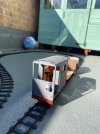
Then the main stock running was for the entertainment of the young ones. the track being from a cheap and cheerful christmas set that seem to be prefectly 32mm guage!
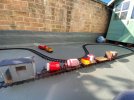
The tippers were running at first but we quickly turned the frames into makeshift tankers for Scarlett. She was very impressed so I think I'm going to have to produce a 3 piece modular layout that I can put out on the balcony (or bring to running days!).
Great to see those slabs "Rose" fairly quickly.. concidering the granditure of them. I today almost had a minature re-enactment of the same kind of senario well.. mine was a lot smaller, but the station office was the same colour..
Here we have the works train...
Then the main stock running was for the entertainment of the young ones. the track being from a cheap and cheerful christmas set that seem to be prefectly 32mm guage!
The tippers were running at first but we quickly turned the frames into makeshift tankers for Scarlett. She was very impressed so I think I'm going to have to produce a 3 piece modular layout that I can put out on the balcony (or bring to running days!).

Tom Insole
Western Thunderer
My little loco working here is my own scratch build Gmeinder 15/18hp (German Brickworks) Lokomotive. I initially made a version that someone had made on Thingiverse (3d Printed loco) then when I saw just how many things were wrong with the model vs the real think I had to make a better one.What is the loco, please?
Regards
Allen
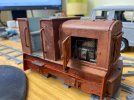
I did have a thread on the builds somewhere on Thunder.
The loco running on the big track dad's made also has a thread. a whole level above my build quality!
Peter Insole
Western Thunderer
Things are getting rather exciting at Lamorna station this weekend!
My volunteer forces have been away enjoying themselves for a couple of days, so I had to work out all sorts of odd wheezes and wangles in order to start a single-handed assembly of the booking office.
The task was made all the more interesting thanks to the decidedly gusty weather! While the following images might look calm and serene, there were some amusing (?) moments during the day when I almost became airborne...

The new concrete wall has proved to be a boon, providing a nice, solid and square support for the fairly lightweight (and sail-like) panels while drilling and screwing them together.
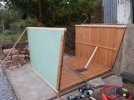
OK., I know this is a slightly peculiar and precarious way of building up a shed... but as usual, there is carefully considered madness in my method.
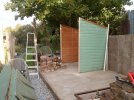

I intend to make up a sturdy new planked floor, raised up on a brick plinth to keep it well clear of any water that tends to accumulate during heavy storms on the slightly less than perfectly level platform surface. Rather than trusting my measuring skills (or otherwise) when engaged in civil engineering projects, I would prefer to build the floor into the existing structure - rather than assemble it first and then hope that the walls fit?!
Being the largest part, the front of the building had to be cut into two sections for transportation, so the top rail and door tread will have to be fixed. As I don't fancy extracting all the old nails and screws, some simple repair plates will hopefully suffice. If I get the design right the new floor construction and additional rafters and purlins to carry an awning extension to the roof should provide the strength needed anyway?
That will be tomorrow's job, provided I can still move after today's exertions..?!
Pete.
My volunteer forces have been away enjoying themselves for a couple of days, so I had to work out all sorts of odd wheezes and wangles in order to start a single-handed assembly of the booking office.
The task was made all the more interesting thanks to the decidedly gusty weather! While the following images might look calm and serene, there were some amusing (?) moments during the day when I almost became airborne...
The new concrete wall has proved to be a boon, providing a nice, solid and square support for the fairly lightweight (and sail-like) panels while drilling and screwing them together.
OK., I know this is a slightly peculiar and precarious way of building up a shed... but as usual, there is carefully considered madness in my method.
I intend to make up a sturdy new planked floor, raised up on a brick plinth to keep it well clear of any water that tends to accumulate during heavy storms on the slightly less than perfectly level platform surface. Rather than trusting my measuring skills (or otherwise) when engaged in civil engineering projects, I would prefer to build the floor into the existing structure - rather than assemble it first and then hope that the walls fit?!
Being the largest part, the front of the building had to be cut into two sections for transportation, so the top rail and door tread will have to be fixed. As I don't fancy extracting all the old nails and screws, some simple repair plates will hopefully suffice. If I get the design right the new floor construction and additional rafters and purlins to carry an awning extension to the roof should provide the strength needed anyway?
That will be tomorrow's job, provided I can still move after today's exertions..?!
Pete.
Peter Insole
Western Thunderer
Mm, well, I did overdo it a little bit, so progress somewhat slowed yesterday. I did watch some bits of the State Funeral - not so much because I particularly wanted to, (although I did feel that I ought to) but more because I didn't have the energy to get out of my chair for very long!
Today has been a little better though.
Having got the right hand, door side half of the front attached to the building, attention turned to the left portion, with the window!
I thought it would be a good idea to attend to some intended modifications while the part remained lying down on a flat surface.

The original square window of clear, but now almost obscure and yellowed acrylic was unusually framed up around the glazing sheet with fairly sturdy, slotted timber, the joints at all four corners were fully tennoned and then the whole assembly was nailed with those horrible, ringed, locking type (I cannot remember what they are called) jobs into the aperture. To make matters worse, the right-hand side was fitted over the door frame, thus directly abutting the closed door and making the width of the shiplap section on the left to the corner notably greater than on the door side! As the glazing could not possibly be replaced without first prying out the entire frame, (in the end I had to completely destroy it with the aid of a hammer and a sharp chisel!) I wanted to replace it with something a great deal less "shed- like" and much more "booking office" in appearance anyway!
I do not have ready access to a portable power saw, so had to resort to the terrible trick of drilling a line of holes and snapping out a section of one plank (seen in the above view) in order to be able to use a conventional hand saw for the rest of the cut.
Great care had to be taken all the way through, as those ageing tongues and grooves are desperately slender and dreadfully fragile!
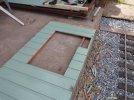
After lowering the aperture by one plank to improve the overall proportions, I had a spare length to cut into some short sections for a fillet between the window and door frame...

Unfortunately, there is not enough to go the full depth, so I'm short of two bits!
If anyone is puzzled, I have used a couple of slender offcuts from the revised corner post arrangements, as well as the old chopped out window edge support, to act as a plank alignment check.
I am really hoping that I can acquire some fresh, new shiplap planks of a similar enough depth or thickness, and from somewhere - very soon - for necessary repairs to the top and bottom rails of the main structure. If I am lucky, (and I'm not holding my breath) that will mean I can cobble a wee bit more of the original material from elsewhere in order to finish off the line!
Only Goodness yet knows what I'll do if I can't...?!
Pete.
Today has been a little better though.
Having got the right hand, door side half of the front attached to the building, attention turned to the left portion, with the window!
I thought it would be a good idea to attend to some intended modifications while the part remained lying down on a flat surface.
The original square window of clear, but now almost obscure and yellowed acrylic was unusually framed up around the glazing sheet with fairly sturdy, slotted timber, the joints at all four corners were fully tennoned and then the whole assembly was nailed with those horrible, ringed, locking type (I cannot remember what they are called) jobs into the aperture. To make matters worse, the right-hand side was fitted over the door frame, thus directly abutting the closed door and making the width of the shiplap section on the left to the corner notably greater than on the door side! As the glazing could not possibly be replaced without first prying out the entire frame, (in the end I had to completely destroy it with the aid of a hammer and a sharp chisel!) I wanted to replace it with something a great deal less "shed- like" and much more "booking office" in appearance anyway!
I do not have ready access to a portable power saw, so had to resort to the terrible trick of drilling a line of holes and snapping out a section of one plank (seen in the above view) in order to be able to use a conventional hand saw for the rest of the cut.
Great care had to be taken all the way through, as those ageing tongues and grooves are desperately slender and dreadfully fragile!
After lowering the aperture by one plank to improve the overall proportions, I had a spare length to cut into some short sections for a fillet between the window and door frame...
Unfortunately, there is not enough to go the full depth, so I'm short of two bits!
If anyone is puzzled, I have used a couple of slender offcuts from the revised corner post arrangements, as well as the old chopped out window edge support, to act as a plank alignment check.
I am really hoping that I can acquire some fresh, new shiplap planks of a similar enough depth or thickness, and from somewhere - very soon - for necessary repairs to the top and bottom rails of the main structure. If I am lucky, (and I'm not holding my breath) that will mean I can cobble a wee bit more of the original material from elsewhere in order to finish off the line!
Only Goodness yet knows what I'll do if I can't...?!
Pete.


Dog Star
Western Thunderer
"annular ring shank"... generally found with nail guns....the whole assembly was nailed with those horrible, ringed, locking type (I cannot remember what they are called) jobs into the aperture.
Peter Insole
Western Thunderer
Thanks Tony for your replies. They both sound like much better options than my only idea so far - for a totally inappropriate cat flap!
Mind you, although the shed might end up making a great little den for the kidlets, the bottom planks are knackered anyway, so I would have to take the next ones up. I only just fit under the door lintel already - and I'm only five feet four (I don't want to admit how much of a stoop I have developed that might significantly reduce that declaration!).
Pete.
Mind you, although the shed might end up making a great little den for the kidlets, the bottom planks are knackered anyway, so I would have to take the next ones up. I only just fit under the door lintel already - and I'm only five feet four (I don't want to admit how much of a stoop I have developed that might significantly reduce that declaration!).
Pete.
Peter Insole
Western Thunderer
Yep, those are the things! Thank you, Dog Star!
I'm with you too Simon, although they are only one step worse than those long, skinny, cross head, countersunk screws - the ones with their blasted cutting threads all the way to the top! In fact, just the type that, along with the ARS nails are the only fixings (all driven in far too deep and starting to go rusty!) that were holding the shed together in the first place!
Pete.
I'm with you too Simon, although they are only one step worse than those long, skinny, cross head, countersunk screws - the ones with their blasted cutting threads all the way to the top! In fact, just the type that, along with the ARS nails are the only fixings (all driven in far too deep and starting to go rusty!) that were holding the shed together in the first place!
Pete.
Peter Insole
Western Thunderer
I had a run-a-round day today... but in the end; way-hey...

It took quite a while to find any suppliers that carried this particularly thin material - and even longer to find one that actually had any in stock!
Admittedly, it wouldn't have been so difficult to acquire the stuff pre-packaged in bulk bundles, but as it is a bit too lightweight for my own preference I wouldn't want to try and find any other use for the considerable excess.
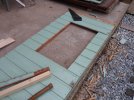
By the time I got back home with my prize there was barely enough daylight left to cut out the previously identified section of original, and with just a little feeling of triumph, finally finish off the window surround!
Pete.
It took quite a while to find any suppliers that carried this particularly thin material - and even longer to find one that actually had any in stock!
Admittedly, it wouldn't have been so difficult to acquire the stuff pre-packaged in bulk bundles, but as it is a bit too lightweight for my own preference I wouldn't want to try and find any other use for the considerable excess.
By the time I got back home with my prize there was barely enough daylight left to cut out the previously identified section of original, and with just a little feeling of triumph, finally finish off the window surround!
Pete.
Peter Insole
Western Thunderer
All these images of a shed being put up might, apart from how long it is taking me, look as if Grandad knows exactly what he is doing. Dear friends, that impression is somewhat illusory! Just when I think I have found a solution to one problem and acted upon it, I then realize that I have unwittingly set myself up for another...
The top one and a half planks here (with the site dismantling cut line of the original doorway at top right) had to be removed before the new replacement, complete full-length planks are fitted. Not by any means a straightforward task as it happens:

It is impossible to pull those partly buried ring nails out, and any attempt to knock or lever up a panel in the vain hope of raising the heads just enough to get the claw underneath risks splitting the fragile tongues and grooves. A domino effect would be inevitable.
After much cogitation, I came to the conclusion that my only option was to use a nail punch and whack each nail head the rest of the way down into the studding, which then allowed me to carefully tap the first plank sideways. It took quite a while to ease out, as trying to move it by hand produced some ominous creaks! Once that plank was away, I was then free to use as much violence necessary to get rid of the top one!
It then dawned on me that a similar approach was completely impossible on the other (door) section - as I had already fitted it to the building!
No good Fred, it's gotta come orf... and so we had another cuppa tea..!

Before cracking on with Plan B!
All went swimmingly well, until I discovered that a pile of hardcore on the platform was right in the way of swinging the whole frontage into position and making the fine adjustments required to the frames before drilling and screwing it all together.
The muck just needed shifting... and another cuppa tea...


There, all nice and square... so I thought; quit while ahead... Then the weatherman said:
"Wet while we're in bed"...

The hut got a hat!
I hope we don't end up with an elevated paddling pool in the morning?!
Pete.
The top one and a half planks here (with the site dismantling cut line of the original doorway at top right) had to be removed before the new replacement, complete full-length planks are fitted. Not by any means a straightforward task as it happens:
It is impossible to pull those partly buried ring nails out, and any attempt to knock or lever up a panel in the vain hope of raising the heads just enough to get the claw underneath risks splitting the fragile tongues and grooves. A domino effect would be inevitable.
After much cogitation, I came to the conclusion that my only option was to use a nail punch and whack each nail head the rest of the way down into the studding, which then allowed me to carefully tap the first plank sideways. It took quite a while to ease out, as trying to move it by hand produced some ominous creaks! Once that plank was away, I was then free to use as much violence necessary to get rid of the top one!
It then dawned on me that a similar approach was completely impossible on the other (door) section - as I had already fitted it to the building!
No good Fred, it's gotta come orf... and so we had another cuppa tea..!
Before cracking on with Plan B!
All went swimmingly well, until I discovered that a pile of hardcore on the platform was right in the way of swinging the whole frontage into position and making the fine adjustments required to the frames before drilling and screwing it all together.
The muck just needed shifting... and another cuppa tea...
There, all nice and square... so I thought; quit while ahead... Then the weatherman said:
"Wet while we're in bed"...
The hut got a hat!
I hope we don't end up with an elevated paddling pool in the morning?!
Pete.


Osgood
Western Thunderer
Indeed, you could say it’s a “ringer” for a light railway waiting room…….That looks just great, you have really "nailed" the proportions that such a structure should have....
Peter Insole
Western Thunderer
Thank you Simon, SimonD and Tony!
You are quite right Simon (d), and the potential rot issue still has me slightly vexed. The photographs are rather deceptive though, and it might not be apparent that the building only overlaps the end of the wall by a mere inch and a half and is not actually in front of it. There is also enough room to walk (albeit in crab fashion) between both structures and the wire netting fence! It will be a bit of fun when the brambles, nature's own barbed wire, grows back into the gap!
I have considered all manner of methods and materials to cover or otherwise protect the (invisible) rear of the shed, but am only too aware that any sort of impervious cladding placed in direct contact with timber is a recipe for disaster!
Occasional clearing, plus the intended provision of a degree of additional overhang and guttering for the new roof should hopefully afford a little more protection than the more conventional garden shed designs allow?
Pete.
You are quite right Simon (d), and the potential rot issue still has me slightly vexed. The photographs are rather deceptive though, and it might not be apparent that the building only overlaps the end of the wall by a mere inch and a half and is not actually in front of it. There is also enough room to walk (albeit in crab fashion) between both structures and the wire netting fence! It will be a bit of fun when the brambles, nature's own barbed wire, grows back into the gap!
I have considered all manner of methods and materials to cover or otherwise protect the (invisible) rear of the shed, but am only too aware that any sort of impervious cladding placed in direct contact with timber is a recipe for disaster!
Occasional clearing, plus the intended provision of a degree of additional overhang and guttering for the new roof should hopefully afford a little more protection than the more conventional garden shed designs allow?
Pete.