You are using an out of date browser. It may not display this or other websites correctly.
You should upgrade or use an alternative browser.
You should upgrade or use an alternative browser.
Chas's workbench
- Thread starter Chas Levin
- Start date

Chas Levin
Western Thunderer
It's going to be a real shame to paint that! Looks marvellous as it is.
Thanks, and totally agree about the look of it unpainted! Someone said the same thing on another forum too, where I put some pics. It's the black and brass thing, isn't it? I have to paint it though, otherwise it would always look unfinished to me.
I'll take great care not to use too thick a coat anywhere and obscure detail - those walkways on top of the tank, for instance: they'll be a challenge!
Last edited:
Chas Levin
Western Thunderer
Happy New Year everyone - I hope everyone had a good break and plenty of whatever they wanted - turkey, telly, modelling...
My Airfix-Masokits Esso build is almost ready for final assembly now:

I say 'almost' because I'm not happy with the slightly off-centre positioning of the oval' Esso' transfers and I'm going to strip and re-do them, though they can be fixed on last of all, so I'll start of assembling the rest of the wagon.
I found all the transfers for this vehicle a little more problematic than usual: the tiny lettering for the solebars I had to make up from bits and pieces on a 3mm Methfix sheet and cutting and fixing individual letters in that scale and into a solebar recess was a little tricky, though I managed most of it in one go, with only a couple of sections needing re-doing.
The large 'Esso Petroleum' with symbols and running number was less troublesome than expected - as you can see though, I took the easier option of using the complete piece with '3300', rather than cutting off that number and using one of the other numbers provided, which would have made it a little more varied than other models but also involved more alignment issues!
The oval 'Esso' was the most troublesome of all, in term of getting it central on the oval 'shield' shape: I managed to tear one of the pieces, trying to move it round and although I hid the tear fairly well, neither transfer is really central. The transfers are slightly larger than the brass piece, so they need to be really properly central and then trimmed... but without being able to move them around from the front, it's difficult assessing placement from the rear.
I probably should have given the black painted ovals a few coats of Klear first, which might make the transfers easier to manoeuvre, but does anyone have any tips for positioning oval transfers like this?
My Airfix-Masokits Esso build is almost ready for final assembly now:
I say 'almost' because I'm not happy with the slightly off-centre positioning of the oval' Esso' transfers and I'm going to strip and re-do them, though they can be fixed on last of all, so I'll start of assembling the rest of the wagon.
I found all the transfers for this vehicle a little more problematic than usual: the tiny lettering for the solebars I had to make up from bits and pieces on a 3mm Methfix sheet and cutting and fixing individual letters in that scale and into a solebar recess was a little tricky, though I managed most of it in one go, with only a couple of sections needing re-doing.
The large 'Esso Petroleum' with symbols and running number was less troublesome than expected - as you can see though, I took the easier option of using the complete piece with '3300', rather than cutting off that number and using one of the other numbers provided, which would have made it a little more varied than other models but also involved more alignment issues!
The oval 'Esso' was the most troublesome of all, in term of getting it central on the oval 'shield' shape: I managed to tear one of the pieces, trying to move it round and although I hid the tear fairly well, neither transfer is really central. The transfers are slightly larger than the brass piece, so they need to be really properly central and then trimmed... but without being able to move them around from the front, it's difficult assessing placement from the rear.
I probably should have given the black painted ovals a few coats of Klear first, which might make the transfers easier to manoeuvre, but does anyone have any tips for positioning oval transfers like this?
Chas Levin
Western Thunderer
At long last the Airfix-Masokits Esso tanker is finished:

Delayed by various things as usual, lastly through difficulties with those large oval Esso logos! got tyhere in the end though.
Here's a sequence showing tank fittings appearing on the body:


And here are a few more of the finished wagon:


Lastly, a quick question about spring maintenance: do people usually oil the springs and bearing carriers in sprung wagons? This is my first sprung build and I've always (sparingly) oiled all moving parts, so it seems natural to me, but I wondered whether particular rules apply in 4mm springing techniques...

Delayed by various things as usual, lastly through difficulties with those large oval Esso logos! got tyhere in the end though.
Here's a sequence showing tank fittings appearing on the body:
And here are a few more of the finished wagon:
Lastly, a quick question about spring maintenance: do people usually oil the springs and bearing carriers in sprung wagons? This is my first sprung build and I've always (sparingly) oiled all moving parts, so it seems natural to me, but I wondered whether particular rules apply in 4mm springing techniques...

Chas Levin
Western Thunderer
Thanks Matt!Wow, what a beauty! Looks stunning!
Chas Levin
Western Thunderer
I've never oiled sprung W irons (where I've retained them), but a bit of graphite in one form or another is useful - a soft pencil is ideal.
Adam
Thanks Adam; I haven't applied any yet, thought I'd wait and see what other do. I hadn't thought of graphite, interesting idea. What about the type of very light teflon grease sold for model gears, or would that gum it up? Part of the reason I'm considering it is fear of the steel spring pieces rusting over time...
Chas Levin
Western Thunderer
In between build projects, I revisited my modified Triang EM2, firstly to add some small lead pieces to both bogies to help track adhesion:

As you can see in that picture, I had substituted a second metal Triang power bogie (from Ebay) for the plastic one that comes with the original Triang R351 kit, removing the motor armature and connecting both bogies' pickups. The wiring between the two bogies was way to heavy gauge however, and it was slightly inhibiting the bogies from swinging into curves easily, so I changed it for thinner wire (still rated at 1.5A at 12V):

Both bogies also have the Ultrascale EM2 replacement wheelsets:


The bodyshell has SEF flush glazing and a few bits and pieces, such as brake hoses, plus some careful touching in of paintwork:

The bogies connect together using a miniature plug, in the space in the middle of the body, which also necessitated a second upper spring and suitable spring pieces araldited inside the body's upper 'ceiling', mimicing arrangements for the powered bogie. The second upper spring is taped with electrical tape before the roof goes back on, to hold it in place:

Overall, I think it doesn't look too bad, especially for a commercial kit that's probably about 60 years old:

It runs very well, from a slow and even crawl to far above scale speed, and while it has the usual Triang growl it's by no means the noisiest I've heard. I also had the armature rewound by a small trader company that do it as a restoration service and if anyone has one they want rewound, I can look up the invoice and post details on here.
For my next actual build, after the Esso tanker having taking so long, I'm going for something considerably simpler, that'll be finished considerably faster:
As you can see in that picture, I had substituted a second metal Triang power bogie (from Ebay) for the plastic one that comes with the original Triang R351 kit, removing the motor armature and connecting both bogies' pickups. The wiring between the two bogies was way to heavy gauge however, and it was slightly inhibiting the bogies from swinging into curves easily, so I changed it for thinner wire (still rated at 1.5A at 12V):
Both bogies also have the Ultrascale EM2 replacement wheelsets:
The bodyshell has SEF flush glazing and a few bits and pieces, such as brake hoses, plus some careful touching in of paintwork:
The bogies connect together using a miniature plug, in the space in the middle of the body, which also necessitated a second upper spring and suitable spring pieces araldited inside the body's upper 'ceiling', mimicing arrangements for the powered bogie. The second upper spring is taped with electrical tape before the roof goes back on, to hold it in place:
Overall, I think it doesn't look too bad, especially for a commercial kit that's probably about 60 years old:
It runs very well, from a slow and even crawl to far above scale speed, and while it has the usual Triang growl it's by no means the noisiest I've heard. I also had the armature rewound by a small trader company that do it as a restoration service and if anyone has one they want rewound, I can look up the invoice and post details on here.
For my next actual build, after the Esso tanker having taking so long, I'm going for something considerably simpler, that'll be finished considerably faster:
Chas Levin
Western Thunderer
Before starting on the Wills platelayers' hut kit, I did a spot of RTR 'detailing', adding lighting to a Roco BLS coach. I do love coach (and other) lighting and I'm always interested in trying different systems, so I was pleased to find an original Roco lighting kit. It uses their (to me) unusual system of metal contact rods, sitting on top of contact springs that connect with the wheels/axles and standing vertically inside the carriage compartment, making contact above with strips running the length of the coach:

The photo above shows the parts, and it also shows some 2mm waisted bearings: this is because I found that the rods weren't making very good contact with the upper strips, so I filed the pips off the rear of a couple of bearings and glued them upside-down into the holes in the plastic lighting rig through which the rods protrude, so that the rod tops sit inside the bearings - here's a pic to illustrate:

I'm not entirely sure I'm fitting the contact strips correctly (I couldn't find anything online to show this - but it works the way I've done it, so I'm happy! Here's how it looks from above with the plastic section sitting in place and the filed-down bearing ready to make solid contact with the brass contact strip:

And here's a shot through the upside-down carriage window, showing how the tops of contact rods sit inside the upturned bearings:

This provided a much more reliable contact - here's a quick test, with the plastic lighting strip perched in place:

I also borrowed a trick from my audio day-job, known as 'ruggedising' (or perhaps 'ruggedizing' if you speak American?) whereby parts that might move in transit are held in place using clear silicone. It peels off quite easily for repair/maintenance but it stops things moving about, in this case the upper contact strips and the bulbs:


It looks messy but it's invisible once the roof's on and it does the job:


The photo above shows the parts, and it also shows some 2mm waisted bearings: this is because I found that the rods weren't making very good contact with the upper strips, so I filed the pips off the rear of a couple of bearings and glued them upside-down into the holes in the plastic lighting rig through which the rods protrude, so that the rod tops sit inside the bearings - here's a pic to illustrate:
I'm not entirely sure I'm fitting the contact strips correctly (I couldn't find anything online to show this - but it works the way I've done it, so I'm happy! Here's how it looks from above with the plastic section sitting in place and the filed-down bearing ready to make solid contact with the brass contact strip:
And here's a shot through the upside-down carriage window, showing how the tops of contact rods sit inside the upturned bearings:
This provided a much more reliable contact - here's a quick test, with the plastic lighting strip perched in place:
I also borrowed a trick from my audio day-job, known as 'ruggedising' (or perhaps 'ruggedizing' if you speak American?) whereby parts that might move in transit are held in place using clear silicone. It peels off quite easily for repair/maintenance but it stops things moving about, in this case the upper contact strips and the bulbs:
It looks messy but it's invisible once the roof's on and it does the job:
Chas Levin
Western Thunderer
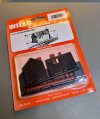
Something quick and simple next, a Wills Platelayers' Hut (and by the way, I now know that you can't upload photos on here if they have an apostrophe in the title!), chosen because the Esso tanker too me so long and my other current build (a Sentinel railcar) is taking a long time too, so finishing something quickly will be very satisfying. It's also a chance to try out these magnetic clips from Smart Models:

One slightly puzzling thing straight away though: if you align the ends with the locating ridges inside the sides, the ends are in too far, leaving the sides sticking out:


To have the sides and ends form a neat, square corner, you have to position the ends a little away out from what are surely intended as locating ridges:


If I've missed or misunderstood something here please let me know, otherwise I intend fixing the corners as in the second pair of pictures, to form 'normal' or flush corners (and I've already checked that the roof pieces still fit correctly). I can't understand why they intend there to be the sides sticking out like that... I'll have a google though, in case that's how these its are usually done.
Edited to add: google has a couple of examples where the sides protrude a tiny amount, presumably to represent a side timber laid that way against the end, but nothing like the amount you get if you put the end up against the inner ridge, so not much clearer really!
One slightly puzzling thing straight away though: if you align the ends with the locating ridges inside the sides, the ends are in too far, leaving the sides sticking out:
To have the sides and ends form a neat, square corner, you have to position the ends a little away out from what are surely intended as locating ridges:
If I've missed or misunderstood something here please let me know, otherwise I intend fixing the corners as in the second pair of pictures, to form 'normal' or flush corners (and I've already checked that the roof pieces still fit correctly). I can't understand why they intend there to be the sides sticking out like that... I'll have a google though, in case that's how these its are usually done.
Edited to add: google has a couple of examples where the sides protrude a tiny amount, presumably to represent a side timber laid that way against the end, but nothing like the amount you get if you put the end up against the inner ridge, so not much clearer really!
Chas Levin
Western Thunderer
A hut has materialised and, under a fresh coat of primer, a little filler's clearly needed, especially on the chimney stack:


Chas Levin
Western Thunderer
The Wills Platelayers' Hut is finished:


Now... what to build next?
Now... what to build next?
Chas Levin
Western Thunderer
Now... what to build next?
...and the answer to that question involves a return to the Continent, as my next WT project will be these vintage 1980s Revell CIWL coaches:

I bought these, years apart, with the intention of building them together. I fully realise they're far from finescale, more of a fun project. I sometimes run a boat train or a short Orient Express formation on Continental running days and I wanted to have some coaches I've built myself, rather than the admittedly gorgeous but undeniably RTR ones from Rivarossi...
Both kits look to be complete, more pics and details to follow...

timbowales
Western Thunderer
It is a constant source of personal amazement at the fascinating stuff that turns up on WT
Chas Levin
Western Thunderer
I'm starting with the bogies, as that's where the instructions to both kits start and in order to assess any ride height issues early on, especially as I'm substituting metal wheels and brass bearings for the plastic ones in the kit.
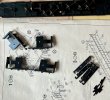
I'm using standard Hornby coach wheel sets, because I have plenty in stock and they run smoothly, but the axles are longer than the plastic ones in the kit, so I dry-assembled a bogie to test the width using waisted bearings and it seemed like a passable fit, so I popped waisted bearing in place on top of a dab of plastic solvent:
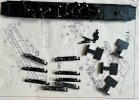
Cue some slightly blue language as my first glued bogie assembly bulged far and wide, with nowhere near a meeting of sides and ends! How I thought the waisted bearings' shouldered rims sitting on top of the bearing holes' edges would give sufficient internal frame width I cannot explain, but very luckily the dabs of plastic solvent beneath the bearings hadn't dried and I was able to lever out each bearing with only minimal ill-effect.
I then very carefully drilled out each bearing hole with a 2mm drill, holding the bogie wide with the light reflecting off the outside face of teach axlebox. I found that if you drill very slowly and carefully and you keep you eyes glued to the well-lit outside axle-box face, you can see the very earliest sign of the drill breaking through - you can see when the plastic surface just starts to deform, when the plastic centre of the axle-box becomes sufficiently thin that the inside pressure of the drill starts to push the centre point outwards in a tiny pimple... and that's when you immediately stop drilling!!
That probably sounds a bit risky, but I managed not to break through a single axle-box and it gave sufficient depth to drop in plain unshouldered Romford 2mm bearings to a surprisingly good depth (which this time I made sure to test fit properly!):

Bogie assembly could then proceed and while the below half-assembled units dry, I'll be painting wheel rims white...
I'm using standard Hornby coach wheel sets, because I have plenty in stock and they run smoothly, but the axles are longer than the plastic ones in the kit, so I dry-assembled a bogie to test the width using waisted bearings and it seemed like a passable fit, so I popped waisted bearing in place on top of a dab of plastic solvent:
Cue some slightly blue language as my first glued bogie assembly bulged far and wide, with nowhere near a meeting of sides and ends! How I thought the waisted bearings' shouldered rims sitting on top of the bearing holes' edges would give sufficient internal frame width I cannot explain, but very luckily the dabs of plastic solvent beneath the bearings hadn't dried and I was able to lever out each bearing with only minimal ill-effect.
I then very carefully drilled out each bearing hole with a 2mm drill, holding the bogie wide with the light reflecting off the outside face of teach axlebox. I found that if you drill very slowly and carefully and you keep you eyes glued to the well-lit outside axle-box face, you can see the very earliest sign of the drill breaking through - you can see when the plastic surface just starts to deform, when the plastic centre of the axle-box becomes sufficiently thin that the inside pressure of the drill starts to push the centre point outwards in a tiny pimple... and that's when you immediately stop drilling!!
That probably sounds a bit risky, but I managed not to break through a single axle-box and it gave sufficient depth to drop in plain unshouldered Romford 2mm bearings to a surprisingly good depth (which this time I made sure to test fit properly!):
Bogie assembly could then proceed and while the below half-assembled units dry, I'll be painting wheel rims white...
Graeme King
Western Thunderer
When you'd drilled one axlebox to maximum permissible depth, did you wrap a piece of tape around the still-exposed part of the drill bit to serve as a crude depth gauge for the remaining holes?
Chas Levin
Western Thunderer
I do that usually Graeme but in this case I was so keen to avoid piercing the axle-boxes that having spotted on the first one that I could see the first tiny bulge, I decided that was a more reliable control point. I find sometimes that tape round a drill moves fractionally after it's rubbed against the first few workpieces and the tolerances were so fine here that I didn't want to risk turning the bogie side over to find the drill tip saying hello!When you'd drilled one axlebox to maximum permissible depth, did you wrap a piece of tape around the still-exposed part of the drill bit to serve as a crude depth gauge for the remaining holes?
The wheels have now had their tyres painted white and have been assembled into part-built bogies; I'll leave what's been glued so far to harden overnight before making up the other ends:

Chas Levin
Western Thunderer
A quick update before I go on holiday. I'd hoped to get both CIWL coaches to the same stage but I haven't been able to, so it's just the one - the Restaurant Car, that's showing some progress:

That underframe structure - I'm not sure what it should be called, it's like a filled in pair of truss rods - was difficult to fix in place with its two side pieces, partly because it was warped, so I had to resort to rather a Heath Robinson construction to hold the whole shape in place:


It was only afterwards that I realised it would have been easier to glue one end of it and let that end set really securely, then glued the rest!
That underframe structure - I'm not sure what it should be called, it's like a filled in pair of truss rods - was difficult to fix in place with its two side pieces, partly because it was warped, so I had to resort to rather a Heath Robinson construction to hold the whole shape in place:
It was only afterwards that I realised it would have been easier to glue one end of it and let that end set really securely, then glued the rest!
Chas Levin
Western Thunderer
Some Italian rail content now, as we travel from Rome to Naples: