Hadleigh's Ltd. Sevastopol Works

Dave

Western Thunderer
I gave up on having an engine shed completely. It would take up a relatively large amount of space but add nothing to the operating of the layout. It's a shunting layout, so needs sidings to shunt and so where the shed was to be will now be a gantry crane and siding for incoming scrap metal and pig iron to feed the electric arc furnace.
20250801_171936.jpg

Pattern shop/pattern store for the foundry.
20250811_163257.jpg

SWtraveelling crane.jpg
 

Dave

Western Thunderer
Progress is slow but sure.

The office block is ready to be planted and testing using an 0-6-0 showed up a couple of small snags with the trackwork that hadn't come to light with 0-4-0s.

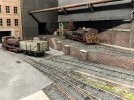
Most of the buildings are at least at the card shell stage, which allows me to get a better feel of how it's all coming together.

DSCF2361.JPG

DSCF2360.JPG

DSCF2364.JPG

DSCF2363.JPG
 

Dave

Western Thunderer
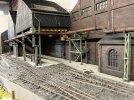
I have some ballast down now but it's not progressed much otherwise.
20251005_112017.jpg

20251005_112041.jpg

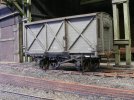
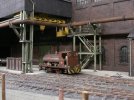
I've been building wagons and have 15 in the works. Setting the layout in the 1948-60 period has opened up all sorts of possibilities of using types that I've never used before, particularly elderley unfitted vans and other pre-grouping stuff that made it into BR days.

This one is a RTR LNWR van that I weathered but most of what is to come are in kit form.
DSCF2370.JPG
 

Dave

Western Thunderer
Progress has been made on the covered travellling crane/building end. I've probably put far too much effort into the crane when you consider how little of it can be seen from the layout operator's position, below.
20251011_174012.jpg

20251011_173911.jpg

20251015_114705.jpg
The crane and the whole area are not yet finished and the building will need to be properly settled in to remove the gap between it and the ground.
 

Dave

Western Thunderer
This particular area still needs some work, including capping and a handrail atop the retaining wall, but it's getting there.
20251017_160114.jpg

I added another ancient van to the fleet.
DSCF2376.JPG
It's an ex-Caledonian 10-tonner, a Rapido model. All I had to do is put some proper couplings on and slap some weathering on.

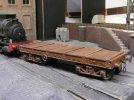
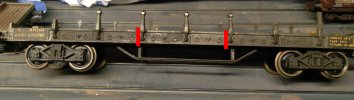
Far more effort went into this internal use bogie, for carrying large ingots.
DSCF2354.JPG

It started out as an old Playcraft bogie bolster that I picked up at an exhibition for just £2.
20250830_143914.jpg
 

Dave

Western Thunderer
Added interest to the otherwise plain foundry building.
DSCF2379.JPG
The ladders are Ratio but the cages and walkways are all from scratch, as is the large air vent/extraction fan.

There are no figures anywhere yet but the ladders and cars give a relatable human scale to things among the towering buildings.
DSCF2392.JPG
The cars would belong to the management. I would like motorcycles parked up, as worker's transport, but there's a distinct lack of such things available in 4mm.
 

AJC

Western Thunderer

simond

Western Thunderer
Flash website too!

I guess in the fifties & sixties motorbikes, with and without sidecars, were pretty common.

Pre-war however, there were many fewer drivers and I suspect the average working man walked to work, or maybe had a bicycle

A motor vehicle of any sort would have been something of a luxury.

This History of Driving and the introduction of the UK driving licence. contains some useful references, along with a few spelling errors…

And there is an excel table in here that gives a picture of new vehicle registrations throughout the 1900’s - not all, unfortunately, but the “top seller brand” and quantity. The early twenties were the heyday of RR & Bentley!

 
Last edited:

Phil O

Western Thunderer
Added interest to the otherwise plain foundry building.
View attachment 250233
The ladders are Ratio but the cages and walkways are all from scratch, as is the large air vent/extraction fan.

There are no figures anywhere yet but the ladders and cars give a relatable human scale to things among the towering buildings.
View attachment 250234
The cars would belong to the management. I would like motorcycles parked up, as worker's transport, but there's a distinct lack of such things available in 4mm.

Hi Dave,

Where did you get your pipework from?
 

Dave

Western Thunderer
Hi Dave,

Where did you get your pipework from?
Hi Phil. The pipes are Plastruct piping but the flanges and bends are from Goodwood Scenics. They do a decent range of diameters and also valves to suit.

Ditto in 7mm. And decent drawings are hard to come by too…

though many workers would have had push-bikes, I guess.
I guess so. Wills do a kit for a bicycle rack, with a corrugated iron roof, which will suit.

How about these?


No idea what vintage this actually represents, mind ('70s? I'm guessing here - going on the indicators).

Adam
I would agree that it's probably 1970s, with the indicators and disc front brake. It looks a bit odd because, from what I can see in the pictures, the power unit has been done as a mirror image of the other side - there's no gearbox.

I have done some work on another building. Lots of cutting of Wills English Bond sheeting. The lean-to part is the re-use of a building that I made for another layout around 10 years ago.
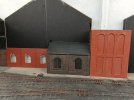
20251026_173434.jpg
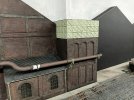
The flat-topped area, above will eventually have a large Braithwaite-type water tank atop it. This odd bit of building is to hide the join bewteen baseboards that rises up to join the backscene boards.

The heavy rivetted metalwork is supposed to be part of the framework for a large press, or steam hammer, that the building has been constructed around.
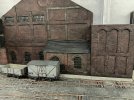
20251029_175036.jpg
I wanted to build something along these lines, and not just a row of black corrugated iron buildings, because old photos of places such as Hadfields, and Brown Bayleys, show large brick buildings that are seemingly blackened with what even back in the 1950s was probably over 70 years of smoke and general grime. The intention has always to have buildings that could show a development and expansion of the works and not simply one homogenous row of identical buildings, so this would be one of the older buidings, but not one that was there at the beginning of the works. They are all gone now, the earliest being built in 1856. That is when, in my fictional history, Col. Roland Hadleigh, upon returning from the Crimea, left the Royal Engineers and started the company, naming its premises Sevastopol Works.

 

hrmspaul

Western Thunderer
Flash website too!

I guess in the fifties & sixties motorbikes, with and without sidecars, were pretty common.

Pre-war however, there were many fewer drivers and I suspect the average working man walked to work, or maybe had a bicycle

A motor vehicle of any sort would have been something of a luxury.

This History of Driving and the introduction of the UK driving licence. contains some useful references, along with a few spelling errors…

And there is an excel table in here that gives a picture of new vehicle registrations throughout the 1900’s - not all, unfortunately, but the “top seller brand” and quantity. The early twenties were the heyday of RR & Bentley!


I am old enough to remember the vast toilets and personal washing facilities at some of the large works we went wagon hunting in. But, by then cars had largely replaced bikes. How were the thousands of bikes stored during the working day at large works? Pictures of going home time can show that, as now, other road users and pedestrians didn't stand a chance against pedal bikes.

Paul
 

simond

Western Thunderer
Yes, despite the numbers of cars in the seventies, the press of men on foot and on bikes leaving Cammell Laird when the whistle blew was quite memorable to a young undergrad.
 

Dave

Western Thunderer
Work continues on the covered crane building and the brick building. The tank for the brick building is now made and needs to be properly fitted, weathered and piped up.

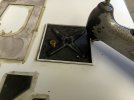
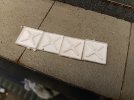
I made the tank by sticking individual panels on to a thick styrene box. The panels are milled from styrene and are supposed to represent Braithwaite pressed steel panels. There's no graduated depth stop on the pantograph, so it's a bit hit and miss and the raised areas stand out more than they ought to but the tank something that will be under close scrutiny, so it will do the job.
20251111_131109.jpg

20251111_131101.jpg

20251113_174920.jpg
 

spikey faz

Western Thunderer
Work continues on the covered crane building and the brick building. The tank for the brick building is now made and needs to be properly fitted, weathered and piped up.

I made the tank by sticking individual panels on to a thick styrene box. The panels are milled from styrene and are supposed to represent Braithwaite pressed steel panels. There's no graduated depth stop on the pantograph, so it's a bit hit and miss and the raised areas stand out more than they ought to but the tank something that will be under close scrutiny, so it will do the job.
View attachment 251733

View attachment 251732

View attachment 251734
Nice!

Mike
 

Alex W

Western Thunderer
Coming slightly late to the party on this one, I read with interest about your use of copper tape stuck down on the baseboard surface as the DCC bus, as like you I don't fancy struggling beneath boards to get ar wiring that is over my head! Such so that I Googled copper tape and am off to buy some later! Now that the ballast is down, have you had any issues with the glue in the ballast causing a short between the busbars?
 

Dave

Western Thunderer
Coming slightly late to the party on this one, I read with interest about your use of copper tape stuck down on the baseboard surface as the DCC bus, as like you I don't fancy struggling beneath boards to get ar wiring that is over my head! Such so that I Googled copper tape and am off to buy some later! Now that the ballast is down, have you had any issues with the glue in the ballast causing a short between the busbars?
Hi Alex. It only caused a problem whilst the ballast was not fully set for 3-4 days afterwards. Even though it was mostly dried on the surface, there must have still been enough moisture deep down to cause a short circuit but after it all dried out properly there wasn't a problem. The glue is PVA and as far as I'm aware isn't itself conductive.

Progress since my previous post.

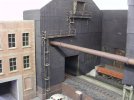
The large pipe span between buildings seemed excessive for the pipe alone, so I've encased it in its own lattice bridge. The bridge structure is scratchbuilt, using styrene section, milled parts and parts from two Ratio signal gantry kits.
20251125_142921.jpg


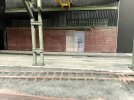
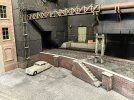
The covered crane building now has glazing, gutter, drain pipe and a walkway. It is ready to be permanenty planted to the floor.
20251125_142621.jpg

DSCF2413.JPG
 
Top