You are using an out of date browser. It may not display this or other websites correctly.
You should upgrade or use an alternative browser.
You should upgrade or use an alternative browser.
Hadleigh's Ltd. Sevastopol Works
- Thread starter Dave
- Start date


John57sharp
Western Thunderer
It'll keep the slugs of the layout too….Thanks Dave. That's useful to know. I went B&Q today to buy some copper tape and learned they have it in the gardening section, not electrical

Dave
Western Thunderer
Two more low relief buildings have been added.
The one on the left is supposed to house the furnaces for reheating ingots, prior to forging. The tank is a buffer to hold fuel oil from the main storage tanks. I need to make some sort of building to go in front of this one to house fans, or whatever, to force air into the furnaces.
The paint was still wet when I took the photo. I had painted it but forgot to score vertical lines into the corrugated sheet and so had to do this in situ and then go over the exposed metal with more paint.

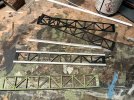
The building on the right will have a gantry crane in front of it. I will be scratchbuilding most of it but the main girders/runners are from a Walthers kit. The photo below shows a trial fit of one girder, before scoring the lines into the corrugated sheet.

Although what has been done so far requires more work in detailing, all of the board now has ground cover and all of the track is ballasted, except for the area below.

My original idea for this area was to have a railway viaduct running from the backscene to the front but I abandoned that. I'm now considering reviving that idea, or having an elevated road. Making something such as a dual carriageway in reinforced concrete (card!) on columns would be cheap and easy to build, but I'm not sure if that's suitable for the 1950s. Is all that sort of structure more a 1960s and 70s thing?
The one on the left is supposed to house the furnaces for reheating ingots, prior to forging. The tank is a buffer to hold fuel oil from the main storage tanks. I need to make some sort of building to go in front of this one to house fans, or whatever, to force air into the furnaces.
The paint was still wet when I took the photo. I had painted it but forgot to score vertical lines into the corrugated sheet and so had to do this in situ and then go over the exposed metal with more paint.
The building on the right will have a gantry crane in front of it. I will be scratchbuilding most of it but the main girders/runners are from a Walthers kit. The photo below shows a trial fit of one girder, before scoring the lines into the corrugated sheet.
Although what has been done so far requires more work in detailing, all of the board now has ground cover and all of the track is ballasted, except for the area below.
My original idea for this area was to have a railway viaduct running from the backscene to the front but I abandoned that. I'm now considering reviving that idea, or having an elevated road. Making something such as a dual carriageway in reinforced concrete (card!) on columns would be cheap and easy to build, but I'm not sure if that's suitable for the 1950s. Is all that sort of structure more a 1960s and 70s thing?
Dave
Western Thunderer
I discovered that the sort of bridges that I meant, when considering how to fill the space above, are actually prestressed concrete. First used in the UK in 1954. That means the technology was around in the time period of the layout, but perhaps not the sort of road that I was thinking of - think raised sections of the M6, Spaghetti Junction and all that...
I've put that on hold for now and am building the rest of the overhead crane.
I've put that on hold for now and am building the rest of the overhead crane.

simond
Western Thunderer
Box girders were very popular in the sixties & seventies. Not my bit of Engineering but there are some Civils on here (I’m a rude Mechanical, as Shakespeare would have it, presumably uncivil…) who would know much more
Google “concrete box girder bridge uk problems“ and the AI thing gives a load of history
atb
Simon
Google “concrete box girder bridge uk problems“ and the AI thing gives a load of history
atb
Simon
Dave
Western Thunderer
It's been a while since I updated this. In the end I decided to put another flat relief building in the remaining gap.
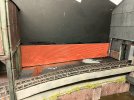

That area hasn't progressed beyond the above but the crane area has. The driver's cabin is scratchbuilt from brass sheet, whilst the machinery cabin is what was intended to be the driver's cabin. The crane needs some access ladders and lighting to finish it.

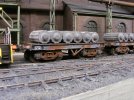
Lots of multi-faceted steel ingots have been made by 3D-printing. The small (3-ton) ingots would be broken into 4 pieces and each piece would be forged into a wagon wheel.
10-ton ingots.
That area hasn't progressed beyond the above but the crane area has. The driver's cabin is scratchbuilt from brass sheet, whilst the machinery cabin is what was intended to be the driver's cabin. The crane needs some access ladders and lighting to finish it.
Lots of multi-faceted steel ingots have been made by 3D-printing. The small (3-ton) ingots would be broken into 4 pieces and each piece would be forged into a wagon wheel.
10-ton ingots.
Dave
Western Thunderer
Handrails along the edge of the upper level have been installed and only a couple of areas still require them. The pillars are 20 thou. cartridge brass and the rails are 0.45mm brass wire. I used brass because I'm bound to catch one with a shunting pole, hand, or whatever and it's more robust than plastic.


John57sharp
Western Thunderer
Those handrails are the business! Great work.
John
John
Dave
Western Thunderer
The last stretch of handrails will go here.

Despite this wall being one of the first scenic additions in the layout build I have only today added the capping stones. They need mortar to be added and then a little weathering to blend them in to the rest of that section of wall.

Despite this wall being one of the first scenic additions in the layout build I have only today added the capping stones. They need mortar to be added and then a little weathering to blend them in to the rest of that section of wall.
Dave
Western Thunderer
Thanks, Martin.This really is absolutely convincing. Fantastic modelling.
Martin
This building was seen earlier. I wasn't happy with its appearance and so clad it to appear as corrugated asbestos.

It has temporarily been covered with cling film whilst the final section of ballasting is done.

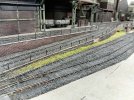
The small section of handrail has been installed but when I said it was the last stretch of handrails I had forgotten about the top of the stone wall along the incline needing them.
This has now been made and fitted.
I went through a time of thinking that it this layout was a bit rubbish but now that it's nearing completion I'm beginning to think that it's
not bad at all. Although there are areas that still need work, and there are details to add, it's mostly there. The only thing preventing me from using it properly now are the Fiddle Yards. There is no means of locking the traverser at one end, and the sector plate at the other, to line them up with the in/out tracks. That kind of thing really isn't my forte and so I've been putting it off, but I can put it off no longer.
John57sharp
Western Thunderer
Looks great to me!
John
John
simond
Western Thunderer
There are a few well-proven solutions, involving sliding bolts and sprung balls and suchlike.There is no means of locking the traverser at one end, and the sector plate at the other, to line them up with the in/out tracks. That kind of thing really isn't my forte and so I've been putting it off
Even stepper motor-driven sector plates and sliding traversers.
If you want to post photos, I’m sure there will be Thunderers who can suggest solutions.
That said, there is a reasonable probability of getting more suggestions than there are Thunderers…
Dave
Western Thunderer
Thanks, Simon. I'll be working on the KISS principle. Stepper motors are most definitely above my pay grade.There are a few well-proven solutions, involving sliding bolts and sprung balls and suchlike.
Even stepper motor-driven sector plates and sliding traversers.
If you want to post photos, I’m sure there will be Thunderers who can suggest solutions.
That said, there is a reasonable probability of getting more suggestions than there are Thunderers…

I've got the general idea of what I want to do and that involves tubes and rods; a sort of minature version of a sliding bolt, but it's finding the space to fit it and how, precisely, to fit it. The FY is a real bodge. I can take photos, if anyone wants a proper laugh.
Dave
Western Thunderer
If you are easily offended by extremely poor wooodworking look away now.
You can understand now how it's not easy to fit anything in due to the varying heights and close proximity to the edge of the crappy chipboard top of the traverser deck.

The thick lumps of brass are copy font from the pantograph engraver. They're spares and with weird symbols on that I don't even recognise, never mind have a use for. They are drilled, pinned and loctited onto lumps of plywood. Each will have a brass tube soldered on, through which will pass a brass rod to act as a bolt. My soldering iron is a puny 25w thing, so I'll have to drag the RSU out and put the earth to each plate to have any hope of soldering the tubes on. A set up similar to this will be added to the sector plate at the other end of the layout.
There is one more hateful woodworking task before proper operation of the layout can commence and that is to put up some stock shelves above the FY at the other end. I have far too many wagons to be able to keep them all on track.
The operating system is by picking 7 wagon cards at random, 7 being the maximum that can fit in the run-round loop. Each card gives the wagon's identity and whether it comes in from the BR exchange sidings loaded or empty as there is of course loaded traffic both ways. Some wagons only ever come in loaded and only leave empty, such as minerals but these can carry either scrap metal for the furnaces, or coal for the boilers. The choice of empty/loaded and choice of load will be done by toss of a coin.
The cards are laminated so can be used again.

The layout is basically a glorified shunting plank but the card system means there is purpose to it and the randomisation means the same wagons with the exact same loads and destinations are highly unlikely to make up the same train twice. Except for the wagons that run as a block and always to the same destination and with the same load, of course. They being the fuel oil tanks.
And the Pig Iron opens.
And the limestone hoppers.
And the sand wagons.
So, apart from the tanks, the Pig Irons, the limestone hoppers and the sand wagons, everything is different every time.
You can understand now how it's not easy to fit anything in due to the varying heights and close proximity to the edge of the crappy chipboard top of the traverser deck.
The thick lumps of brass are copy font from the pantograph engraver. They're spares and with weird symbols on that I don't even recognise, never mind have a use for. They are drilled, pinned and loctited onto lumps of plywood. Each will have a brass tube soldered on, through which will pass a brass rod to act as a bolt. My soldering iron is a puny 25w thing, so I'll have to drag the RSU out and put the earth to each plate to have any hope of soldering the tubes on. A set up similar to this will be added to the sector plate at the other end of the layout.
There is one more hateful woodworking task before proper operation of the layout can commence and that is to put up some stock shelves above the FY at the other end. I have far too many wagons to be able to keep them all on track.
The operating system is by picking 7 wagon cards at random, 7 being the maximum that can fit in the run-round loop. Each card gives the wagon's identity and whether it comes in from the BR exchange sidings loaded or empty as there is of course loaded traffic both ways. Some wagons only ever come in loaded and only leave empty, such as minerals but these can carry either scrap metal for the furnaces, or coal for the boilers. The choice of empty/loaded and choice of load will be done by toss of a coin.
The cards are laminated so can be used again.
The layout is basically a glorified shunting plank but the card system means there is purpose to it and the randomisation means the same wagons with the exact same loads and destinations are highly unlikely to make up the same train twice. Except for the wagons that run as a block and always to the same destination and with the same load, of course. They being the fuel oil tanks.
And the Pig Iron opens.
And the limestone hoppers.
And the sand wagons.
So, apart from the tanks, the Pig Irons, the limestone hoppers and the sand wagons, everything is different every time.
Last edited:
Dave
Western Thunderer
I have got no further with the traverser. Being in hospital for a fortnight doesn't help with modelling progress but I've been out for a week and have finished a few wagon projects and have also, at last, begun to populate the layout with little people.
I may or may not have mentioned that the ARP signalbox isn't a signalbox in the way it would be on the main line. The idea is that it controls the points immediately adjacent to it but doesn't control any signals. Train control on the works system is by radio and access to the single line to and from the BR exchange sidings is by radio, backed up by a staff. If a driver doesn't have the staff then he cannot proceed beyond this side of the bridge. I have read of an indusrial system using radio in the 1950s, so it's not complete fantasy. I guess they must have either used miitary surplus or something powered by car batteries that had to be removed from the loco and charged as required.
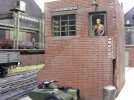
Plate VB. I think these came in around `1960, so that's toward the end of my time period and is why I have only lightly weathered it. I made it from a Parkside kit, home-made milled brass brake gear, spare roller bearings from another Parkside kit and some OLEO buffers from Accurascale.

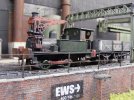
This Neilson crane tank started out as a Southeast Finecast whitemetal kit for one of two SECR crane tanks that were built for them by Neilson. I made mine into the industrial version by replacing the jib with a flatter one that is built from brass. The SECR ones didn't have powered slewing, so I had to make the slewing engine from scratch using plasticard. I built it for a different layout maybe 5 or 6 years ago but it has never run. I went to DCC shortly after building it and wasn't able to fit a decoder and Stay Alive in. Decoder technology has advanced since and I have been able o fit a Zimo MX615 and a Lais SA and manage to keep both hidden.
I may or may not have mentioned that the ARP signalbox isn't a signalbox in the way it would be on the main line. The idea is that it controls the points immediately adjacent to it but doesn't control any signals. Train control on the works system is by radio and access to the single line to and from the BR exchange sidings is by radio, backed up by a staff. If a driver doesn't have the staff then he cannot proceed beyond this side of the bridge. I have read of an indusrial system using radio in the 1950s, so it's not complete fantasy. I guess they must have either used miitary surplus or something powered by car batteries that had to be removed from the loco and charged as required.
Plate VB. I think these came in around `1960, so that's toward the end of my time period and is why I have only lightly weathered it. I made it from a Parkside kit, home-made milled brass brake gear, spare roller bearings from another Parkside kit and some OLEO buffers from Accurascale.
This Neilson crane tank started out as a Southeast Finecast whitemetal kit for one of two SECR crane tanks that were built for them by Neilson. I made mine into the industrial version by replacing the jib with a flatter one that is built from brass. The SECR ones didn't have powered slewing, so I had to make the slewing engine from scratch using plasticard. I built it for a different layout maybe 5 or 6 years ago but it has never run. I went to DCC shortly after building it and wasn't able to fit a decoder and Stay Alive in. Decoder technology has advanced since and I have been able o fit a Zimo MX615 and a Lais SA and manage to keep both hidden.
Dave
Western Thunderer
I managed to stuff the same DCC gear into another long-dormant engine, today.
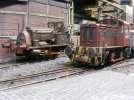
I built Seth, a Hudswell Clarke contractor's engine, around the same time that I built the crane tank and for use on the same layout. The body is an old K's whitemetal kit on a scratchbuilt chassis, with Gibson wheels.

With many years of service added on by weathering and a change of crew, it is now perfect for Sevastopol Works.


I built Seth, a Hudswell Clarke contractor's engine, around the same time that I built the crane tank and for use on the same layout. The body is an old K's whitemetal kit on a scratchbuilt chassis, with Gibson wheels.
With many years of service added on by weathering and a change of crew, it is now perfect for Sevastopol Works.
That is a nice modification of the Parkside kit.Plate VB. I think these came in around `1960, so that's toward the end of my time period and is why I have only lightly weathered it. I made it from a Parkside kit, home-made milled brass brake gear, spare roller bearings from another Parkside kit and some OLEO buffers from Accurascale.
View attachment 260347
You are correct that B936156 is a 1960 construction BR Plate wagons - revenue and departmental SPV ZXV ZYW RRV ZSR ZOV ZVV ZRV ZEB | B936156 Plate VB d 1-434
If date accuracy is of concern you could make it a little earlier (1959) by numbering as one of the lower numbered Lot 3223 wagons. BR Plate wagons - revenue and departmental SPV ZXV ZYW RRV ZSR ZOV ZVV ZRV ZEB | B934169 SPV PLATE VB @ Wellingborough 80-08-26 � Paul Bartlett w
Paul