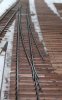
Hartley Hills, LNWR c1900 - buffer stops, how do you build yours?

S

Simon Dunkley

Guest
Fascinating stuff, Graham.

One comment: if the information is known, it can be put into Templot, so the fact that the earlier Templot drawings were not to (pre-)Edwardian LNWR practice is not the fault of the software, which comes with REA switches, etc, as standard. As usual with Templot, inputting the information is easy once you know where to look (having recently done this for some US outline S scale templates). The problem is usually getting hold of the info in the irst place (as I have been finding out, trying to identify what US shortlines were doing 100 years ago.)
 

Dog Star

Western Thunderer
Fascinating stuff,..
The information on some of the drawings is "fascinating" in itself. Sometime back there was a discussion on one of my threads about the rail inclination through crossings... some of the LNWR PW drawings (dated 1909) specify that a switch rail is twisted (over a given) length from vertical to the inclination of the adjacent closure rail. And yes, the corresponding sections show that the switch rail is planed such that the "switch toe" is vertical when closed to the stock rail.

... if the information is known, it can be put into Templot, so the fact that the earlier Templot drawings were not to (pre-)Edwardian LNWR practice is not the fault of the software, which comes with REA switches, etc, as standard.
Agreed.

I felt that asking Richard to enter the data and then redo the templates was not a reasonable request... and almost two years have elapsed between production of the templates and the availablity of the switch data.

regards, Graham
 

Rob Pulham

Western Thunderer
Hi Graham,

I certainly admire your tenacity with this. The results looks superb, many would have thrown the teddy out of the cot a long time ago:thumbs:
 

Dog Star

Western Thunderer
Turnout 3A of Hartley Hill is progressing in that the diverging stock rail has been added - said like that the task seems so simple, not so as this post shall show. Just to make things a little more difficult, I have laid the diverging stock rail of turnout 3A and the through stock rail of turnout 4A as a continuous length of rail so as to maintain a smooth curve through the formations. For those who like such things, the track diagram can be found here .

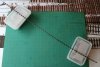
This photo show the single length of rail which is to represent, on the model, three separate lengths of prototype rail, to cover from the heel of turnout 4A through the toe of turnout 3A to the start of the corresponding check rail. This rail has been curved to shape. blackened, chaired and droppers attached (hence the rail is supported above the work surface to avoid damage to the droppers).hh-stock-1.jpg

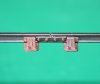
As the rail represents several "lengths" of prototype rail I have made cuts in the rail head to simulate the rail joints of the prototype. The presence of these "joints" has an impact on the chairing - see the keys of the chairs adjacent to the cut in the rail. This joint is near to the heel of the switch and therefore includes some bridge chairs, such chairs are used where the stock and switch / closure rails are so close that there is not enough space between the rails for two plain line chairs. On the right hand side of the photograph can be seen a dropper... added after the rail has been chaired and before blackening (getting things done in the correct order needs planning when laying more than one length of prototype rail using a single piece of 7mm rail). hh-stock-2.jpg
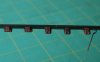
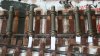
I use Exactoscale ABS fishplates for joining rails... painted a greasy Chocolate colour whilst attached to the sprue. Each moulding is made of two fishplates, one with bolt heads and one with square nuts. Each pair of fishplates is joined by a bridge piece, that bridge piece has to be removed for use with the simulated rail joints - a split moulding is shown below the sprue.
hh-stock-3.jpg

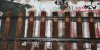
Araldite secures the separate fishplates to the rail - for some of the pre-1900 track the nuts are on the running face of the rail as that is what can be seen in LNWR photos of the Victorian era, for the post-1900 track the nuts are on the outside of the rail (the non-running face). The rail joint is made using a jeweller's saw blade, something like a 4/0 which gives a gap of around ten thou (a scale 7/16").hh-stock-4.jpg

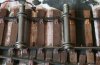
Apologies for the scruffy appearance of the track bed, a consequence of the template / foam getting torn when the drill snags the copydex (used for sticking the underlay to the baseboard surface) and of the numerous alterations made to the timbering as the switch design evolved. In this photo the sprung track gauges from the S7 Group Stores are being used to secure the toe of the turnout as the first step in fixing the stock rail. The toe of the switch is one timber to the right of the RH gauge.
hh-stock-5.jpg

The first couple of chairs at the toe of turnout 4A need to be firm before proceeding along the stock rail - this is because trying to lay that rail with (a) a set at the switch toe and (b) gauge widening beyond the switch heel needs accurate positioning of the stock rail along the line of the turnout.. The gauges are left in position for about ten minutes after application of butanone, pressure is applied to the rail tops so as to enusre that the chairs are in contact with the timbers. Tins of baked beans are useful for holding chairs in place as the tin sits nicely on two gauges as shown (other beans are available...).hh-stock-6.jpg

The next post is going to cover gauge widening through the closure plus the use of plain line chairs to hold the curve of the stock rail.

regards, Graham

 

7mmMick

Western Thunderer
Fantastic work Graham. I'm really enjoying watching this thread and as a track building novice it's certainly invaluable to me. I'll definitely use some if your ideas although the beans will have to be Branston :)) One thing I did want to ask is about your gauges. I know the West Mersea chaps found that using gauges that gripped both sides of the rail head caused real problems later as it gripped the head square and then once the gauges were removed the chairs naturally spring the rail heads inwards, canting it slightly. And then only later when checked was the track found to be too narrow. Do the gauges you have stop this and have you come across this yourself ?

ATB Mick
 

Ressaldar

Western Thunderer
A timely post Graham, as we (Wirral OGG) have just laid down different types of underlay - cork, granulated cork & foam, using PVA and Copydex and should be able to assess the results this coming week. We are also contemplating using both the ABS and brass fishplates again, via experimentation with the fixing methods - many thanks for posting.

cheers

Mike
 

Dog Star

Western Thunderer
...as we (Wirral OGG) have just laid down different types of underlay - cork, granulated cork & foam, using PVA and Copydex and should be able to assess the results this coming week.
I have used closed cell polyurethane foam (Exactoscale) and latex Carpet adhesive for about ten years now and there has been no deterioration of either the foam or the bond. Ballast is Woodlands Scenic fixed with the Scenic cement... because that stuff does not set hard (as does PVA).

regards, Graham
 

Dog Star

Western Thunderer
Apologies for the scruffy appearance of the track bed, a consequence of the template / foam getting torn when the drill snags the copydex (used for sticking the underlay to the baseboard surface) and of the numerous alterations made to the timbering as the switch design evolved.
The state of the track template has become an embarassment with the markings for droppers / fishplates and alterations... not forgetting the consequences of using an electric drill for the necessary holes through the template / foam / baseboard (drill snags the latex glue and tears the paper / foam). Late in the day a visitor made a suggestion which has been tried, found to work and seems worth passing on.

The suggestion was to use a wad punch to make a clean cut through the paper and foam such that the foam can be lifted from the formation without pulling the latex glue. I have been using a 4mm punch to remove a foam plug before using a 3mm drill to make a hole in the baseboard (for a dropper). After the track, with droppers, has been laid a new foam plug is pushed into the hole to prevent the ballast falling down the hole. If a 4mm punch is used to cut the plug then that plug is a push-fit in the (previously cut) hole.

If a plug is a bit loose in an existing hole, cut another plug with a larger punch (5mm in the example given).

Here is the set of punches which I obtained from possibly the world's favourite internet site:-

punches.jpg

regards, Graham
 

Dog Star

Western Thunderer
One thing I did want to ask is about your gauges. I know the West Mersea chaps found that using gauges that gripped both sides of the rail head caused real problems later as it gripped the head square and then once the gauges were removed the chairs naturally spring the rail heads inwards, canting it slightly. And then only later when checked was the track found to be too narrow. Do the gauges you have stop this and have you come across this yourself ?
Mick, I shall respond to this question after the next contribution on Hartley Hill turnout construction... your post deserves a decent answer and that means care in thinking the details through carefully.

regards, Graham
 

Dog Star

Western Thunderer
Following on from the initial post about fixing the diverging stock rail for turnout 4A - in which I outlined the construction of the adjacent stock rails of turnouts 3A and 4A - this post is about securing the stock rail through the switch of turnout 4A. In addition, as Hartley Hill is home to at least one of Webb's large freight tender engines and may well see a Spaceship, this post includes details of how I introduce gauge widening into the switch and closure rails. All of the photos in this post show the toe of the switch, just eight timbers of the turnout.

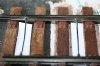
This photo shows how the diverging stock rail, adjacent to the toe of the switch, is fixed. The stock rail is "set" at the toe of the switch - the leftmost, pale colour, timber - so as to accomodate the width of the switch rail. The "set" is prototypical and is sufficient so that the distance between the running faces of the stock rails, at the end of the switch planing, is equal to the track gauge plus the width of the rail head. I use plain chairs rather than slide chairs at this time so that the stock rail is secured in the correct position through the switch - slide chairs have a single jaw and do not hold the rail firmly without adhesive. The diverging stock rail is gauged from the corresponding switch rail when that switch rail is in the closed position - to achieve the gauging of the stock rail the spring gauges are opened so that the switch rail and adjacent stock rail are held within the collars at one end of the track gauge. In this photo the LH track gauge is fixing the stock rail at 33mm... the next two track gauges are fixing the stock rail at 33mm plus 5 thou (the thickness of writing paper) and the two track gauges to the RHS are fixing the stock rail at 33mm plus 10 thou (writing paper folded over). A strip of writing paper (or a folded strip) is placed over the rail, then the track gauge is opened, the gauge is placed over the paper strip and the gauge pressed down... finally the track gauge is pressed over the diverging stock rail.
hh-stock-7.jpg

This photo shows the stock rail fixed from the toe of the switch (the pale timbers on the left) to the first block chair - this switch has eight slide chairs with stud bolts at the 7th and 8th slide chairs. The self-coloured plain chairs are used to secure the line of the stock rail and shall be replaced with the appropriate (and painted) slide chairs.
hh-stock-8.jpg

This photo shows that some of the plain chairs, for timbers 2, 4, 6 and 8, of the switch have been removed once the butanone has evaporated and the bond made between chair and timber.
hh-stock-9.jpg

This photo shows that (painted) slide chairs have been introduced at timbers 2, 4, 6 and 8. The slide chairs are fixed to the stock rail using Araldite. When the Araldite has cured then the slide chairs are fixed to the timbers with butanone.
hh-stock-10.jpg

This photo shows that the plain line chairs at timber positions 1, 3, 5 and 7 have been removed as the stock rail is fixed to the slide chairs (timbers 2. 4. 6 and 8) by epoxy adhesive.
hh-stock-11.jpg

This photo shows the remaining slide chairs - timbers 1, 3, 5 and 7 - fixed in place with Araldite (chair to rail) and butanone (chair to timber).
hh-stock-12.jpg

regards, Graham
 

Dog Star

Western Thunderer
This post might be considered as a bit of a fake... in that I am working on turnout 3A and the photo in this post is of turnout 4A - this dubious situation comes about because I wished to lay as much of the stock rails for turnouts 3A and 4A in one go as was possible. The positions of the rail joints in the stock rails dictated the maximum length of rail which could be used and similarly dictated where that rail would be positioned. Hence the rail forms the stock rail for the check-rail / crossing of turnout 4A plus the stock rail for the switch and closure of turnout 3A.

This photo shows the stock rail at the position of the check rail for turnout 4A. The check rail requires five check chairs whereas the photo shows that the stock rail has seven "half check chairs"... this is so that there are some "spares" in place should any of the half check chairs fall apart during the task of gauging / securing the stock rail.
hh-stock-13.jpg

Any surplus half chairs are removed after the stock rail has been fixed in position. Those who are eagle-eyed might spot the track feed which is within the length of the pending check-rail, the feed splits the check length into two chairs / three chairs. Sense suggests that I ought to have put at least one extra spare chair on either side of the track feed - luck was with me when fixing these chairs in that I did not need a spare chair to the left of the feed.

regards, Graham
 

Dog Star

Western Thunderer
Hartley Hill traffic can now run a mite further than previously - turnout 3A is usable because the diverging stock rail and through switch blade have been made and fitted (which includes making the half dozen block chairs from the switch heel to the end of the switch rail) plus there has been a successful outcome to the first experiment with lost-wax stretcher bars (products from the home of WMR-HQ otherwise known as Perfect Miniatures. I think that the masters for these stretchers were made by Colin Dowling - nice job Colin :thumbs: ).

The first photo shows the front and back stretchers - these are of the round rod type which was in use in Victorian times. The white strip to the LHS is a matchstick to hold the switch rails in position whilst the rapid cure epoxy resin hardens (other cure times for Araldite are available).
hh-3a-sw-8.jpg

This photo shows how the rod stretchers fit into the switch blades - the ends of the round section are inserted into holes in the web of the switch rail and soldered from the back face. A switch drive rod can be seen under the LH stretcher.
hh-3a-sw-9.jpg

And this is what the (almost) completed turnout 3A looks like at this time - ok, there is a check rail missing... stock runs smoothly through on the Up Main (wrong-line ticket in possession) without the check rail and that is pleasing. Some half chairs need to be added to the crossing - I have yet to decide when the LNWR started using the "slab and bracket" style of chairing for the Vee so study of photos is needed... as well as a session in learning how to use the camera!hh-3a-sw-10.jpg

regards, Graham
 

Pugsley

Western Thunderer
Very nice. Presumably the stretchers are araldited one side for insulation and soldered the other? Either that, or you're not planning on using DCC :)
 

Dog Star

Western Thunderer
Presumably the stretchers are araldited one side for insulation and soldered the other? Either that, or you're not planning on using DCC :)
You are correct about the stretchers... now that I know how to fettle and fit I shall create a suitable topic in the Permanent Way forum when I do the next set of switches.

Not sure why you have said "not planning on using DCC" for I think that having non-insulated switches can cause trouble with DC and DCC electrics - rather depends upon how the crossing polarity is controlled and the power fed to the individual switch rails. I did consider adding an extra set of contacts to the Fulgurex motor and connecting power to a switch rail only when that switch rail was closed to the adjacent stock rail - for about 30 seconds and then decided that an admonishment from Mr. Steph would not be pleasant. The stretcher bars are insulated at one end (and tested for non-conductivity) so that a switch rail can be bonded to the adjacent stock rail.

regards, Graham
 

SimonT

Western Thunderer
Graham,
this is looking very nice indeed, looking forward to seeing how you insulate the stretchers within the end castings. I used plastic wire insulation on Brokenborough, soldering the switch rails to the castings and epoxying the wire insulation to both the casting and the stretcher. Occasionally I became attached through too enthusiastic application of the epoxy. :confused: On the DCC layouts the switch rail has been bonded to the stock rail on all turnouts using a nickel-silver plate under each rail at about the switch heel opening. For ultimate S7 godliness we should produce a range of appropriate SS, 2), 3P chairs to do all the work!
Nice curves!

Simon T
 

Pugsley

Western Thunderer
You are correct about the stretchers... now that I know how to fettle and fit I shall create a suitable topic in the Permanent Way forum when I do the next set of switches.
Thanks for the confirmation.

Not sure why you have said "not planning on using DCC" for I think that having non-insulated switches can cause trouble with DC and DCC electrics - rather depends upon how the crossing polarity is controlled and the power fed to the individual switch rails.
Only because you're likely to get away with a momentary short on DC, but the smallest short will turn off the DCC power.
 

Steph Dale

Western Thunderer
...I did consider adding an extra set of contacts to the Fulgurex motor and connecting power to a switch rail only when that switch rail was closed to the adjacent stock rail - for about 30 seconds and then decided that an admonishment from Mr. Steph would not be pleasant...


Interesting approach, but probably one best avoided as a reliability nightmare... (and am I really that bad? :confused:)

Only because you're likely to get away with a momentary short on DC, but the smallest short will turn off the DCC power.

Aah, I wondered what you were driving at Pugs, get it now! The odd errant wheel back on an opposing switchblade would be an intermittent problem and a pain to try and resolve should it ever occur.

Trackwork looks lovely Graham - more power to your elbow sir!

Steph
 
Top