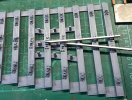
Hayfields 7mm 3D Printed Turnouts

Hayfield1

Western Thunderer
I thought I better have my own thread about my experimenting with 3D printed track in 7mm scale, for some years now I have been building trackwork mainly in 4mm scale. Basically the visual quality of ready to run and some of the kits available have in my opinion been lacking visually in basic geometry and chair representation.

Rather than getting better over time with the demise of Exactoscale's P4 track company kits the situation got worse and modelers were forced to scratch build thankfully with Exactoscale's chair range from the kits which are still available. In 7 mm scale the choice of chair options has got much worse since the demise of Shapeways who sold prints from the Off the Rails range

Templot has been the best 2D track planning software for years and thanks to Martin Wynne's computing skills making basic plans (templates in Templot speak) very easy to use of not just basic turnouts but diamonds, slips, three ways etc for the modeler with basic computer skills

I guess for the past decade Martin has indevoured to add 3D to Templot's repertoire, mainly looking at 4mm scale with a system caller plug track (chairs which plug into sleepers and timbers. By last year (if not longer) it was possible in 4mm scale and upwards to either filament print or laser cut track bases and resin print chairs

I guess Martin has seen a tremendous improvement in the ability ow the quality of printing. Earlier on this year Martin tried an experiment in printing the plug chairs with one of the (slightly) better quality filament machines and it was found the print quality was far better than expected. To cut a story short after a lot of experimenting and tweaking COT track (chairs on timbers) emerged. On two other threads I have shown some of its evolution, but I don't want to take either over So I thought I would have a thread where I can share my further experiments and perhaps have a 2 way chat about it

Can I say at the outset to produce these is not just about buying a 3D printer, in fact this in the end was the easiest skill to learn. But first you need to learn basic Templot skills, then learn the Templot 3D process, finally learn the 3D printing process. Its not a quick fix and the system is still in development
194.jpeg

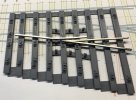
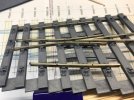
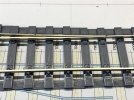
Firstly why bother, I would like to think this photo illustrates why so many scratch build their turnouts, other than the copperclad tiebar (which will be replaced) I think the look of the prototype is much closer.

210.jpeg

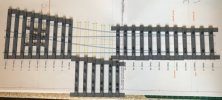
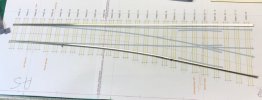
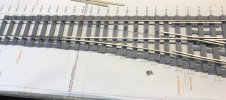
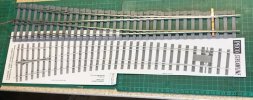
Unless you have a very large printer, the turnout is printed in sections (in Templot they are called bricks). This is an A5 turnout where I have printed the first and third sections, it's been designed to 0MF (31.5mm) standards simply to give better running when using modern wheels
211.jpeg

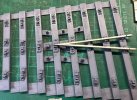
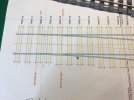
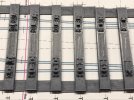
Whilst the magnification and light amplify certain things, once painted it looks fine, the main point is the detailed chairs, in the case it's the switch where the special chairs bridge the gap between the slide chairs and more normal chairs P chair positions P1 to P4

212.jpeg

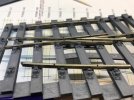
This is the common crossing chairs A, B, C & X, not only the correct chairs but daylight between the Vee and wing rails

When you have your own printer the actual cost is very low, so anyone with a little expertise could recoup the cost of the printer after building a few turnouts, but for me the important factor is both the visual appearance and the level of chair detail
213.jpeg

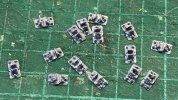
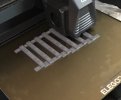
The third brick being printed, timbers have been formed as have the chair bases

I now hope over the following weeks to describe how I build a test track, both to test some locos I am building and to test the system

Please feel free to join in with the thread, happy to try and answer any questions and or discuss this new and exciting development in track building technology
 

Hayfield1

Western Thunderer
I have just become aware that my friend James Walters of Bexhill West fame has inconjuction with Martin Wynn of Templot made James's posts and videos about Templot plug track much easier available via the Templot Club forum


As well as the acclaimed YouTube videos James in a very clear way has a few tutorials which clearly explain the basics in a printable format. Well worth bookmarking this site as the videos are an excellent introduction into the program. However Templot is constantly moving on bot in improving the prints and making the process simpler
 

Hayfield1

Western Thunderer
The main reason for going over to 3D printing first and foremost to use a prototypical design, yes there still has to be some compromises but far less than other methods. Secondly ease of build, hopefully you will see how easy this build method is. Finally cost, in raw materials the timbers and chairs cost just over £1, the coat of rail depends on where you buy it at most £10

After making a plan usually I spend between 1 and 2 hours attaching the plan to a build board, then cut and temporary fix the timbers to the plan

Well whilst the actual print time is about 7/8 hours, the machine works on its own except for loading the print file and starting the machine, then removing the print, a few mins each time, plus the time it takes to produce the 3 print files, less than 5 mins per file.

But the end product is not only a completed track base, but with COT track all the correct chairs are in place

215.jpeg

Here you see all 3 prints, but as you can see the middle one is too big by 2 timbers, in smaller scales it is advisable to add joining clips to the prints. But I have found in 7mm scale, due to the mass of 7mm rail it is able to hold all in place, hopefully it will become clear later on

216.jpeg

You will see I have removed the spacers on the left hand section at the end it joins the center section, I have also removed the left hand timber on the center section

217.jpeg

I have removed the left hand spacers on the right hand section and the right hand timber on the middle section

218.jpeg

Now you can see all 3 sections clearly fit on the plan

The time I have spent working on this turnout probably is under an hour, I have not only a complete track base of timbers but also accurately placed chairs to the desired gauge

If I did hand build a turnout this way using conventual methods I would have taken quite a few hours, using expensive gauges and probably not to the same accuracy and definitely without many of the appropriate chairs

So I do not upset any of my friends, this system is still slightly experimental, restricted at the moment to turnouts (on the automated system) and as Templot has been for years, in development. However thanks to Martin Wynn's clever programing is proving to be a very useful tool for track builders.

Next up I will show and explain the easy to use and inexpensive filing jigs

John
 
jigs

Hayfield1

Western Thunderer
Hopefully see making 7mm turnout track bases, which both look prototypical, are highly detailed and relatively inexpensive can be achieved with a relatively low skill base, now its time to do the tricky part of making and fitting rails, is it tricky ? Not with ingenious filing jigs

219.jpeg

Very cleverly Templot also allows the provision of printing simple to use filing jigs. These jigs not only work with Templot 3D but any other form of traditional track building. Just use the 2D plan you have designed or make a Template in Templot to the design required

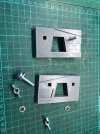
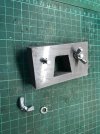
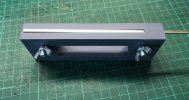
I have shown on the left one of three filings jigs for a pair of switch rails. On the right is the Vee rail

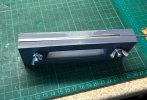
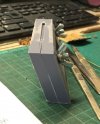
220.jpeg The jigs are easily bolted together 221.jpeg

222.jpeg

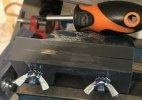
The jig is either clamped to a bench or fitted into a vice and the vee rail is simply filed up. You need to file both sides (and bend) of the rail to get the rail web at the tip.

Martin Wynn has a wonderful diagram that explains it, hopefully he will add it to the thread, if not go to Templot Club

223.jpeg

The simple but very effective design simply requires both rails to be slid in place

224.jpeg This is a very good shot of the chair detail

Must be a contender for the simplest Vee ever made, only a 10" file and some emery cloth used and it took no time at all

Firstly the filing jigs make a nice crisp and accurate angle on the rails, no soldering required other than droppers wires, a spot of glue holds all in place. Also we have made a start on building a common crossing (which many struggle with) with little or no effort.

Next up will be making and fitting the wing rails, which again using traditional methods causes issues. Again Martin has come up with a simple but very effective method

Personally I think all professional track builders, should be taking a very close look at this build method in 7mm scale, if only for the added chair detail it provides. The good news for the average modeler, is that highly detailed (bespoke) turnouts are now available to them without breaking the bank, in fact probably cheaper than its RTR equivalent.

I am happy to try and coach/discus/help anyone thinking about using this system, my skill sets are not the highest but as you can see I have been assisted in learning how to make these turnouts and happy to share this with others, but please bear in mind this is 7mm only, its experimental(ish) and still being developed
 

Lyndhurstman

Western Thunderer
That’s very interesting. Thanks for taking the time to explain it a so clearly. As someone who enjoys track building, it’s always good to see evolutions and positive developments in tools and techniques. Especially the filing jigs.

I did try to get to grips with Templot many years ago, but I found that after spending my day working at a PC I just wasn’t able to give it the energy required.

Thanks again

Cheers

Jan
 

martin_wynne

Western Thunderer
I did try to get to grips with Templot many years ago, but I found that after spending my day working at a PC I just wasn’t able to give it the energy required.
@Lyndhurstman

Hi Jan,

How long is "many years ago"? :)

Templot has been in continuous development for over 40 years. The program today is very different from what it was 10 years ago -- not least the current ongoing development of 3D-printed track.

Also, Templot is now an open-source project, Templot5, and any help is very welcome:

GitHub - Martin-Wynne/Templot5: Open-source version of Templot

cheers,

Martin.
 

Hayfield1

Western Thunderer
@Hayfield1

Thanks John.

I'm not too sure which diagram you mean, but the full instructions for using the 3D-printed filing jigs are at:

How to ... using the Templot rail filing jigs

cheers,

Martin.

Martin

Firstly thanks for the reply and link

Its the diagram explaining how to file and bend then file again the rail, so that the rail web is at the tip of the vee (not the head at the top, foot at the bottom and a gap in the middle if only one side is filed), seem to remember a lot of yellow, If not I will do a separate reply
 

Hayfield1

Western Thunderer
That’s very interesting. Thanks for taking the time to explain it a so clearly. As someone who enjoys track building, it’s always good to see evolutions and positive developments in tools and techniques. Especially the filing jigs.

I did try to get to grips with Templot many years ago, but I found that after spending my day working at a PC I just wasn’t able to give it the energy required.

Thanks again

Cheers

Jan


Jan

Templot is so much easier to use these days, most things have short cut features/actions
 

martin_wynne

Western Thunderer
Its the diagram explaining how to file and bend then file again the rail,
@Hayfield1

Hi John,

That's not needed for Templot plug track and COT track. In fact if you do bend it and file it again, it won't fit in the chairs properly. Just one filed face is all that is needed.

Here you can see that if both sides were filed for a solid tip, it wouldn't fit in the chair:

vee_nose_in_chair.png


The chair fills the gap between the rail head and the rail foot on that side at the tip. At the same time holding the nose tip down in the chair. (Finetrax kits are the same.)

With most model rail sections, the rail web is much over-scale width. This means that after you have blunted the nose back to the scale width, there is very little gap left. The scale blunt nose width for REA bullhead is 3/4". That's 0.25mm (10 thou) in 4mm/ft scale and 0.44mm (17 thou) in 7mm/ft scale. Blunt the nose back to this width after filing.

If you have got the blunting correct, when you push the rail into the chair it should stop with the blunt nose just a little way back from the far side of the chair.

cheers,

Martin.
 
Last edited:

Longbow

Western Thunderer
With 3D printers becoming ever cheaper and better, you don't need a crystal ball to see that in due course this will eventually become the method of choice for custom built track. Congrats to all involved.
 

Hayfield1

Western Thunderer
With 3D printers becoming ever cheaper and better, you don't need a crystal ball to see that in due course this will eventually become the method of choice for custom built track. Congrats to all involved.

Longbow

Initially my thoughts were exactly the same, but I have become to realize a bit of application and effort is required

I had a good start as I have a reasonable grasp of Templot. Turning a 2D plan into a 3D printable file is a process that is easy to learn. With help I learned how to use a 3D printer(s) though I do struggle a bit with resin printing. But I only use my printers for track building and nothing else yet

Before you can make a print

1 You need small amount of knowledge on how to use Templot 3D
2 To start off with the process to turn a 2D print into a 3D file is a little daunting for some (me) but it soon becomes second nature
3 You either need to know how to use your 3D printer or use one of the printers in use with the Templot Club members and ask their help
4 Standard printing software works better when tweaked to optimize performance, again using a printer in use by Templot Club members helps as you can use tweaked printing files published in the forum
5 It also helps to keep yourself informed of advances in this discipline

Yes I agree 3D printing is moving railway modelling forward, just look at British Finescale products, their product seem to be in demand and well received.

Yes in theory once you have grasped what is needed to make a working print(s) / laser cut fret it is very easy (for some at least)

The main issue is Templot is not a product, but a free to use 2D & 3D tool track builders tool, so not a commercial entity, but usually Templot is a very friendly place and new users are warmly welcomed. In fact a nice community if you are interested in trackwork/track building

As you say 3D printing will play an evermore important role in railway modeling, for the young or young in heart its an easy progression, for others its still something done by others for many and various reasons

Like any other track building method, once the basics are mastered it is easy

John


"3D designs copyright © Martin Wynne and OpenTemplot contributors".
 

Lyndhurstman

Western Thunderer
@Lyndhurstman

Hi Jan,

How long is "many years ago"? :)

Templot has been in continuous development for over 40 years. The program today is very different from what it was 10 years ago -- not least the current ongoing development of 3D-printed track.

Also, Templot is now an open-source project, Templot5, and any help is very welcome:

GitHub - Martin-Wynne/Templot5: Open-source version of Templot

cheers,

Martin.
Hi Martin
Thanks for your response.... I've checked my Templot Release Code email... it was Wed, 2 Jul 2008, 13:35 :)

Cheers

Jan
 

Hayfield1

Western Thunderer
I have found the area which modelers find so difficult is in building a common crossing to gauge. Firstly Templot Plug and COT track sorts out the gauge, then we saw how easy and simple using a filing jig is to build a Vee, the next bit is to finish the common crossing.

225.jpeg

Using a Templot template accurately form the wing and check rails. Simply an exercise in marking, bending and filing

226.jpeg

Before fitting the rails, I have a scrap piece of rail where one end is filed a bit sharper, simplu to use to clear out any strings from the chairs from the print process

227.jpeg

After cleaning up the rail ends, removing any burs and filing a slight chamfer on the end, gently feed the first wing rail through the bottom two chairs, If all is well a spot of super glue on one chair will hold the rail in place

Follow the same process with the other wing rail

228.jpeg

Next up fit the check rails, again using the same method as described for fitting the wing rails, the chairs have a slight give in them, just be gentle


229.jpeg

Next up is fitting the chair jaws, the holes are not slots for the jaws but to hold the glue (2 part epoxy)
which keeps the jaws in place

230.jpeg

Two of the 3 jaws fitted. A word of warning each jaw goes in the order of sequence they are printed in, and if cut correctly clip under the head of the rail, do a trial run first

231.jpeg

At the end of the day no complicated forming the crossing using soldering irons and gauges. Martin pure genius

I have now broken the back of the build, the part which usually causes the issues is broken down into a simple build process which keeps the prototypical look of the knuckle bend

Its not only COT track that is so easy, so is plug track in 4mm & 7mm scales, not forgetting other scales like S and gauge 1

As I said this is going to be part of my test track. So I think I will try and develop the build, through to test track and painting and it would be nice to see others give it a try, or get involved with questions/comments/constructive thoughts, might even be worth having a peep at Templot Club ?

John


"3D designs copyright © Martin Wynne and OpenTemplot contributors".
 

Hayfield1

Western Thunderer
204.jpeg

One thing that may bring a smile to your faces, Martin gave me a file with chairs without keys to be scattered around the layout. Another member went one better by replacing the bolts and making the screw/bolt holes

We do have a bit of fun now and then

John


"3D designs copyright © Martin Wynne and OpenTemplot contributors".
 

Hayfield1

Western Thunderer
I have been out all day so am catching up with the thread

232.jpeg

After breaking the back of the building the turnout yesterday, by dispelling all the fears of building a common crossing. Next up are the stock rails. The straight rail is simply a case of cutting the rail to length and dressing both ends. The curved stock rail is slightly different

235.jpeg

Firstly we must put in a slight bend at the rail SET, this is where the switch rail touches the stock rail, so needs to be a gentle bend.
Secondly we must copy the curvature of the rail (starting where I have put an X. I have a set of metal rollers, by gently running the rail between your thumb and forefinger works perfectly well and will also form a gentle curve (and probably quicker)

233.jpeg

Next up (dont forget to use the scrap bit of rail with a bit of a taper on the end, used to clear the holes in the chairs form any swarf left over from the printing process) is to thread the rail through the chairs. I find with the straight rail right to left (on a r/h turnout) is best

Do go gently as the chairs individually can be a bit fragile, but gain strength in numbers, if the odd chair does break simply glue it back with a spot of superglue

234.jpeg

Finally thread the curved stock rail, but this time (for a r/h turnout) thread from left to right

For a left handed turnout its left to right for the straight stock rail then right to left for the curved rail

Its now looking very much like a turnout with only the switch rails to form and fit, again a few very clever but simple to use filing jigs make light work of the job. So far all of these functions can be carried out with a pair of decent wire cutters, a pair of pliers, a 10" fine and a couple of needle files, nothing the average modeler does not have in their tool box (I did have the luxury of a pair of rolling bars which are not really needed and a cheap printable filing jig was used) No gauges or expensive assembly jigs etc have been required

Any queries or requests, please ask

John


"3D designs copyright © Martin Wynne and OpenTemplot contributors".
 

Hayfield1

Western Thunderer
Before I move on to showing how I use the filing jigs for the switches I thought a recap is in order,

What I have not covered was the initial stages, namely making a 2D template (plan) then turning the plan into a 3D printable file, certainly the first step is easy for most folk, the second part is a process which can be learnt

The first step after making or obtaining a track base print, is easy to do in that a prepared short length of rail is run through the chairs, job done without any expensive of difficult tools to end up with a track base ready to use and the cost in basic material is just over £1.00

As you can see so far all we have used are a few tools that most have and one easy to use, inexpensive and reusable filing jig. the material base cost again being around £1.00

The amount of rail I will use is around 2m at a cost of about £4 per meter, though this can be reduced by a bit of shopping around

So for me an A5 turnout will cost me under £10 in raw materials, plus the cost of 4 jigs. The jigs can be reused so the more they are used the cheaper per unit they become

Whilst the main and for me the most important benefit is having a highly detailed turnout. The taboo that you must have a very high skill level to build a turnout, let alone a highly detailed one has been broken

In the past to get a turnout built to these standards you would have to had very deep pockets. Not now and in fact it turns out very much cheaper than even a RTR unit let alone a kit

Perhaps we should think of a few shortcuts in making printed track more available, but 3D track building is in its infancy and needs to be proven, but I am finding it great fun and I doubt if I could make anything near as good by scratch building using traditional methods and parts available

John
 

Hayfield1

Western Thunderer
236.jpeg

To be ably to easily (there are other methods) file switch blades there are 3 easy to use filing jigs
The left hand pair are used to file the switch rail backs
The other 2 pairs are for both the left and right hand switch rail inner faces

237.jpeg

Like the Vee jig simply slide the rail in the correct way, in this case for a right hand turnout its head to the top
Clamp the jig to a bench or into a vice and gently file across the head

238.jpeg

Here you can see the rail filed across the back
 

Hayfield1

Western Thunderer
239.jpeg

As you can see its a front/inner right switch rail jig, but the camera lies, as its not at 90 degrees, but at an angle so when clamped to the bench the filing plain is horizontal but the rail is angled so only the head is filed off

241.jpeg245.jpeg

Shawing both being clamped to a bench and the angle, a simple but very effective modification by Martin240.jpeg

Like the back a very simple and easy to use method of making a switch rail

242.jpeg

These H section Exactoscale fishplates have a dual function, firstly insulation between the wing and switch rails and they look good

243.jpeg

The straight switch rail fitted

244.jpeg

The switch rail rests behind the set, snugly against the rail, no wheel jump here

The second switch is made exactly the same but using the other inner Jig and of course curving the rail prior to fitting

The only thing easier is to get a pair ready made, but that costs, 500mm of rail £2 but a set of pre-made switch rails £25
 
Top