Heljan BR class 02, conversion to S7

RichardG

Western Thunderer
Do I spot that the PCB is 21pin with a 470uf capacitor already in place for when a decoder is added?

Yes the decoder connector is a MTC21.

I have rung out the connections to the 470uF capacitor and it is indeed connected across pins 16 (+) and 20 (gnd). So we have a simple stay-alive built into the motherboard on the loco.

While I have the blanking plug detached, the 21 pin header on the motherboard is 2.5 mm tall. So any decoder having underside components less than 2.5 mm tall should fit.
 

Bob Essex

Western Thunderer
That’s useful so long as the PCB also has the other bits in circuit for what is needed, which I presume it does, although TBH 470uf is pretty paltry for 7mm and especially if it’s just an electrolytic rather than tantalum. One question that springs to mind is how that might work with the Zimo 21-pin types. The two they make, sound/silent, both come with onboard capacity for 16v tantalums and presently a 1000uf comes already attached. I wonder what conflict might arise.

Bob
 

RichardG

Western Thunderer
That’s useful so long as the PCB also has the other bits in circuit for what is needed, which I presume it does, although TBH 470uf is pretty paltry for 7mm and especially if it’s just an electrolytic rather than tantalum. One question that springs to mind is how that might work with the Zimo 21-pin types. The two they make, sound/silent, both come with onboard capacity for 16v tantalums and presently a 1000uf comes already attached. I wonder what conflict might arise.

I have no experience of the 'managed' stay-alive units using a three-wire connection, but I have added extra capacitors across the power rails of decoders with no obvious problems. This is what Heljan are doing here.

Connecting capacitors in parallel makes one bigger capacitor, just add the values together. I don't honestly think there will be a 'conflict'. As an engineer I would expect to double the voltage rating of an electrolytic i.e. twice its operating voltage, and so a 50V not a 25V electrolytic here. However I have looked inside enough consumer electronics (and model trains!) to know that modern manufacturing is pretty cheeseparing. And my education was forty years ago.

I have dug out the multimeter. The Heljan class 02 is drawing 210 mA running forwards and 190 mA reverse on a rolling road. The figures on the layout with a short train (six wagons) are less than 260 mA. The maximum constant current draw I can achieve is 320 mA, this is during wheelspin getting 14 wagons underway.

The motor is physically quite small for an 0 gauge model, perhaps it is a coreless one. So I am not terribly worried about the size of the 470 uF capacitor.

I have bought a s/h LokPilot, so I'll find out what the capacitor achieves next week. There is free space below the motherboard which could take more capacitors.
 
Last edited:

spikey faz

Western Thunderer
Hi Richard.

When I converted my Ixion Hudswell Clarke to S7, I used Slaters wheels (turned to S7 by Col :thumbs:).

The Ixion bearings and drive gear were reamed out to accept the Slaters 1/8 axle. There's an article on the S7 website on how to do this.

If you could apply the above to your model, I guess you'd have to make new pickups and maybe add some dummy frames to bulk things out a bit.

Just my thoughts.

Mike
 

RichardG

Western Thunderer
The Ixion bearings and drive gear were reamed out to accept the Slaters 1/8 axle.

Hi Mike.

This approach went through my mind too, but the class 02 needs 3ft 6in wheels. Sadly these can only be had from Slater's with a 3/16 inch axle.

To be honest, I think the HJ chassis will take a HJ wheel and nothing else. A mate has just described the innards of the Tower Models 02 to me, and I know one of these (even a workshop model) isn't going to satisfy me either. I had best be happy with what I have, or build a new chassis.
 

spikey faz

Western Thunderer
Hi Mike.

This approach went through my mind too, but the class 02 needs 3ft 6in wheels. Sadly these can only be had from Slater's with a 3/16 inch axle.

To be honest, I think the HJ chassis will take a HJ wheel and nothing else. A mate has just described the innards of the Tower Models 02 to me, and I know one of these (even a workshop model) isn't going to satisfy me either. I had best be happy with what I have, or build a new chassis.
Ah! Thats a shame about the axle diameter.

Well, I've seen what you did on your other thread about turning wheels to S7. I reckon you could do the same here.

Mike
 

Yorkshire Dave

Western Thunderer
The slots in the inner chassis accept the wheel bushes, and are 4.5 mm wide. This rules out putting Slater's axles directly into the factory chassis.

Reading the thread thus far it seems there are a lot of trees creeping in with the wood disappearing :). As I understand the Slaters wheels for the BR class 02 shunter are cat no. 7842/02 which have 3/16'' (4.7625mm) axles.

With access to a lathe couldn't you skim 0.13125mm (0.2625/2) off the Slaters 3/16'' (4.7625mm) axles to reduce them to 4.5mm. This will still leave the square end with a shoulder for the wheel to back up to.

This will allow the them to drop into the existing slots. If it's possible to obtain the final drive gear as a spare part this will avoid using the gear off the standard wheels and you'll then have S7 and O scale drop in wheelsets.
 

RichardG

Western Thunderer
Reading the thread thus far it seems there are a lot of trees creeping in with the wood disappearing :). As I understand the Slaters wheels for the BR class 02 shunter are cat no. 7842/02 which have 3/16'' (4.7625mm) axles.

With access to a lathe couldn't you skim 0.13125mm (0.2625/2) off the Slaters 3/16'' (4.7625mm) axles to reduce them to 4.5mm. This will still leave the square end with a shoulder for the wheel to back up to.

This will allow the them to drop into the existing slots. If it's possible to obtain the final drive gear as a spare part this will avoid using the gear off the standard wheels and you'll then have S7 and O scale drop in wheelsets.

Dave I could do all of this. If I arranged the Slater's axles to be split axles, I wouldn't need to add new pickups for the S7 wheelsets.

What puts me off is the imbalance of engineering standards I would be creating, with good quality wheels married to a low-rent motor and gearbox and sitting in a rigid chassis. And these very soft metal side rods. If I go for Slater's wheels, I'd want to make a new chassis from scratch and use a better motor and gearbox. I think this would give me more satisfaction during the rebuild and in the long run, though I realise this is a purely subjective thing.

What is creating a particularly distracting "tree" is, having flattened out the curved side rod the model is running rather well. So I'd like to start the conversion on the bodywork, to sort out some of the less "scale" details. I do usually write about what I have done rather than what I want to do (it brings less back-tracking!) but the heatwave this week is making rattling on here so much more enjoyable than leaning over a hot soldering iron.
 

adrian

Flying Squad
Reading the thread thus far it seems there are a lot of trees creeping in with the wood disappearing
It does seem to be the case here.
This will allow the them to drop into the existing slots. If it's possible to obtain the final drive gear as a spare part this will avoid using the gear off the standard wheels and you'll then have S7 and O scale drop in wheelsets.
This would be my solution.
Dave I could do all of this. If I arranged the Slater's axles to be split axles, I wouldn't need to add new pickups for the S7 wheelsets.
Personally I don't see the need for the split axle, I would just skim down the axle diameter slightly to fit. As the footplate is part of the chassis then using the underside of the footplate to add a couple of wiper pickups onto the top of the slaters wheels should be really easy to do.
And these very soft metal side rods.
I suspect you'll be fine with the rods, but if you wanted a replacement just clamp one rod to two layers of thin steel strip and use it as a drilling guide for the crankpin holes. An hour or so with a piercing saw and needle file will result in a nice set of steel rods.
 

RichardG

Western Thunderer
It does seem to be the case here.

I think we can see a few possible approaches, and none of them stands out as being the ideal:

1) Skim the backs of the HJ wheels and form new flanges
2) Drop Slater's wheels with modified axles into the existing chassis
3) Use Slater's wheels in a new chassis

The main challenges are:

a) The Heljan wheels are not orthogonal on their axles so they wobble a bit.
b) The Heljan wheelbase is not precisely 42 mm (6 scale feet) which rules out using a set of Premier rods except with a new chassis.
c) The final drive gear is not listed as a spare part, and will have to be drilled out to go onto a 3/16 inch axle (or procure a custom gear).
d) I cannot fathom out how the Heljan chassis is held together, but I do think dismantling will be a one-way process.

I am waiting for a decoder to arrive. See if this lets the model runs better or worse.
 

adrian

Flying Squad
If it was mine I'd be going with option 2.

Ignore challenges a), b) and d) as no longer relevant. Challenge c) is still there as there only seems to be a thin slot for the gear, I would measure the gear and see if metal replacement available, if not then I'd get a thin steel washer, solder it to the axle in the right place and then a reamer through the gear wheel and pin the plastic gear to the steel washer to be a positive fixing.

Then new wiper pickups under the footplate onto the top of the wheels.
 

Yorkshire Dave

Western Thunderer
Sounds like a plan.

I would have never thought of this on my own.

That's what we're all here for - throwing ideas into the cauldron to provide a solution :).

I'm guilty of becoming so involved with convention and minutiae and quite often stood back to think outside the box for what if? can I? unconventional solutions or even just return to basics and keep it simple.
 
Buffers and front handrails New

RichardG

Western Thunderer
This seems like a good time to start doing some actual modelling. Let me see how this goes before I spend money on better wheels.

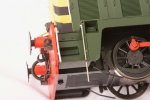
The handrails beside the front steps could be better. These are of plastic, fixed to the buffer beam but not the bottom step. I imagine, Heljan have done this to let the buffer beam be a removable subassembly. The handrails are too thick and to me they just look wrong.
DSC_2986.jpeg
This is an original handrail and an experimental replacement.

DSC_2989.jpeg
The new handrails are of nickel silver wire (diameter to match the brass wire handrails on the model) with top brackets drilled and cut from 1 mm square styrene. When I stick these on, the buffer beams will be fixed onto the model. I want to decide on the buffers before I do this.

The Heljan buffer heads are completely flat, while the photos I have found show buffers of the usual curved shape. Please, does anyone know of flat buffer heads like the Heljan ones? Perhaps on different classes of locos working in industry.

To make things easier, I want my model to be an unidentified ex-BR loco, now working in industry or possibly preserved. I’ll imagine it is one of the locos which was scrapped upon withdrawal from BR.

 
Top