
You are using an out of date browser. It may not display this or other websites correctly.
You should upgrade or use an alternative browser.
You should upgrade or use an alternative browser.
7mm Heybridge Basin
- Thread starter RichardG
- Start date
Threadmarks
View all 28 threadmarks
Reader mode
Reader mode
Recent threadmarks
( Diversion : shipping of timber to Chelmsford ) Backscene . . experiments and discussion Backscene . . completed Low level photos . . using DSLR on a monopod . . using a phone camera . . using a pinhole 'lens' . . removing shadows from display case . . softer lighting


Flaxfield
Western Thunderer
My layouts have the inner side of the roof the same colour as the backscene. It makes it really pop.
As Alan said earlier, I also use the Rice approach and both my Cameo layouts have three rows of lighting.
The first overhangs the front of the layout by some 4cm (Pretty certain Iain advocated 4 inches ). This makes sure the front of the layout is properly illuminated. The second is bang on halfway whilst the third is right up against the backscene to remove any shadows.
Rob
As Alan said earlier, I also use the Rice approach and both my Cameo layouts have three rows of lighting.
The first overhangs the front of the layout by some 4cm (Pretty certain Iain advocated 4 inches ). This makes sure the front of the layout is properly illuminated. The second is bang on halfway whilst the third is right up against the backscene to remove any shadows.
Rob

RichardG
Western Thunderer
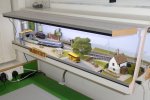
This is the roof on my shelf layout. The whole assembly slides out below the strip of white-faced board, so the front overhang can vary between nothing and about 80 mm.
This was in November 2019. I suppose that in a way it was a proof of concept for me. A lot of my models at the time were. Putting a roof on a layout does seem to keep the worst of the dust off.
I would have bought my copy of Iain Rice's book on cameo layouts in 2020. He did suggest an overhang of four inches, he was writing in the context of fluorescent tubes at the time. 40 mm sounds fine to me. The book took me to build my lockdown layout, which ultimately failed to work for me and I broke up a few months ago. So "Heybridge Basin" now follows this shelf layout in my chronology of layouts I have kept.The first overhangs the front of the layout by some 4cm (Pretty certain Iain advocated 4 inches ). This makes sure the front of the layout is properly illuminated.

Willl
Western Thunderer
My latest layout follows Rice practice of having the lighting rig set forward about 3-4 inches. This does avoid shadows at the front of the layout (which Rye Sands is pretty bad for, as the lighting has no overhang), but the back of the layout is a bit gloomy - I think Rob's idea of having a second / third lighting strip nearer the rear is probably necessary if you're going to do the whole 4 inches overhang.
Will
Will

Osgood
Western Thunderer
Lux? Lumen? It’s all empirical to me!
I took some good advice from a couple of WTers a while back to get me into the right ball park, then got some gear and had a play (7m x 0.75m viewing area, rail level 1.1m, high back scene, no top panel).
I set the continuous lighting bar directly above the front edge of layout, i.e. forward of the viewer, at 2m high.
As I was unsure how much light would be needed I went for potential overkill on the basis you can always turn the light source down, but not exceed its capacity.
Conclusions:
I took some good advice from a couple of WTers a while back to get me into the right ball park, then got some gear and had a play (7m x 0.75m viewing area, rail level 1.1m, high back scene, no top panel).
I set the continuous lighting bar directly above the front edge of layout, i.e. forward of the viewer, at 2m high.
As I was unsure how much light would be needed I went for potential overkill on the basis you can always turn the light source down, but not exceed its capacity.
Conclusions:
If the light source is a little above the viewer, the shadows created by it will not be visible by the viewer.
The light source does not need to be above or behind the viewer, but the further forward it is the more screening it will require to shield it from the viewer.
With continuous output (COB) LED tape there are no side shadows as sometimes seen with spaced LED tape.
Be prepared for any scenario of natural / artificial light on the exhibition battlefield, so make provision for high-powered lighting that can be controlled down to whatever level is required.
If you wish to eliminate any shadows caused by ambient (natural or artificial) light, you will need to provide layout lighting that is stronger - if that makes the layout too bright, the solution is to screen the layout from ambient light.
Install a powerful natural (4000k) tape and a tri-colour variable warmth tape - both with dimmers. This allows you to adjust base light level using the 4000k tape and to then adjust warmth using the variable tape. (tape specs incl. power outputs TBA when I can find the file). The tri-colour tape will add additional base light too if the 4000k tape can’t quite do it.
Hope that helps a little.
timbowales
Western Thunderer
Life was so much simpler when we just had tungsten filament bulbs or fluorescent tubes 
RichardG
Western Thunderer
I think all of the conclusions by @Osgood will be helpful to anyone planning a new lighting installation of renewing an existing one; and so to try to wrap this up for now I offer a few more of my own:
Above all, I suppose, we really have never had it so good in terms of the lighting equipment out there to buy. There ought to be something for every layout, taste and budget.
Bonus conclusion: if you are thinking of putting some COB tapes under kitchen wall cupboards to light up the work surfaces, you need 8W/m tape. Absolutely definitely nothing brighter.
Finally, thank you to @Yorkshire Dave for his suggestion on adding project boxes to tidy up the connections.
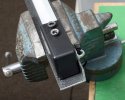
I worked this up this afternoon. It is just (just) sufficiently lightweight to let the lighting bar continue to hang vertically.
The output of a COB tape is indeed through most of 180 degrees from side to side, but putting the tape into a purpose-made extrusion will make this beamwidth narrower. This narrowing has helped me, because the quadrant extrusion lets me direct the light down towards the layout and not horizontally into the eyes of an operator behind the layout.
A diffuser is of limited benefit to the lighting effects created on the layout, and it will reduce the intensity of the light too; but it does make reflections in nearby windows (and again, incidental eye contact) easier on the eye.
An aluminium support for a tape will provide a heatsink and help the tape to last longer.
Installing the rig just above my own head height lets me add scenic details or stock and see what they will look like straight away, without banging my head or carrying the baseboard outdoors into a better light.
Above all, I suppose, we really have never had it so good in terms of the lighting equipment out there to buy. There ought to be something for every layout, taste and budget.
Bonus conclusion: if you are thinking of putting some COB tapes under kitchen wall cupboards to light up the work surfaces, you need 8W/m tape. Absolutely definitely nothing brighter.
Finally, thank you to @Yorkshire Dave for his suggestion on adding project boxes to tidy up the connections.
I worked this up this afternoon. It is just (just) sufficiently lightweight to let the lighting bar continue to hang vertically.
RichardG
Western Thunderer
I am so glad the ballasting and the lighting are done. Both are an open invitation to failure, and both are about as much fun as pulling teeth. Yet somehow, the results make it all seem worthwhile. My progress on Heybridge Basin probably seems funereal to many but the layout has got better over the last eleven months.

9 April 2024
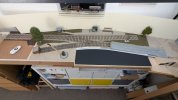
9 March 2025 (lighting rig on, shadows from sunlight coming through open doorway and window blind!)
I want to leave the water in the basin until I have some kind of boat to pour it around. This leaves the backscene as the last major item and I will defer this until I have more of the modelling done. The magnolia is gentle on the eye and it fades to nothing in colour photos turned to black and white - good for period-style photos. The layout is in a good state to let it rest and indeed enjoy while I make things to glue down onto it or build more stock.
9 April 2024
9 March 2025 (lighting rig on, shadows from sunlight coming through open doorway and window blind!)
I want to leave the water in the basin until I have some kind of boat to pour it around. This leaves the backscene as the last major item and I will defer this until I have more of the modelling done. The magnolia is gentle on the eye and it fades to nothing in colour photos turned to black and white - good for period-style photos. The layout is in a good state to let it rest and indeed enjoy while I make things to glue down onto it or build more stock.
timbowales
Western Thunderer
Those photos show how delightfully small the layout actually is 
RichardG
Western Thunderer
Those photos show how delightfully small the layout actually is
Thanks Tim . . . I think I can make it look bigger than it is in my photos, because there are several different viewpoints.
Years ago I decided the ideal small layout I wanted to build would be 5ft long. This being just enough to extend beyond my peripheral vision at a usual viewing distance, and just about bearable to carry around in one piece. But 7 mm points are so long, I needed more. I mean, I started with the 1.2 m baseboard and then added the 0.4 m sections at each end, and the total of 2 metres is just about right. It is at the very limit of what I can pack into my car and the minimum which will satisfy me at home.
I do sometimes feel I could be building a layout twice the size in precious little more time, but at least with the backdrop and the fiddle yard done I have set the boundaries. It won't grow again until after I have finished it.
( Diversion : shipping of timber to Chelmsford )
RichardG
Western Thunderer
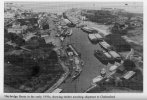
This might be the most useful photograph of Heybridge Basin I ever see. The scene in the 1890s would be similar, minus the private cars. The lighters were 60 x 16 feet, and their design didn't change much during the shift from horse to diesel power.
My imaginary railway station is on the land where the cars are parked, with the line to Heybridge following the towing path to the lower left. The bulk timber is dealt with on the opposite side of the basin (behind the viewer of the layout), which conveniently leaves the railway installation to deal with other commodities and occasional small loads of timber. So everything I have made so far still fits in with the location.
I chanced upon this photo in a book "Barging into Chelmsford" written by John Marriage, the second edition published in 1997 by Ian Henry Publications of Romford. I have been looking for this book for ages, and then last Friday I bought one of four brand-new copies sitting in the charity bookshop at Hylands Park. Such is life. The book fills in a lot of unknowns about the operation of the navigation during the late 19th and early 20th centuries.

RichardG
Western Thunderer
A couple of other authors have written about "a large timber shed" on the southerly side of the basin, and I couldn't really get my head around what they were describing. The photograph shows a structure like a barn, open on at least two sides, to keep stacks of timber protected from the weather. Suddenly, I know what they were trying to describe.
I also know, I cannot really have a model of a lighter on this layout unless it is a little underscale, perhaps 1:48. A rowing boat would be a better fit.
The timber traffic ceased in 1972, before I moved to Essex but some years after the loss of the Witham to Maldon railway. Which is a bit poignant. From 1972, the timber was landed at Colchester and moved to Chelmsford by road. The Chelmer and Blackwater must have been one of the last working waterways in the country.
I also know, I cannot really have a model of a lighter on this layout unless it is a little underscale, perhaps 1:48. A rowing boat would be a better fit.
The timber traffic ceased in 1972, before I moved to Essex but some years after the loss of the Witham to Maldon railway. Which is a bit poignant. From 1972, the timber was landed at Colchester and moved to Chelmsford by road. The Chelmer and Blackwater must have been one of the last working waterways in the country.

Eastsidepilot
Western Thunderer
During part of my truck driving years, 80's/ 90's, we shifted timber, plywood out of Colchester all over the country but the bulk of it came through the Baltic wharf at Wallasea Island on the R. Crouch, Russian and Swedish boats on the whole, also steel came through here.From 1972, the timber was landed at Colchester and moved to Chelmsford by road. The Chelmer and Blackwater must have been one of the last working waterways in the country.
Econofrieght awaiting over length steel loads.
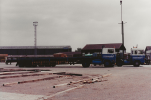
The yard shunter loading timber. The Russian boat was about as big as they got up the R. Crouch.
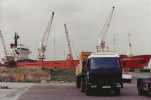
Last edited:
RichardG
Western Thunderer
If I am reading Marriage correctly, it was the timber traffic for Brown's (at Springfield basin) which was re-routed to Colchester in 1972. I can guess, Brown's were not the only timber importer in the region, so I expect this move took Brown's traffic into line with the traffic for a few other firms.
The Boreham bypass (extending from Hatfield Peverel to the Army and Navy roundabout) opened in 1971*. Perhaps this brought about Brown's decision to use Colchester and road haulage to take the timber to Chelmsford.
*Sabre Roads
The Boreham bypass (extending from Hatfield Peverel to the Army and Navy roundabout) opened in 1971*. Perhaps this brought about Brown's decision to use Colchester and road haulage to take the timber to Chelmsford.
*Sabre Roads
Eastsidepilot
Western Thunderer
Brown's yard was the only merchant we loaded out of the wharf at Colchester as far as I remember. Most of loads went to builders merchants all over the UK.
I only did this for a few years before getting the Italian job.
Mention of Chelmsford reminds me of one of the drivers turning an artic over on the roundabout under the A12/A130 jct., loaded with 20 plus tons of 4x2, the wrecker turned up to airbag it and get it back on it's wheels but the coppers in charge cut the straps while it was on it's side so I and another couple guys had to take another trailer up to accident and the whole load hand balled onto the trailer ! The boss was doing his nut as was the wrecker crew, and what the copper didn't know was that our boss drank with the Chief Constable for Essex at the Con Club !
I believe the coppers involved had something to explain !
The road was shut for most of the day as you can imagine, and being before mobile phones communication between the yard and us was a problem which prompted the boss to turn up and give us a hand, I remember him throwing a few f**** at the coppers !
I only did this for a few years before getting the Italian job.
Mention of Chelmsford reminds me of one of the drivers turning an artic over on the roundabout under the A12/A130 jct., loaded with 20 plus tons of 4x2, the wrecker turned up to airbag it and get it back on it's wheels but the coppers in charge cut the straps while it was on it's side so I and another couple guys had to take another trailer up to accident and the whole load hand balled onto the trailer ! The boss was doing his nut as was the wrecker crew, and what the copper didn't know was that our boss drank with the Chief Constable for Essex at the Con Club !
I believe the coppers involved had something to explain !
The road was shut for most of the day as you can imagine, and being before mobile phones communication between the yard and us was a problem which prompted the boss to turn up and give us a hand, I remember him throwing a few f**** at the coppers !

jonte
Western Thunderer
Brown's yard was the only merchant we loaded out of the wharf at Colchester as far as I remember. Most of loads went to builders merchants all over the UK.
I only did this for a few years before getting the Italian job.
Mention of Chelmsford reminds me of one of the drivers turning an artic over on the roundabout under the A12/A130 jct., loaded with 20 plus tons of 4x2, the wrecker turned up to airbag it and get it back on it's wheels but the coppers in charge cut the straps while it was on it's side so I and another couple guys had to take another trailer up to accident and the whole load hand balled onto the trailer ! The boss was doing his nut as was the wrecker crew, and what the copper didn't know was that our boss drank with the Chief Constable for Essex at the Con Club !
I believe the coppers involved had something to explain !
The road was shut for most of the day as you can imagine, and being before mobile phones communication between the yard and us was a problem which prompted the boss to turn up and give us a hand, I remember him throwing a few f**** at the coppers !
Of course they did………….

jonte
RichardG
Western Thunderer

There is a suitably shorter bracket in the fiddle yard.
Something the proponants of modular layouts never mention is that the backscene will be unique for each configuration unless you punctuate the display with joins in the sky. Suitably flexible arrangements for lighting get glossed over as well.
Ten months on, this lighting rig is probably the best thing I have made so far for this layout(!) - it unifies the scene and it makes the trains look better. The downside is, along with the backdrop board, it ties the baseboards together and disables all opportunities to move modules around. This is because I thought of the "end cheek" holding the upright for the rig to be part of the fiddle yard not part of the layout.
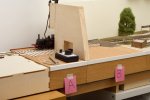
So it seems best to move the end cheek from the fiddle yard board to Module B.
This gives me flexibility to use Module A if I wish, and to remove the fiddle yard to work on it; and a facility to remove both and extend the layout around a curve into the room. All without disturbing the lighting rig. Or even remove both and build a new scenic board to go in their place.
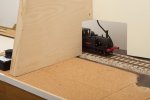
I have lost a strip off Module B, but the area for scenic development is less doubtful now, even fixed.
I doubt I would try another modular layout for home use, simply because I arranged the modules to fit the space and then never altered the configuration. It is easier to make something simply sectional, where boards can be added or removed to suit the location but don't need to be assembled in multiple permutations.
Threadmarks
View all 28 threadmarks
Reader mode
Reader mode